Showing posts with label 3D printing. Show all posts

Sunday, September 25, 2011

The textile block - Lloyd Wright vs 3d printing

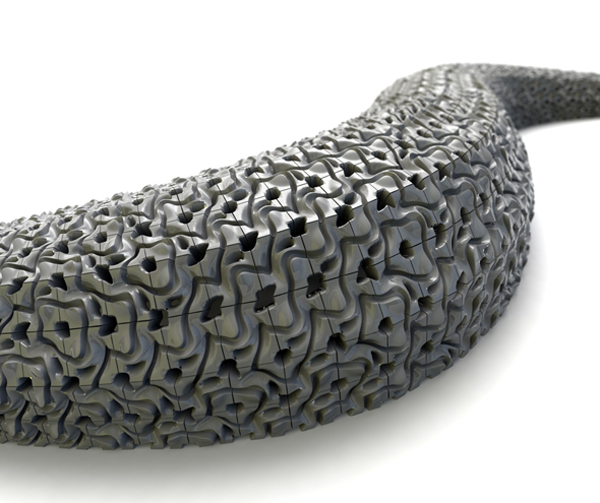
Here is what concrete could be - or is - if you include the ever expanding group cement based composites to your conception of 'concrete'. And better get used the look because 3d printing has never been cheaper and more available with this new fusible mix. SeatSlug is the first 3d Printed Bench at a Low Cost / Rael San Fratello Architects.

[Image of the G.M Millard House aka La Miniatura, the first of a series of houses where Wright explores the textile block. Via Coletta Design Blog.]

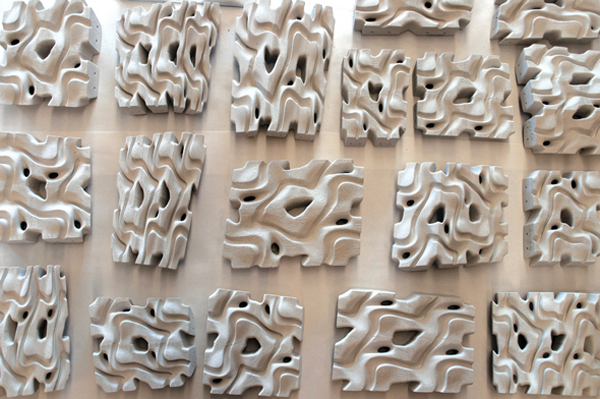
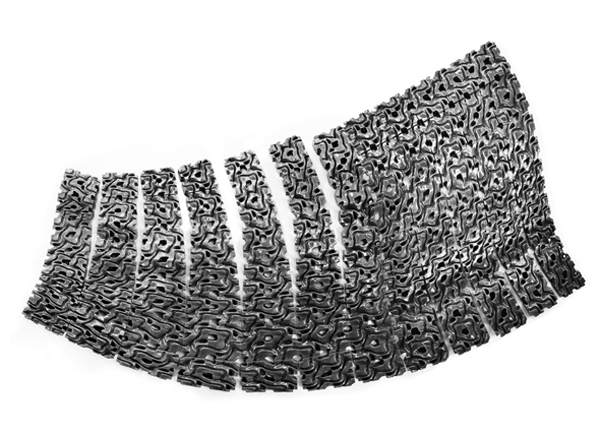
It is also quite the take on the 'textile block', the concrete unit developed by Frank Lloyd Wright for La Miniatura and a series of houses where he explored this notion of a 'machine produced concrete block', perfect like an industrially produced fabric. This particular notion of 'textile concrete' also has quite new perspectives for architecture in the light of the 3d printed project. The 'textile surface' of the SeatSlug is comprised of 230 individual pieces. The textile elements printed for the bench makes me wonder into which form Lloyd Wright's La Miniatura would have been 'printed' today?

Below is via stumpleupon
The cement based polymer has a compression strength of 4700 pounds but cost up to 90% less than conventional fusible powders. Rapid 3d printing technologies have been traditionally used to create relatively expensive prototypes for industrial design or more recently small scale objects with low cost devices.
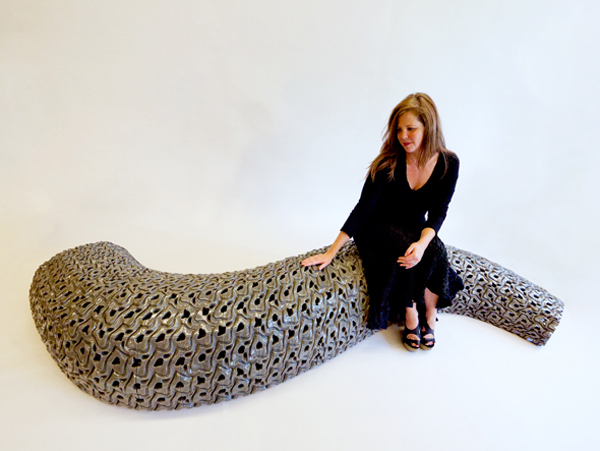


The promise of 3d printing for usable mass consumed objects seem to have been just around the corner for nearly a decade now. A new formulation cement-based polymer developed by Rael San Fratello Architects in partnership with the University of Washington and University of California Berkeley replaces more expensive powder mediums for large scale objects. The prototype SeatSlug bench is a demonstration project of the potential of the material and 3d printing process to make sophisticated large pieces using low cost, non repetitive objects. The bench is comprised of 230 individual pieces, each developed as a unique shape.

The SeatSlug is based on the shape of the recently discovered flabellina goddardi sea slug and surface inspired by karakusamon patterns, traditional Japanese designs. The unique shape is both functional and collectable with its provocative massing and highly polished finish, possibly with an eye to be built individually for higher end furniture stores or galleries. The manufacture of large scale merchandise as low cost printed objects with hand assembly near the end user addresses the issues of scale and cost of high quality products, which are often not available to market due to restraints in supply and demand.

Via stumpleupon

Saturday, March 13, 2010

Printing in stead of pouring

A few years back I attended a conference on advanced architectural structures and flexibel moulds at TU Eindhoven. A lot of interesting research projects and build structures were presented which were all well structured and academically well known- and then there was Enrico Dini - an Italian entrepreneur, designer and inventor who showed us, very passionately the long road to develop a 3d printer for printing buildings - rapid prototyping becomes rapid building. 
The perspectives for 3d printing structures are obvious when when compared to the procedure of constructing formwork, pouring the concrete followed by throwing the formwork away...


 [Image of a structure printed in sand and an inorganic binder - the material doesn't use cement and resembles sandstone]

" D_shape technology makes it possible to 3D print 6 by 6 by 1m parts. These parts could either be shipped to the construction site or the entire building could be 3D printed on location. The parts made by D_shape resemble 'sandstone.' They are comparable in strength to reinforced concrete and the ingredients are the binding material and any type of sand. D_Shape's materials cost more than regular concrete but much less manpower is needed for construction. No scaffolding needs to be constructed so overall building cost should be lower than traditional building methods.

The system works with a rigging that is suspended over the buildable part (you can see it at the top of the first image[below. A-M]). The system deposits the sand and then the inorganic binding ink. No water is necessary. Because the two components meet outside the nozzle, the machine does not clog up and can keep up its accuracy of 25 DPI. Enrico and D_Shape are currently talking to lots of construction & engineering companies and architects about their technology." from Shapeways.

[Image of the 3d printing machine developed by Enrico Dini, photo from Blueprint Mag.]

The images shown above Dini also presented at his presentation - they are photos of a structure to sit in a roundabout in Pisa. The technique alone will be really interesting to follow. Large is great of course - but I do see a more quickly applied use in fx intricate filligree structured screens for wonderfully transparent facades.


[Enrico Dini and architect Andrea Morgante's sculpture: Radiolaria ]

A similar technology is Contour Crafting - here the technique is printing concrete another composite material which, however needs cement. The web site hasn't changed since I don't know when - so I have no idea of where this project is going except for what's expressed here - of course it has to do with funding.

 [Image of the principle in Contour Crafting]