Showing posts with label Design. Show all posts

Friday, June 13, 2014

Concrete board games for the summer


[I want - this cool concrete chess game that comes in three shades of gray, via]

Oh, wow, it's been a long while. So without hesitation, let's start where I ended last - with a Concretely favorite, the Danish manufacturer Contec.

Below are images of a selection of beautiful board games cast in three different shades of gray (no pun intended) smooth high strength concrete.- all ready for the summer - and I guess you can even leave the boards outside if you feel like it.
[Play bacgammon on a concrete board, Image via the Contec-shop]

[Play chess with the concrete queen and king, image via the Contec-shop ]

[Nine Men's Morris - I completely forgot about this board game. It looks cool in concrete. Via the Contec-shop]


Sunday, August 11, 2013

Design and sculptural fun in GFRC - Hans Henrik Øhlers

['White Tube'  is a fun playground sculpture in Guldbergs Plads, Copenhagen N by Danish artist Hans Henrik Øhlers. PU-foam, Steel reinforcement, Fibre concrete. Image by the artist]
['White Tube'  by artist Hans Henrik Øhlers. PU-foam, Steel reinforcement, Fibre concrete. Image by the artist]

I notice this great sculptural playscape whenever I bike past the school and playground in the Guldberg Plads situated in Copenhagen neighborhood Nørrebro. I have not yet got off my bike and on to the sculpture - or into it - but now I came across the piece in the secret goldmine website of Contec, the manufacturer of GFRHPC ( Glass Fiber Reinforced High Performance Concrete) with references you can read more about here and here. I guess I have not passed the sculpture by night either - it must be lovely illuminated from within with the embedded fiberoptics
[Enjoy the great atmosphere and work process conveyed in the video of the last parts of making the White Tube on site by Hans Henrik Øhlers]
And if in Copenhagen, check out the entire outer Nørrebro area, which also features superstar architects BIG and cooool artists Superflex' Superkilen Urban Park

[He looks like such a nice guy. Danish artist-builder-innovator Hans Henrik Øhlers. Via]

Danish artist and builder Hans Henrik Øhlers has developed fun and curious specialities and innovative construction methods that he applies to combine sculptural work with functionality - he makes sculptural playground installations in PU-foam covered with reinforcement and GRC, he does furniture design and custom interior designs for recording studios, and acoustic and light installations. 

As you may tell as you scroll down, I am really happy to have stumbled into Øhlers web site - especially the fact that he values to communicate the process of his projects so much.
[Wave Rock by Øhlers. In PU-foam, black polyurea]
[The Slope slidable sculpture by Hans Henrik Øhlers]
[Øhlers custom designs and makes futuristic sound recording studio interiors. Image via]
[Acoustic wall sculpture by Øhlers. For GL music, studio C, via]
[Images of the process of making the acoustic wall sculpture. Via]

The acoustic sculpture is for interiors. It's really interesting because it features reflecting as well as absormant surfaces. Inside the diffusing (through the holes) sound-reflecting shell, there is sound-absorbing Paper-wool. It is placed directly behind the listener in a sound studio. Check out more images of the manufacturing process here. I am a sucker for improving acoustics and I would love to have a few of these acoustic reefs on my wall - and also, though I am enjoying the crafted work by Øhlers I would wish for the techniques he is developing that they could be scaled in numbers, that is to say industrially made. I mean, wouldn't it be great to have access to more sculptural acoustic solutions.
[Images of 'Organic Lamp 1' by Øhlers. 85 cm diameter, made from GFRC with fiberoptics. Via ]
[Furniture in GFRHPC for theater foyer. Design and production by Øhlers, image via]

More concrete designs in GFRC - wait GFHPC, no GFRHPC

Ok, so GFRC is Glass Fiber Reinforced Concrete - the Danish company Contec-prefab uses a patented GFRHPC - which is Glass Fiber Reinforced High Performance Concrete. - not catchy but efficient. See the images below to get an idea of how thin -
[Images of Glass Fiber Reinforced High Performance Concrete (GFRHPC) at Contec-Prefab, via]

Contec did the collaboration with Designer Christian Flindt, which I wrote about here. The company has 20 years of experience of working with High and Ultra High Performance concrete technologies - so, the faithful Concretely reader will not be surprised when the early work was based on a technology developed by Mr. Hans Henrik Bache in late 1970´s and early 1980´s. Compact Reinforced Concrete (CRC). (Mr. Bache is the father of Anja Bache who also explores and develops CRC). Do check out their gallery section here for more collaborations.
[Images of GRHPC designs manufactured by Contec. Images via]

[Fun playground sculpture in Guldbergs Plads, Copenhagen N by Danish artist Hans Henrik Øhlers. Image by the artist]
[Fun playground sculpture in Guldbergs Plads, Copenhagen N by Hans Henrik Øhlers. Image and manufacture via]


Cool fabric-formed contrast - Christian Flindt and Contec

[You need to know in order to notice - I love the contrasting combination of classic furniture materials like wood and upholstered seats with concrete sprayed in flexible molds. Design by Christian Flindt. Photo via]
[Fabric former and he is handsome too - the Danish designer Christian Flindt. Photo via]

It is about time I introduce you to some fabric formed concrete designs by Danish designer Christian Flindt. He may be one of the first designers to combine flexible formwork and sprayed high-performance concrete for design products. That is designs intended to actually be reproduced in greater numbers. I first came across his use of sprayed concrete on fabric molds when my mother (sweetheart, yes) sent me a cutout from her newspaper interview from when Flindt was invited to participate in the competition to make new designs to refurbish Iconic UN assembly Finn Juhl. Since the interview was from during the competition I have not seen any images – and they are not se clearly seen on Flindt’s web site – you really need to know it when you see these images of the entry prototypes that combines soft upholstered seats for the long meetings, with an alternative to backs made from bent wooden veneer ply.
[Look again - the dark finish and the back of the classic chair design is not leather nor is it wood but the smoothest concrete. Design by Christian Flindt. Photo via]

I, finally, found the images of the fabric-formed chair in a lovely hiding place of a company web site today – Contec-prefab - another treat for you, is the high-performance concrete division within the Danish company Contec. While I tend to feel stupid when a company this relevant for my concrete endeavors slips under my concrete radar – I really wish that companies would invest in being searchable online. Oh well. It turns out that Contec and Flindt have teamed up and I really love their work.


[GFRC and wood. Images from the design prototypes for the Finn Juhl Hall. Design by Christian Flindt. Photo via]

I have always had a soft spot for the contrast between the materialities of concrete next to other materials like wood or steel. – Italian architect icon Carlo Scarpa was my first encounter, the amazing Castel Vecchio. I really, really want one of Flindt’s tables where he combines wood and smooth high strength concrete. The accuracy and finishes are great!!

Oh – I nearly forgot – look at the façade prototypes in colored concrete. 

[Facade panels. Design by Christian Flindt. Photo via]

I look forward to more fruitful collaborations by Flindt and Contec. – and I hope that manufacturing technologies soon will make it economically feasible to produce sprayed concrete panels and furniture in flexible formwork in the limited numbers...

The Arizona based design-builder-educator Gore Design is another goodfella using GFRC and flexible formwork. - They do design and manufacture/contracting themselves – but you already knew about that, right?

Friday, April 12, 2013

Concrete poetry in the rain

The development of beautiful concrete surfaces was the aim of a collaboration between the Danish textile designer Line Kramhøft and industrial concrete partner Spæncom.
My favorite of Kramhøft's surface designs is a combination of a surface treatment technique and graphics.
When dry, the concrete appears as is - and only when wet, the graphic pattern is brought to life.
See images of Kramhøft's exclusive concrete surfaces here.

[Images of wet/dry concrete surfaces by Line Kramhøft. Images photographed by yours Concretely at the 2008 exhibition at the Aarhus School of Architecture]

Dutch Solid Poetry
I suspect The Netherlands to experience grey skies as well - nevertheless, Dutch designers Frederik Molenschot and Susanne Happle have developed a similar technique which embraces wet concrete surfaces. They call the principle Solid Poetry. I love it and I want it.
Liquid affection and solid poetry
Susanne Happle writes about her 2004 graduation project: "Whenever the weather change the landscape transforms, the light becomes different and the whole atmosphere changes. All materials seem to alter. In my project I explore the possibilities for hidden design appearing as the environment changes. I applied techniques to enduring and solid materials as glass (liquid affection) and concrete (solid poetry), so that natural processes like differences in temperature causing condense reveal patterns on windows. Rain uncovers decoration on a city square. The possible applications of solid poetry and liquid affection are various: either at home in the bathroom, in the garden, in saunas and dance clubs, where the humidity is high or public spaces like bus stops or pavements. All forms of solid poetry have in common that they change the whole setting; they are surprising and have a life of their own."via where she also shows suggestions of writing that appears on your foggy bathroom mirror etc. 
[Solid Poetry, via]

Ipanema in Copenhagen?
Living in Copenhagen - it is raining right now - I'd just love if bad weather brought forth something poetic, a little treat to make you smile. On a wall or on the concrete pavement. I wonder if the appearance of the iconic pattern from the Rio de Janeiro sidewalks would make Copenhageners dance in the rain instead of frowning?
[Sidewalk on Ipanema, Rio de Janeiro. Via]

PS - in reality, I am dreaming of sipping a caipirinha on Ipanema beach - no concrete - no rain.

898 - Fabric-formed concrete couch

Inspired by the previous post about Nacho Carbonell's soft concrete, here's a few images from my own backyard.


898 (kg)
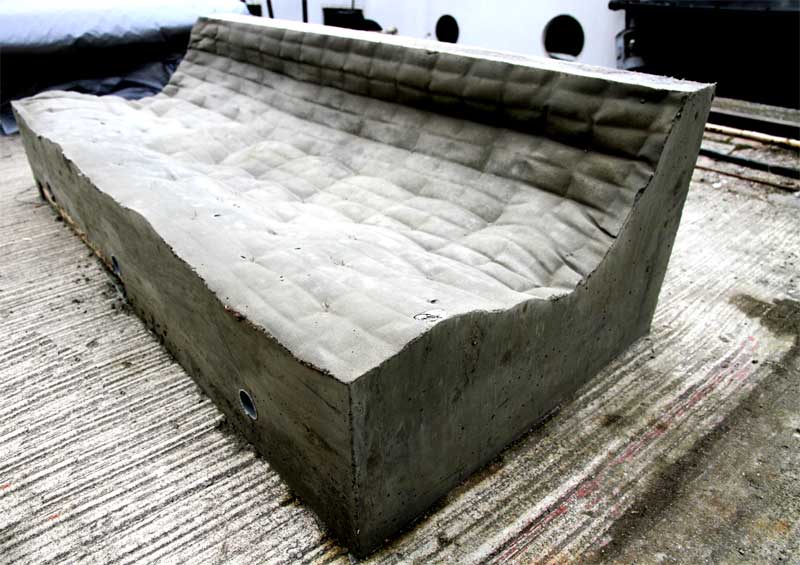
Carbonell's 'soft sofa' reminded me of something that I haven't shared with you - so here's another one - a couch cast by my students during a TEK1 workshop in 2011. The focus in the workshop was on exploiting sharp edges and curved surfaces. The theme was benches but this piece is more of a couch-thing than a bench.
The 898 is cast in fabric-formed concrete. The edges of the furniture is controlled and cut out of rigid plywood. Its surface, on the other hand, is made to appear soft and cast in fabric restrained with a garden fence netting.
[898, couch. From TEK1 concrete workshop at the Royal DK Academy, School of Architecture]

The title of the piece, 898, refers to its calculated weight... The really attentive Concretely reade, may recognize the surface. The students who made the 898 were inspired by the expression of an earlier fabric-formed piece for which the forming method was also its expression.
[Fabric formed concrete surface from 'Wall de Mort'. I discuss the project in my PhD dissertation - and regret to admit that I changed its funky title to the Net Wall... ]

898 couch by:  Cisse Bomholt, Philip Messmann, Michael Sivertsen, Maja Kozak Dehlin, Amanda Lilholt, Mathias Rasmussen, Søren Rosendahl Svare and Kenni Bruun Rasmussen.
Wall de Mort by: Siri Reisæter Rasmussen, Astrid Asmussen, Rasmus Gosvig, Christian Bencke Nielsen
TEK1 teachers, 2011: Anne-Mette Manelius, Finn Bach, and Johannes Rauff Greisen

Dutch concrete sofa

Continuing to share old news, this piece of old news (to me) is still much more recent than Mr Englund's 60's work. The Dutch designer Nacho Carbonell designed the prototype for a concrete couch cast on site in flexible formwork. - back in 2007. - it is in fact more a designed process than an object.

[Soft Concrete by Nacho Carbonell, 2007, image via MatandMe]
See more images of the piece at the designer's website. 

Carbonell writes about the prototype: "The idea of the process defining the final shape of the object, is something that has always interested me. You cannot have total control, the materials are alive and do what they want. I just give them boundaries, against which they can react with freedom, always surprising me. They are my best partners and my source of inspiration. Experimentation is my way of translating a concept into an object. Here I created bags of different shapes. Once the bags are filled up with concrete they reveal their final shape and function, in this case a proposal for a bench for outdoor purposes. The concrete is first colored, then poured into the bags. Once these are ripped off, the furniture  achieves a friendly, funny and soft look as well as a beautiful texture imprinted on it by the material of the bags. Another aspect that is very interesting about the project is the possibility of creating it on the spot, allowing it to be integrated better into the surroundings." via

While discovering Carbonell through the fabric-formed lens, I admit to enjoy the development of his work away from the solid to the more spatial, it is so much tighter. He has made some collections of spatial and communicative structures that are light and textured and architectural sculptures that I would love to experience live. Check them out here.
[Communication Line by Nacho Carbonell, via]

898 in Copenhagen
Pardon the jump but Carbonell's sofa reminded me of something in my own backyard that I haven't shared with you - so see the next post here.

Saturday, October 20, 2012

Erwin Hauer at the Standard

While in New York City I went to the roof top of the Standard Hotel to sip cocktails in the sun and with a spectacular view. Some familiar screens greeted me in the lobby and on the roof itself, two iconic designs from the 1950s by the remarkable sculptor Erwin Hauer.
[Detail of Erwin Hauer's Design 5 on the roof of the Standard, photo by yours Concretely]

While these Hauer screens can be found in the hotel rising over the lovely Highline park, another screen is more hidden as described in this post. 
[Image of Erwin Hauer's Design 5 on the roof of the Standard, photo by yours Concretely]

Hauer's website informs that the screens were built in 2009 and are Design1 (1950) and Design 5 (1956).
Below follows more shots from the visit - taking photos of the concrete interior is perhaps not the most glamorous way of sipping cocktails, that said, the screen on the roof is the only thing worth noticing on the roof itself. -( a complete different story is of course the exhibitionist restrooms the story below).

[Nobody pays attention to the Erwin Hauer piece, but the view is ]


[Above and below, connection details between the Erwin Hauer concrete elements]

And below, a few from the lobby, mental note - buy new camera, my smart phone cam really doesn't do it well.
[Erwin Hauer's Design 1 (org 1950) in the lobby of the Standard. (2009)]

[Erwin Hauer's Design 1 in the lobby of the Standard]

[Detail of Erwin Hauer's Design 1 in the lobby of the Standard. This is so smooth and shiny that I wonder if it is polymer or almost a resin or a reinforced plaster of some sort-  my stupid Instagram filter may be pulling my leg here - but the lobby screens definitely have a smoother finish than the concrete screen outside]