Showing posts with label Textile concrete. Show all posts

Monday, August 19, 2013

Yo_cy's formwork tectonics


[Light and space inside the Cast Thicket by yo_cy, via]
Cast Thicket or filigree concrete
I have forgotten to repost this award winning project by yo_cy from Tex-Fab’s APPLIED: Research through Fabrication competition at the University of Texas at Arlington, which is posted on blog of the Architects' Newspaper A/N Blog. The project is familiar to some fabric-formed filigree-like projects with a major difference that it is facetted structure. Yet, despite being inspired by textile-like mats used for casting walls (which you can see way below), the formwork material is actually thin, lasercut plastic sheets. I enjoy the combination of digital fabrication and of combining the lasercut plastic sheets with the hydrostatic pressure from casting. 
“[With this project] we are reacting to the singular material tendency of digital fabrication and [we have shown that] we can use the computer to coordinate different methods of making a material, and simulate that on a smaller scale.” says Tracy, via
[Cast Thicket principle Via]
Cast Thicket is both a form of construction and a finished design product. To produce finished forms of reinforced concrete, construction begins with the design of prefabricated steel struts, which are positioned using a system of interlocking laser-cut plates. Formwork is also prefabricated and attached to the joints. Plastic formwork is then detached and reattached as the structure grows upwards. The final product has the possibility for infinite variation. via the competition site 
[Cast Thicket by yo_cy]
The structure is awesome and perhaps also thicket like (the title contains a new English word for me) - it rather reminds me of columns in Gaudi's Sagrada Familia as well as art pieces by the wonderful Ernesto Neto who fills spatial fabric structures with everything but concrete and plaster. Instead he uses eps, sand, and even spices.
[Ernesto Neto's fabric-formed soft world]

[Each piece of the plastic casing is connecting by a series of tabs. Photo:Kenneth Tracy]
[The plastic mold is held together with plastic zip ties. Photo:Kenneth Tracy]

While I find the work of yo_cy wonderful, I still have to let out a big sigh because of the overly time consuming construction. The idea of the 'tailor-made' as something related to flexible formwork is still so heavily labor intensive as you can tell on the image above, and thus far from being scaleable. I guess the work now can be compared to crocheting and not sewing.

Woven formwork for Kopo House
I am not sure if this house has been built but I'd love to see it if it does - the project is in Indonesia and contains the literal exploration of manufacturing a formwork textile, I mean the textile is in itself a structure with its own principles and the larger the fibers, the is it a building component and material in itself. yo_cy's Christine Yogiaman and Kenneth Tracy state as their profile that combining labor intensive acts in craft culture with rule-based, digital frameworks their projects in Indonesia multiply the everyday to intensify space. The images on the project show initial weaving samples inspired by Ketupat a sort of rise casting formwork... (!) that are manipulated and given form before it is used as formwork for plaster, I think. Other images show larger scale casts of modules and some rebar, so something is definitely being built. Fingers crossed.

The formwork principle is inspired by Indonesian cast rice dumplings known as Ketupat - wow, see below how great they are!
[Ketupat - --- I love these throwaway sturdy lunch boxes]

[woven mats used as formwork and a plaster cast for the  Kopo House project. I'd love to see the full scale version of this! via - Wait - below are bigger prototypes investigating some formwork types]
[Images of the Kopo House investigations, by Yo_cy]


Credits of the Cast Thicket:  Fabricators TOPOCAST
Competition Tex-Fab’s APPLIED: Research through Fabrication competition at the University of Texas at Arlington 
Designers Kenneth Tracy, Christine Yogiaman
Location Arlington, Texas
Date of Completion February 2013
Material limestone powder, white fiber reinforcement, Poraver glass beads, metakaolin, superplasticizer, .03-inch plastic
Process Rhino, Kangaroo, Grasshopper

Wednesday, November 14, 2012

Lloyd Wright's textile concrete in Florida

Frank Lloyd Wright developed a 'textile block' construction system with prefabricated concrete tiles bound together to form stay-in-place formwork for placing concrete. He used it as early as around 1920 for the Imperial Hotel in Tokyo - which survived a subsequent heavy earthquake with its monolithic structure -  and for projects in California in the 20's, for example the Alice Millard house, La Miniatura, a famous example from 1923.
Below are some images from "Child of the Sun", a collection of Wright buildings from the Florida Southern College that I know very little about but are worth studying. Wright built nine buildings for the campus between 1938 and 1958. So it was great to see and now share a few posts by Nat Chard with images of these textile concrete buildings.
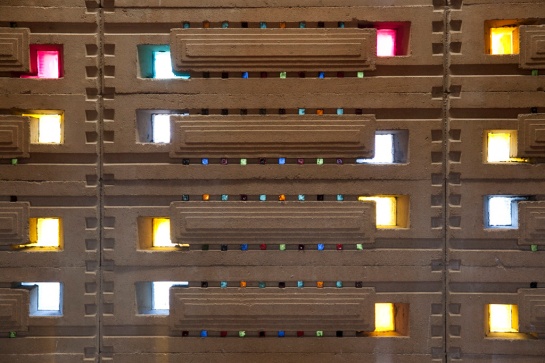
[From the interior of Frank Lloyd Wright’s Annie Pfeiffer Chapel (1938) at the Florida Southern College. Via]

I enjoy following the blog by the architectural (re)searcher and educator Nat Chard who for the past five years or so has been the head of the school of architecture at the University of Manitoba (also home of CAST). Nat was educated at the Bartlett School of Architecture and was also a professor at the Royal Danish Academy of Fine Arts. He has been unstoppable since he took up blogging posting about his own research as well as stereoscopic images of art, technique, skeletons, picture planes of dioramas, - and concrete blocks.

[From the interior of Frank Lloyd Wright’s Annie Pfeiffer Chapel at the Florida Southern College. Via]

"The blocks in Frank Lloyd Wright’s Annie Pfeiffer Chapel at the Florida Southern College are some of his most elaborate, made possible partly through cheap student labour. The blocks have stained glass inserted into them, a combination of a larger L-shaped piece at either end of each block and smaller square pieces along the top and bottom. The inside and outside skin are made of identical blocs, with a cavity in between. The blocks are a composite wall and window." writes Nat
[Thad Buckner Building, formerly the E.T. Roux Library completed in 1945 at the Florida Southern College. Via]

Nat writes: "The blocks are a development of his textile block work in Los Angeles from the ’20s and have similar joint details (I will post some pictures of some of these where the walls have failed). The character of the work emerges though his invention of these building elements. There are abundant technical problems with the blocks (the accelerated decay gives some of his buildings a picturesque quality) but I find them really helpful in thinking through how to make building components that are appropriate to the content of the architecture." Via
[Thad Buckner Building. Via]
[Thad Buckner Building. Via]

Wednesday, May 16, 2012

Textile Revolution

[Image of 'textile mats' courtesy and via ]

In an image search for specific images of geotextile, I stumpled upon a post about Drone Landscapes, Intelligent Geotextiles, Geographic Countermeasures on the always interesting BLDBLOG 

This headline may sound far from the present concrete scene. But textiles are of course a big part of the field of fabric forming. Furthermore, an explosive development of advanced technical textiles influences the construction of concrete.
In fabric formwork alone, full-scale prototypes and buildings in fabric formed concrete uses different types of woven polypropylene, also known as geotextiles.
This is the use of flat sheets of fabrics. Another overlapping field is the tectonics of textile structures, and then there is the 'textile', which refers to symbolic aspects and behavior. Such as the image below - definitely 'textile'.

['Textile concrete': A photo by Toshio Shibata via]

I may have posted an image like the above image of a Japanese retaining wall before, but it is definitely a case of 'textile' concrete, (thanks again Josh for that)
Enough talking  - go read the post about computational geotextiles and get back to me if the influence of  really-smart textiles as concrete formwork makes sense. A 'tiny' problem of this concept of course is that much of the smartness is cast in concrete if used as formwork.