Showing posts with label ECC. Show all posts

Sunday, September 25, 2011

The textile block - Lloyd Wright vs 3d printing

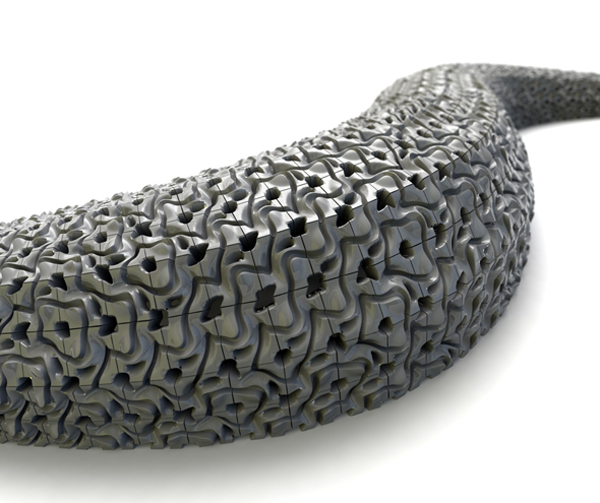
Here is what concrete could be - or is - if you include the ever expanding group cement based composites to your conception of 'concrete'. And better get used the look because 3d printing has never been cheaper and more available with this new fusible mix. SeatSlug is the first 3d Printed Bench at a Low Cost / Rael San Fratello Architects.

[Image of the G.M Millard House aka La Miniatura, the first of a series of houses where Wright explores the textile block. Via Coletta Design Blog.]

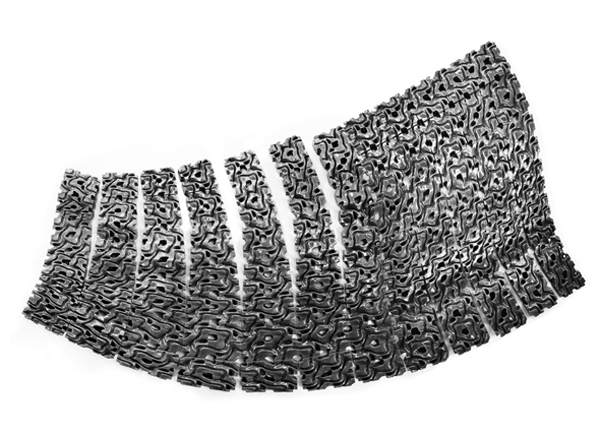
It is also quite the take on the 'textile block', the concrete unit developed by Frank Lloyd Wright for La Miniatura and a series of houses where he explored this notion of a 'machine produced concrete block', perfect like an industrially produced fabric. This particular notion of 'textile concrete' also has quite new perspectives for architecture in the light of the 3d printed project. The 'textile surface' of the SeatSlug is comprised of 230 individual pieces. The textile elements printed for the bench makes me wonder into which form Lloyd Wright's La Miniatura would have been 'printed' today?

Below is via stumpleupon
The cement based polymer has a compression strength of 4700 pounds but cost up to 90% less than conventional fusible powders. Rapid 3d printing technologies have been traditionally used to create relatively expensive prototypes for industrial design or more recently small scale objects with low cost devices.
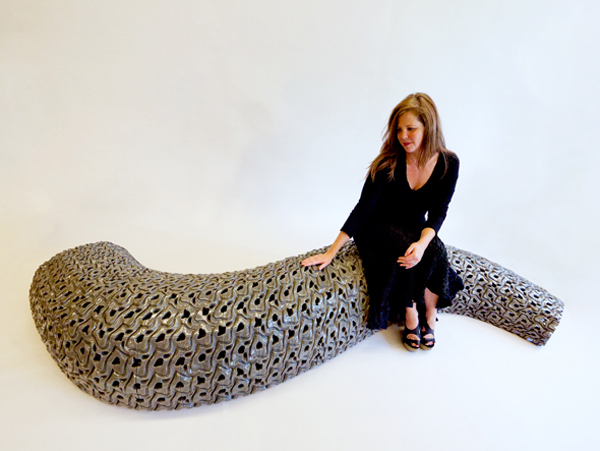


The promise of 3d printing for usable mass consumed objects seem to have been just around the corner for nearly a decade now. A new formulation cement-based polymer developed by Rael San Fratello Architects in partnership with the University of Washington and University of California Berkeley replaces more expensive powder mediums for large scale objects. The prototype SeatSlug bench is a demonstration project of the potential of the material and 3d printing process to make sophisticated large pieces using low cost, non repetitive objects. The bench is comprised of 230 individual pieces, each developed as a unique shape.
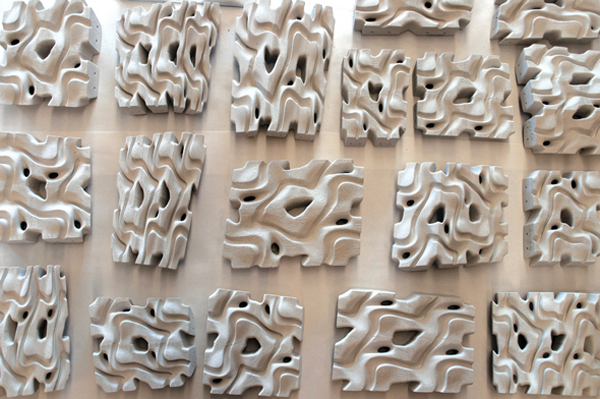

The SeatSlug is based on the shape of the recently discovered flabellina goddardi sea slug and surface inspired by karakusamon patterns, traditional Japanese designs. The unique shape is both functional and collectable with its provocative massing and highly polished finish, possibly with an eye to be built individually for higher end furniture stores or galleries. The manufacture of large scale merchandise as low cost printed objects with hand assembly near the end user addresses the issues of scale and cost of high quality products, which are often not available to market due to restraints in supply and demand.

Via stumpleupon

Wednesday, September 1, 2010

Butong - flexible, perforated concrete

[When crayfish aren't happy at the habitat you've got - remake the 'city plan' - hence the name: Cancer City]

Swedish architects VisionDivision have collaborated with Butong on their recent project Cancer City, an underwater habitat for cray fish - with the luxurious feature of embedded LED lighting to ease catching the crayfish by night.

Butong seems to be a brand new company and patent for a 'concrete based material' as the company write on their website. Another term to use might be the also very broad ECC (Engineered Cementious Composite) which just implies that the material contains cement. 
It seems like both the concrete properties and the formwork technology are very flexible in deed. The surfaces look draped.

Read more about Cancer City here.
Scroll down to view other applications of Butong's own products.
[Embedded functions in the Cancer City]

[Section of the habitat]

[Cancer city before put in the river]

[Crayfish hunting in the LED illuminated underwater concrete landscape]

The architects write about the special concrete they used:
"The choice of material was crucial for the success of the project.
The construction obviously should be water resistance, the city should be strong enough to carry some full grown persons or animals walking on it, the city should also provide shelter to the crayfishes and the construction should not be too heavy since it should be moved to a remote place where no machines can go. The choice of material became "Butong"; a lightweight slightly transparent concrete invented by the firm with the same name.
Butong is only two centimeters in depth without any metal reinforcement that can rust and the mould could be bendable after casting,
which enabled us to make an undulated landscape of concrete without having to build time consuming casting forms. Another attribute with Butong is that it includes calcite; a substance that attracts crayfishes."

[Lamp design by Butong: Bright Night will hit Swedish stores soon (and hard ;)]

[Panel design: Buttong-Pattern]

[Panel design using Butong]

Thin, perforated concrete
I especially enjoy the combination of the concrete and formwork technologies to perforated panel designs. They remind me of beautiful traditional islamic shutters. Besides the effects of transparency and the surface design, using this kind of filigree concrete for solar filtering, you obtain a thermal effect from the concrete mass. 

The mass cools down at night and helps keeping the interior cool during the day of blazing sun. 
[Fragment of a lattice window shutter, Lahore, Pakistan, 15th century. From www.lindenmuseum.de ]

I just looked these shutters up - they're called moucharabiehs - how could I forget ;)

"Summers can be exceedingly hot in Islamic lands; consequently, from an early date 
openings in buildings were partially closed by means of open-work coverings made from stone, stucco, ceramic, or wood
These coverings were commonly known as claustra after the Romans, and subsequently came to be called moucharabiehs in the Arab world and jali in India."

[Window screen (jali), floral and lattice design India, c. 1630-1650 or first half of the 17th century Red sandstone, openwork and engraved decoration, Louvre]