Showing posts with label Art. Show all posts

Sunday, August 11, 2013

Design and sculptural fun in GFRC - Hans Henrik Øhlers

['White Tube'  is a fun playground sculpture in Guldbergs Plads, Copenhagen N by Danish artist Hans Henrik Øhlers. PU-foam, Steel reinforcement, Fibre concrete. Image by the artist]
['White Tube'  by artist Hans Henrik Øhlers. PU-foam, Steel reinforcement, Fibre concrete. Image by the artist]

I notice this great sculptural playscape whenever I bike past the school and playground in the Guldberg Plads situated in Copenhagen neighborhood Nørrebro. I have not yet got off my bike and on to the sculpture - or into it - but now I came across the piece in the secret goldmine website of Contec, the manufacturer of GFRHPC ( Glass Fiber Reinforced High Performance Concrete) with references you can read more about here and here. I guess I have not passed the sculpture by night either - it must be lovely illuminated from within with the embedded fiberoptics
[Enjoy the great atmosphere and work process conveyed in the video of the last parts of making the White Tube on site by Hans Henrik Øhlers]
And if in Copenhagen, check out the entire outer Nørrebro area, which also features superstar architects BIG and cooool artists Superflex' Superkilen Urban Park

[He looks like such a nice guy. Danish artist-builder-innovator Hans Henrik Øhlers. Via]

Danish artist and builder Hans Henrik Øhlers has developed fun and curious specialities and innovative construction methods that he applies to combine sculptural work with functionality - he makes sculptural playground installations in PU-foam covered with reinforcement and GRC, he does furniture design and custom interior designs for recording studios, and acoustic and light installations. 

As you may tell as you scroll down, I am really happy to have stumbled into Øhlers web site - especially the fact that he values to communicate the process of his projects so much.
[Wave Rock by Øhlers. In PU-foam, black polyurea]
[The Slope slidable sculpture by Hans Henrik Øhlers]
[Øhlers custom designs and makes futuristic sound recording studio interiors. Image via]
[Acoustic wall sculpture by Øhlers. For GL music, studio C, via]
[Images of the process of making the acoustic wall sculpture. Via]

The acoustic sculpture is for interiors. It's really interesting because it features reflecting as well as absormant surfaces. Inside the diffusing (through the holes) sound-reflecting shell, there is sound-absorbing Paper-wool. It is placed directly behind the listener in a sound studio. Check out more images of the manufacturing process here. I am a sucker for improving acoustics and I would love to have a few of these acoustic reefs on my wall - and also, though I am enjoying the crafted work by Øhlers I would wish for the techniques he is developing that they could be scaled in numbers, that is to say industrially made. I mean, wouldn't it be great to have access to more sculptural acoustic solutions.
[Images of 'Organic Lamp 1' by Øhlers. 85 cm diameter, made from GFRC with fiberoptics. Via ]
[Furniture in GFRHPC for theater foyer. Design and production by Øhlers, image via]

More concrete designs in GFRC - wait GFHPC, no GFRHPC

Ok, so GFRC is Glass Fiber Reinforced Concrete - the Danish company Contec-prefab uses a patented GFRHPC - which is Glass Fiber Reinforced High Performance Concrete. - not catchy but efficient. See the images below to get an idea of how thin -
[Images of Glass Fiber Reinforced High Performance Concrete (GFRHPC) at Contec-Prefab, via]

Contec did the collaboration with Designer Christian Flindt, which I wrote about here. The company has 20 years of experience of working with High and Ultra High Performance concrete technologies - so, the faithful Concretely reader will not be surprised when the early work was based on a technology developed by Mr. Hans Henrik Bache in late 1970´s and early 1980´s. Compact Reinforced Concrete (CRC). (Mr. Bache is the father of Anja Bache who also explores and develops CRC). Do check out their gallery section here for more collaborations.
[Images of GRHPC designs manufactured by Contec. Images via]

[Fun playground sculpture in Guldbergs Plads, Copenhagen N by Danish artist Hans Henrik Øhlers. Image by the artist]
[Fun playground sculpture in Guldbergs Plads, Copenhagen N by Hans Henrik Øhlers. Image and manufacture via]


Monday, June 24, 2013

Ms Bache's glazed concrete wonders

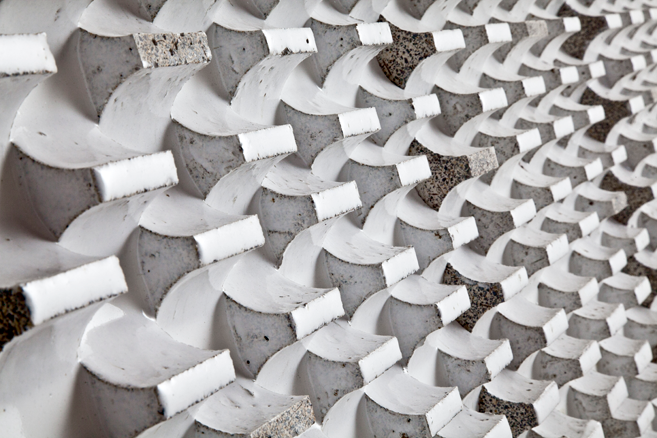
[Detail of Anja Bache's glazed concrete panel, via]

One of my favorite Danish concrete ladies is the energetic and cross skilled artist-scientist Anja Margrethe Bache [Anya Bah-keh]. When I say cross-diciplinary, it is her own description and to her many degrees: she is educated as a sculptural artist from the Royal Danish Academy of Fine Arts as well as a Master of Science engineer. On top she has a PhD in architecture. 
[Anja Bache, via]
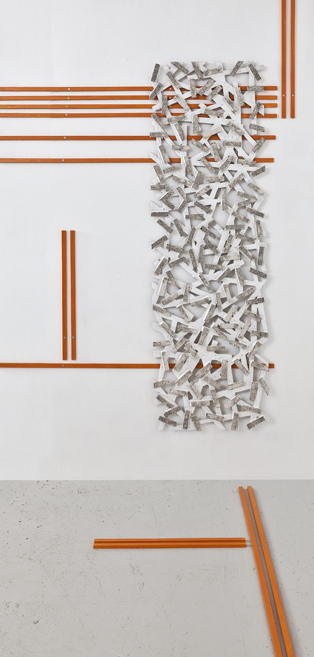
I wish I could have experienced her latest solo exhibition at the Marsden Woo Gallery in London. Judging from the catalogue, which you can get here, all aspects of Anja’s background come together in the exhibited three series of what I would call archtectones of a highly specific and technological nature. Some flat panels mounted on the walls; some that are connected to create spatial structures, and finally an assemblage of more volumetric objects. (I would love to see some of the perforated panels hanging in a window or outside to see the light through the holes and reflected on the glazed surfaces.)
[Glazed concrete and painted wood. From the show 'Signs and the Signed' 2013, Via]

 
[Glazed concrete panels similar to those on show in London, Photo by Ole Akhøj, via]

The ‘ceramics installation’ at the gallery shows a scope of Anja’s niche invention of ceramic glazed high-strength concrete

Two generation of high strenght
In fact two generations of concrete passion forms the crazy cool, inventive and highly advanced material investigations behind Bache’s narrative of the London city grid and the site of gallery. The thing is that Anja Bache’s father is Hans Henrik Bache who worked as a senior scientist at the Danish cement plant Aalborg Portland back when they actually were cutting edge and had R&D priorities. Bache Senior invented a concrete technology called Densit – “Denisfied Cement/ultra fine particle base materials (1978) which a strong binder/cement to offer was increased compressive strength. – The Densit is strong but extremely brittle and thus not suitable for any loadbearing concrete structures unless it is prestressed (to avoid tensile stress upon the structures) even the dried up densit alone would crack… Later Bache invented Compact Reinforced Concrete – or CRC. It is a high strength concrete technology, which is super strong but tough [sej* argh, suddenly not sure of the English word here but the opposite of brittle] allowing for large spans at very thin dimensions. 

The technology is basically a way to design concrete according to its structural function – no matter how large (in theory). In her PhD and post-doc work Anja Bache herself has suggested super large structures – as in 500+ meters long.

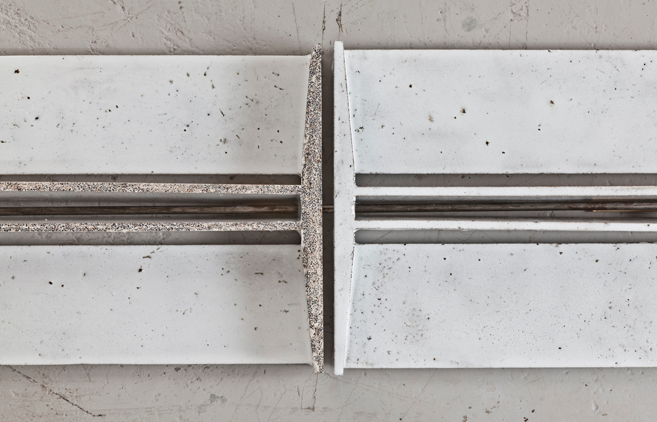
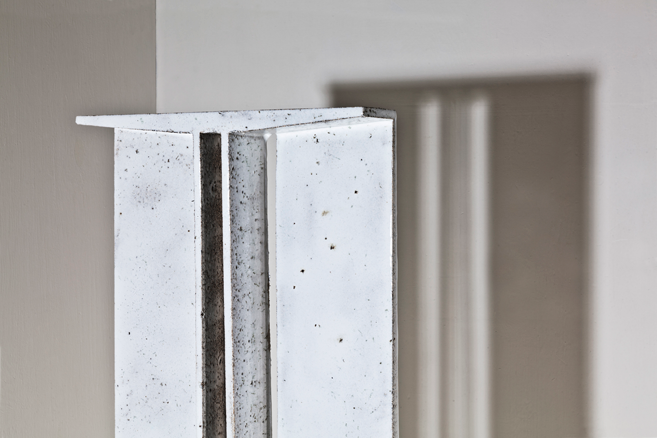
The glazing technique is remarkable and combines glazing - that is often associated with ceramics/clay – and high strength concrete. As shown at the exhibition, the combination results in perforated, thin sheets that I am longing to put on a façade, and profiles for what could be the most amazing structural elements – some time. For now a major limiting challenge is the size of the kiln used to fire the elements. The combination of a cement-rich material and ceramic glazing techniques also means that high temperature kilns have been used for two processes, making cement and firing the glazed concrete pieces. This raises an obvious question in regard to resource and energy consumption if used in high volumes in construction. While the energy question is relevant in the long run, the investigative route taken by Bache is so inspiring in leading an agenda into the questioning of what concrete is or could be.

Below are some random images of Anja Bache's many investigations into glazed high strength concrete.
[Photo by Ole Akhøj, via]
[Photo by Ole Akhøj, via]

[ Via ]

[Photo: Ole Akhøj Via]

[Photo: Ole Akhøj, via]
[Photo: Ole Akhøj, via]

Friday, April 12, 2013

Dutch concrete sofa

Continuing to share old news, this piece of old news (to me) is still much more recent than Mr Englund's 60's work. The Dutch designer Nacho Carbonell designed the prototype for a concrete couch cast on site in flexible formwork. - back in 2007. - it is in fact more a designed process than an object.

[Soft Concrete by Nacho Carbonell, 2007, image via MatandMe]
See more images of the piece at the designer's website. 

Carbonell writes about the prototype: "The idea of the process defining the final shape of the object, is something that has always interested me. You cannot have total control, the materials are alive and do what they want. I just give them boundaries, against which they can react with freedom, always surprising me. They are my best partners and my source of inspiration. Experimentation is my way of translating a concept into an object. Here I created bags of different shapes. Once the bags are filled up with concrete they reveal their final shape and function, in this case a proposal for a bench for outdoor purposes. The concrete is first colored, then poured into the bags. Once these are ripped off, the furniture  achieves a friendly, funny and soft look as well as a beautiful texture imprinted on it by the material of the bags. Another aspect that is very interesting about the project is the possibility of creating it on the spot, allowing it to be integrated better into the surroundings." via

While discovering Carbonell through the fabric-formed lens, I admit to enjoy the development of his work away from the solid to the more spatial, it is so much tighter. He has made some collections of spatial and communicative structures that are light and textured and architectural sculptures that I would love to experience live. Check them out here.
[Communication Line by Nacho Carbonell, via]

898 in Copenhagen
Pardon the jump but Carbonell's sofa reminded me of something in my own backyard that I haven't shared with you - so see the next post here.

Thursday, March 28, 2013

New concrete love from hinsidan (Sweden)


I’m really excited to share with you some really old news. Casting in membrane molds has been done before. The interesting aspect of this fact arises when the old practice hits your radar. Today, mid-1960’s work by Swedish artist Lars Englund hit my radar and blew me away!

[Image of Swedish artist Lars Englund in a concrete factory in Gröndal, 1967. via]

It is a thrill to browse through (web)pages of a long sold out mastodon catalogue of his 2005 exhibit at the Moderna Museet in Stockholm, Sweden. For the fabric formwork experience it is obviously his work Volume 1964-67. The images shown here are from the artist’s web site and show piece made from materials such as rubber, plastic, concrete, and even bronze.  The pieces are thus inflated (rubber) and cast as positives or negatives over either flexible membranes, plastic sheets (?) or solid casts.


[Images of the Volume series, 1964. top "Tool for Volume", plastic, and bottom "Volume" in bronze. Via]


Space, architecture, sculptural form
Born in 1933, the artist has had a long carreer exploring scales and techiques that bridges space, architecure, and sculptural form. His work is exciting for the Concretely blog because he combines organic formal language with geometric abstractions (as described here, in Swedish)

“Lars Englund went his own way when he, like the American 1960s minimalists was inspired by the new industrial materials. When his organic forms met rubber, plastics, carbon fiber and concrete he created works that still seem hyper-modern. The materials have always been allowed a life of their own in Englund’s art, from the early swelling rubber volumes to the sensual experiments in plastic and spring steel.” Via

[Lars Englund at the Trelleborg Rubber Industri, 1965]
[Volume, rubber, 1965]

Structure, space, material
Originally coming from the world of painting, he transferred his ideas to the three-dimensional realm, and yet line remains a decisive element in his work. It defines a corpus by making visible the limits that mark its separation from its surroundings, thus placing emptiness and space in a tense relationship to one another. In so doing, he repeatedly seems to question in a frame visually perceptible to the beholder what and how much (material, for example) is necessary to make the limits of space visible. Here, Englund not only raises questions about an aesthetic engagement with the subject of space and the void and a dialogue with the surroundings, but also opens the field for questions on the importance of space and limits in the territorial context. An additional facet is the philosophical dimension of “empty space” in the sense of leeway or room to develop in every sense. His work thus reveals a sensitive topicality and offers delicate room for interpretation, without having to stand at the foreground, for his reduced vocabulary of forms is striking in its clarity and unobtrusiveness and operates independently. Via
[Surface Support Structure, small sphere, 1968-74. Via. The Swedish title of this series is Bärverk, which could translate to grid structure or system. Verk, however means 'work' as both action and structure]
[Surface Support Structure, detail, Huddinge Hospital, 1973]
[Bärverk: Prototypes and sketches for Spatial Surface Support Structure are presented at Galerie Burén in Stockholm in 1974]
[Bärverk. Studies for Surface Support Structure, the Torpedo workshop, Skeppsholmen, Stockholm, 1970s]

Pardon the art gallery talk. Yours Concretely is a formwork nerd and I love the temporary spatial aspects of formwork structures before a pour. A part of creating space is to construct it. Constructing fabric formwork structures (not that I am talking about the actual formwork and not the concrete) can be about creating simple means and simple formwork-tectonic principles and then testing them against the concrete pour.
[Volume, plastic concrete, 1967. I think this piece must consist of concrete elements and not inflatable rubber but who knows... A contemporary version of this can be seen in Andrew Kudless' Seed P_Ball]

So—I love Englund’s playful focus on tectonic structures that combine various materials and levels of control and deformation. They are structures in space and they have themselves an inner space with degrees of materiality, transparency and rigidity. - do go explore sketches, prototypes and art pieces at Englund's extensive website.

[Pars pro toto, polycarbonate, 1979. Via]
       
Thanks again to my NYC formworks friend Josh Draper for the link to your Swedish dobbeltgänger.

Friday, September 17, 2010

Master of plaster - Rachel Whiteread

For some reason I just recently looked further into the amazing, solid world of Rachel Whiteread.
In the beginning of the 1990s she basically cast all the voids she could find - empty houses, inflated mattresses, the space under furnitures, behind book shelves, you name it.

Of course what she did, tells stories of what those spaces are about and adds narrative aspects to casting into molds. It's about time that I add a few images and some words someone else has written:
[Rachel Whiteread: Untitled (Nine Tables) 1998]

Untitled (Stairs)2001 - from Tate Advent Calendar [the image above is of tables and not of chairs, sorry]

"Chosen by Jo Fells - "I first saw this in a show in Edinburgh, it reminded me of how I love to sit on the stairs and used to play under the stairs in the broom cupboard - Whiteread's work gets me thinking about spaces we don't often consider, under the chair, the bed, the texture of the walls, the space under the stairs. For me that's what art is about - a trigger to make you see the world through new eyes."
Jo Fells, Museum of London


object: 3750 x 220 x 5800 mm

sculpture
T07939"

[Rachel Whiteread: House, 1993]

About House, Whiteread's most famous piece - For Damon Hyldreth, he sees,

“…a reversal of an enclosing, comforting, dwelling, a place of repose and comfort, a symbol of domestic hopes and dreams. What was left was a monument to one’s most private moments but with the privacy stripped bare and petrified. “House” monumentalized the past in a subversive manner, instead of allowing for a connection to and retrieval of the past, “House” subverted the warm cozy memories of home.”
I found the quote in a longer post about the cast house spaces on the Imoralist blog here.

[Spaces between book shelves, Plaster - the dye on the back of cheap paperbacks has transferred into the plaster, it seems]

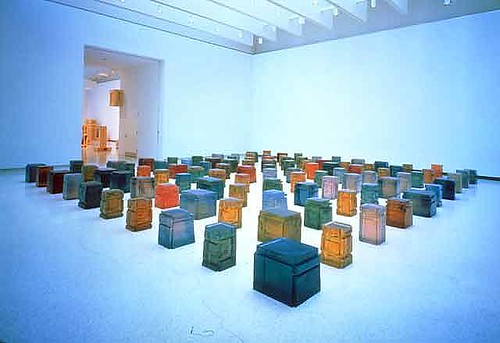
["One Hundred Spaces", Recin casts of spaces under chairs]

Wikipedia informs us:
For the Sensation exhibition in 1997, Whiteread exhibited Untitled (One Hundred Spaces), a series of resin casts of the space underneath chairs. This work can be seen as a descendant of Bruce Nauman's concrete cast of the area under his chair of 1965.
The critical response included:
"like a field of large glace sweets, it is her most spectacular, and benign installation to date [...] Monuments to domesticity, they are like solidified jellies, opalescent ice-cubes, or bars of soap — lavender, rose, spearmint, lilac. They look like a regulated graveyard or a series of futuristic standing stones with a passing resemblance to television sets."[7]
— Andrew Lambirth, The Spectator, October 12, 1996.


[Rachel Whiteread, Untitled (Air Bed II) 1992

Polyurethane rubber. Object: 1220 x 1970 x 230 mm,sculpture. Tate ]

The Tate site tells us more more:
"Whiteread's sculptures are casts of carefully chosen objects, most of which bear the traces of human use. She most often casts the 'negative' spaces around these objects, which then become the 'positive' form of the sculpture. Often the objects recall poignant events; her recent group of bed casts can be associated with sleep, illness and dying. This work adds another dimension to the group of bed casts, with its combination of solid sculptural form and associations of air-filled fragility. Here, the mould containing the air mattress during the casting process has become part of the work, enclosing the Lilo within its box-like shape.
 (From the display caption August 2004)"
It was this last piece that I was reminded of, when I came across concrete furniture cast in pvc inflatables, namely furniture by designers Tejo Remy & René Veenhuizen.
[Chair and bench cast in pvc]

A blog post on Dezeen informs us on the process of casting :"a series of furniture that appears to be made of inflated fabric, but actually is made from poured concrete. Remy & Veenhuizen cast each prototype as a single piece in individual molds created from waterproof PVC or plastic sheeting. Once assembled, the molds are placed upside down and concrete is poured into the feet. The legs are steel reinforced and the concrete itself contains small metal fibers that add stability. Within two days the works are solid enough for the mold to be cut off; and, within two weeks, the furniture is completely dry.

The pieces were exhibited in the designers' first solo exhibition in the spring of 2010 at Industry Gallery