Showing posts with label Flexible formwork. Show all posts

Monday, August 19, 2013

Ole Egholm - Concrete making and formwork tectonics - doctoral defense

More flexible formed formwork tectonics
The Cast Thicket project I just wrote about here reminds me of work by the Danish architect and doctoral student Ole Egholm who also explores the formwork tectonics of folded plastic sheets. Egholm  is defending his doctoral thesis on Friday September 13th 2013 in Aarhus. His project is related to my own doctoral work in the sense that it is about concrete, formwork tectonics, about flexible formwork, uses Gottfried Semper and other similar theories and key texts about tectonics, and it is investigated through making with the assistance of lots of great students, yet Ole has a digital starting point where as my own investigations were analog. Also important is his focus on building systems based on concrete elements, for example the vault shown below. 
[Youtube video of the assembly of the ReVault]
The use of concrete elements in Denmark could definitely use a lift and Ole's approach is great. His project has the title The Tectonic Potentials of Concrete and you can read an English summary of it here. The experiment shown below is from the ReVault workshop made in Aarhus as a collaboration between researchers and architecture students from Aarhus and from University of Technology, (UTS) in Sydney, Australia.
[Images from Re-vault, via. Elements are connected with zip ties. See more images here]

Ole and I have found similar sources of inspiration and this becomes clear when Ole Egholm writes about his conceptual universe that it 
"is based on research into established writings concerning tectonic thinking. The ideas of German Theorist Gottfried Semper are presented as a strategy for describing form as a result of materials and technical matter. Furthermore the idea of poetic construction is presented. Set forth by the English / American theorist Kenneth Frampton, the idea is that poetic construction is achievable though attention the properties of materials, structural logics and the craft of making. The thoughts of Marco Frascari which suggest a reading of details as a creator of meaning are introduced to be able to help establishing a progression in the case studies. Due to the narrow research focus on the making of concrete, an additional conceptual framework which emphasizes tectonics as a physical phenomenon is presented: The relationship between material, technique and form. Finally, a distinction was made between relationships surrounding mould making and the actual creation of geometric forms in concrete. The former was referred to as mould tectonics, the latter concrete tectonics." From Egholm's summary
This relation between formwork principles and the cured physical manifestation (concrete) is what I relate to as Stereogeneity - I think that Ole, as I am, is drawing on the definition of tectonics presented by Eduard Sekler. - well, I did write an entire post about Sekler, the tectonic, and the relationship between the mold and the molded here

Revault credits, participants
Eleven students from Aarhus School of Architecture (AAA) and UTS
Dave Pigram -architect, Senior lecturer - UTS
Ole Egholm Pedersen - architect, ph.d. candidate - AAA
Niels Martin Larsen - architect, ph.d. candidate - AAA
Stefan Rask Nors - architect, assistant professor - AAA
Ronni Lundoff Madsen - M.Sc. Architectural Engineering - Alectia
Jacob Christensen - M.Sc. Architectural Engineering - Vision+


Yo_cy's formwork tectonics


[Light and space inside the Cast Thicket by yo_cy, via]
Cast Thicket or filigree concrete
I have forgotten to repost this award winning project by yo_cy from Tex-Fab’s APPLIED: Research through Fabrication competition at the University of Texas at Arlington, which is posted on blog of the Architects' Newspaper A/N Blog. The project is familiar to some fabric-formed filigree-like projects with a major difference that it is facetted structure. Yet, despite being inspired by textile-like mats used for casting walls (which you can see way below), the formwork material is actually thin, lasercut plastic sheets. I enjoy the combination of digital fabrication and of combining the lasercut plastic sheets with the hydrostatic pressure from casting. 
“[With this project] we are reacting to the singular material tendency of digital fabrication and [we have shown that] we can use the computer to coordinate different methods of making a material, and simulate that on a smaller scale.” says Tracy, via
[Cast Thicket principle Via]
Cast Thicket is both a form of construction and a finished design product. To produce finished forms of reinforced concrete, construction begins with the design of prefabricated steel struts, which are positioned using a system of interlocking laser-cut plates. Formwork is also prefabricated and attached to the joints. Plastic formwork is then detached and reattached as the structure grows upwards. The final product has the possibility for infinite variation. via the competition site 
[Cast Thicket by yo_cy]
The structure is awesome and perhaps also thicket like (the title contains a new English word for me) - it rather reminds me of columns in Gaudi's Sagrada Familia as well as art pieces by the wonderful Ernesto Neto who fills spatial fabric structures with everything but concrete and plaster. Instead he uses eps, sand, and even spices.
[Ernesto Neto's fabric-formed soft world]

[Each piece of the plastic casing is connecting by a series of tabs. Photo:Kenneth Tracy]
[The plastic mold is held together with plastic zip ties. Photo:Kenneth Tracy]

While I find the work of yo_cy wonderful, I still have to let out a big sigh because of the overly time consuming construction. The idea of the 'tailor-made' as something related to flexible formwork is still so heavily labor intensive as you can tell on the image above, and thus far from being scaleable. I guess the work now can be compared to crocheting and not sewing.

Woven formwork for Kopo House
I am not sure if this house has been built but I'd love to see it if it does - the project is in Indonesia and contains the literal exploration of manufacturing a formwork textile, I mean the textile is in itself a structure with its own principles and the larger the fibers, the is it a building component and material in itself. yo_cy's Christine Yogiaman and Kenneth Tracy state as their profile that combining labor intensive acts in craft culture with rule-based, digital frameworks their projects in Indonesia multiply the everyday to intensify space. The images on the project show initial weaving samples inspired by Ketupat a sort of rise casting formwork... (!) that are manipulated and given form before it is used as formwork for plaster, I think. Other images show larger scale casts of modules and some rebar, so something is definitely being built. Fingers crossed.

The formwork principle is inspired by Indonesian cast rice dumplings known as Ketupat - wow, see below how great they are!
[Ketupat - --- I love these throwaway sturdy lunch boxes]

[woven mats used as formwork and a plaster cast for the  Kopo House project. I'd love to see the full scale version of this! via - Wait - below are bigger prototypes investigating some formwork types]
[Images of the Kopo House investigations, by Yo_cy]


Credits of the Cast Thicket:  Fabricators TOPOCAST
Competition Tex-Fab’s APPLIED: Research through Fabrication competition at the University of Texas at Arlington 
Designers Kenneth Tracy, Christine Yogiaman
Location Arlington, Texas
Date of Completion February 2013
Material limestone powder, white fiber reinforcement, Poraver glass beads, metakaolin, superplasticizer, .03-inch plastic
Process Rhino, Kangaroo, Grasshopper

Thursday, March 28, 2013

New concrete love from hinsidan (Sweden)


I’m really excited to share with you some really old news. Casting in membrane molds has been done before. The interesting aspect of this fact arises when the old practice hits your radar. Today, mid-1960’s work by Swedish artist Lars Englund hit my radar and blew me away!

[Image of Swedish artist Lars Englund in a concrete factory in Gröndal, 1967. via]

It is a thrill to browse through (web)pages of a long sold out mastodon catalogue of his 2005 exhibit at the Moderna Museet in Stockholm, Sweden. For the fabric formwork experience it is obviously his work Volume 1964-67. The images shown here are from the artist’s web site and show piece made from materials such as rubber, plastic, concrete, and even bronze.  The pieces are thus inflated (rubber) and cast as positives or negatives over either flexible membranes, plastic sheets (?) or solid casts.


[Images of the Volume series, 1964. top "Tool for Volume", plastic, and bottom "Volume" in bronze. Via]


Space, architecture, sculptural form
Born in 1933, the artist has had a long carreer exploring scales and techiques that bridges space, architecure, and sculptural form. His work is exciting for the Concretely blog because he combines organic formal language with geometric abstractions (as described here, in Swedish)

“Lars Englund went his own way when he, like the American 1960s minimalists was inspired by the new industrial materials. When his organic forms met rubber, plastics, carbon fiber and concrete he created works that still seem hyper-modern. The materials have always been allowed a life of their own in Englund’s art, from the early swelling rubber volumes to the sensual experiments in plastic and spring steel.” Via

[Lars Englund at the Trelleborg Rubber Industri, 1965]
[Volume, rubber, 1965]

Structure, space, material
Originally coming from the world of painting, he transferred his ideas to the three-dimensional realm, and yet line remains a decisive element in his work. It defines a corpus by making visible the limits that mark its separation from its surroundings, thus placing emptiness and space in a tense relationship to one another. In so doing, he repeatedly seems to question in a frame visually perceptible to the beholder what and how much (material, for example) is necessary to make the limits of space visible. Here, Englund not only raises questions about an aesthetic engagement with the subject of space and the void and a dialogue with the surroundings, but also opens the field for questions on the importance of space and limits in the territorial context. An additional facet is the philosophical dimension of “empty space” in the sense of leeway or room to develop in every sense. His work thus reveals a sensitive topicality and offers delicate room for interpretation, without having to stand at the foreground, for his reduced vocabulary of forms is striking in its clarity and unobtrusiveness and operates independently. Via
[Surface Support Structure, small sphere, 1968-74. Via. The Swedish title of this series is Bärverk, which could translate to grid structure or system. Verk, however means 'work' as both action and structure]
[Surface Support Structure, detail, Huddinge Hospital, 1973]
[Bärverk: Prototypes and sketches for Spatial Surface Support Structure are presented at Galerie Burén in Stockholm in 1974]
[Bärverk. Studies for Surface Support Structure, the Torpedo workshop, Skeppsholmen, Stockholm, 1970s]

Pardon the art gallery talk. Yours Concretely is a formwork nerd and I love the temporary spatial aspects of formwork structures before a pour. A part of creating space is to construct it. Constructing fabric formwork structures (not that I am talking about the actual formwork and not the concrete) can be about creating simple means and simple formwork-tectonic principles and then testing them against the concrete pour.
[Volume, plastic concrete, 1967. I think this piece must consist of concrete elements and not inflatable rubber but who knows... A contemporary version of this can be seen in Andrew Kudless' Seed P_Ball]

So—I love Englund’s playful focus on tectonic structures that combine various materials and levels of control and deformation. They are structures in space and they have themselves an inner space with degrees of materiality, transparency and rigidity. - do go explore sketches, prototypes and art pieces at Englund's extensive website.

[Pars pro toto, polycarbonate, 1979. Via]
       
Thanks again to my NYC formworks friend Josh Draper for the link to your Swedish dobbeltgänger.

Wednesday, December 21, 2011

Floating Concrete- Weaving Shores

Weaving Shores Kissing Buoy is a studio project from the course Formworks at Columbia University that I introduced here
[Concept of floating concrete buys in Weaving Shores Kissing Buoy, via]

The project is a concrete buoy that becomes part of a woven landscape on the shore of the East River in Greenpoint, Brooklyn. It responses to the workshop brief to produce 1 and 2 part molds and design a concrete element system that incorporates the specific elements and mode of construction.

[Concrete Prototype, Weaving Shores Kissing Buoy, via]
The concept and the production of a concrete element that floats and interlocks into a 'woven,' walkable, and physically flexible system is a great way to get many parameters at play during the course.

The presentation is also inspirational because of the introduction to reference works and technologies.
[Weaving Shores Kissing Buoy, via]
The idea of fabricating concrete shores is not really that intriguing to me. Giving it a second thought, the need to respond to the rising seas on our warm Globe calls for drastic measures to create adaptable shores. The project also suggests a combination of human recreation and an artificial 'aquatic habitat.'
[Reef Balls, artificial concrete reefs, via]

One of the project's references is work by the Reef Ball Foundation, which is a simple concrete forming method to produce artificial reefs. The aim is to create an  aquatic habitat for the animals and plants who become homeless due to drastic methods of fishing. The concrete reef also works to protect existing natural reefs.

Weaving Shore Kissing Buoy by students: Aisha Alsager, Joanne Hayek, Anne Wei, and Bernadette Ma.

Formworks at Columbia

Formworks is a course taught at GSAPP, Columbia by my new formwork friend Joshua Draper (yes, it is a very cool last name these days, what?).
[JAJI Noise Continuum, via]

Since 2008 the studio class has hybridized methods of casting with digital fabrication
"The ambition is to challenge the repetitive nature of casting and formwork by developing a parametric, dynamic formworks system and produce a series of precast elements using that system. 

Organized around a series of short but intense assignments, students are introduced to 1 and 2 part molds, silicone casting, vacuforming, rotational molding and a variety of casting materials. Students respond with their own system which takes these techniques and systems of organization, assembly and fabrication further." Via


[JAJI is a project that investigates the role of the milling direction(s) in creating form and surface pattern. via]


JAJI project by students: Jennifer Chang, Aaron Berman, Juan Fransisco Saldarriaga, and Idan Naor.


See presentations of work by the Formworks classes:
formworksfa11.blogspot.com
formworksspr11.blogspot.com
formworksfa10.blogspot.com
formworksspr10.blogspot.com
formworksfa09.blogspot.com
formworksspr09.blogspot.com
formworksfa08.blogspot.com
formworkssum08.blogspot.com 

Thursday, January 6, 2011

Fabric formed concrete benches

As a direct continuation of the previous post on an upcoming concrete workshop in which students will design and produce benches, here's another couple of examples. Bench could be read as just another word for span - it's just a matter of scale, whether the span holds a person or a floor, right?
[Image of fabric formed beam - could be used as bench, by CAST at University of Manitoba, Canada]

Fabric formed beam - or bench
Above image is cast as a beam of 22 metres. - I've sat on it, so you could use it as a bench, I guess - What's interesting about this piece when it comes to producing a long span is the fact that it was cast in just two flat sheets of fabric!
The beam is actually quite old and the good people at CAST (very firgurative abreviation for Centre for Architectural Structures and Technology at the University of Manitoba).
Do read more about the pioneering work at CAST and professor Mark West here.
[Image of Buenos Aires concrete bench by Grupo Bondi, 2010]
[Detail of concrete bench with aluminium clamp tube, photo from Grupo Bondi]

Fabric formed furniture
The pieces of furniture by the Argentinian Grupo Bondi definitely look familiar. (see the post on the Ambiguous Chair here). The guys have been working with flexible molds for some years and, opposed to the research pieces done elsewhere, there's actually price tags on most items.

The bench weighs 145 kgs. The concrete mattress sits on iron legs and will fool you with the apparent upholstered bulges. Previous work could be shells? The cushion below is only 39 kgs according to the designers.
[Concrete furniture by Grupo Bondi]
I bet that those pieces must have been cast in fabrics or similar flexible formwork. Do check out the web site for more design ideas cast in flexible formwork and products to order.

The stunning shell solution
I need to show you a more recent project from CAST. Ronnie Araya works there as an assistant Professor and did these beautiful thin shells that also have some spin off work for furniture. - the overall interest is architectural structures - but, as mentioned befor - working with technologies at a furniture scale is an interesting starting point - and something that is more likely to sooner have a life outside the studio than large load bearing structures.
I wrote more about this piece in this previous post
[Image of rigid fabric formwork and the cast shell - I think this is a scale model in plaster. Image courtesy of CAST]
[Image of full scale PVC-coated mold ready to be cast with GFRC, Glass Fibre Reinforced Concrete, Photo from CAST].

Read more about the stunning shell work at CAST here. The words is that the studio is doing a project with shells like these - so I guess work does get out of the lab! Can't wait to see it!

Wednesday, December 15, 2010

Adapa - more flexible formwork

I just came across Adapa, a brand new company started by two recently graduated Danish engineers on the basis of their thesis work (-that's what I've heard, anyway).

The guys have developed an adaptable formwork method using they good old pin-art principle, gotten themselves a client, and are underways towards a patent on their method.

Way to go - below are a few images from their web site - they will be guys to watch!
[Rendering of concrete shelter for Danish National Park Mols Bjerge]
[Rendering of the back side of the shelter showing signs of biological growth]
[Kinetic mould]
About the Kinetic Mould
From the website we know:
"The concept of the flexible mould to make it economical sound to produce double curvature surface elements in different material directly from CAD software. The flexible mould can within minutes position it self to any possible shape which makes it ideal for high volume industrial production."


[The flexible mould process from design to construction]

About uses
"The flexible mould seeks to satisfy the growing market for free form surfaces which typically is a very expensive surface to construct" besides the aim is to "promote more advanced as well as interesting architecture thereby leaving behind the concept of  flat tedious surfaces in architecture."

Pin art what?
The pin-art principle I referred to in the beginning of the post may ring a bell if you see this image below.

-or this movie of a performance on a large pinart frame at a kids' museum in Sheboygan, Wisconsin, USA


Friday, September 17, 2010

Master of plaster - Rachel Whiteread

For some reason I just recently looked further into the amazing, solid world of Rachel Whiteread.
In the beginning of the 1990s she basically cast all the voids she could find - empty houses, inflated mattresses, the space under furnitures, behind book shelves, you name it.

Of course what she did, tells stories of what those spaces are about and adds narrative aspects to casting into molds. It's about time that I add a few images and some words someone else has written:
[Rachel Whiteread: Untitled (Nine Tables) 1998]

Untitled (Stairs)2001 - from Tate Advent Calendar [the image above is of tables and not of chairs, sorry]

"Chosen by Jo Fells - "I first saw this in a show in Edinburgh, it reminded me of how I love to sit on the stairs and used to play under the stairs in the broom cupboard - Whiteread's work gets me thinking about spaces we don't often consider, under the chair, the bed, the texture of the walls, the space under the stairs. For me that's what art is about - a trigger to make you see the world through new eyes."
Jo Fells, Museum of London


object: 3750 x 220 x 5800 mm

sculpture
T07939"

[Rachel Whiteread: House, 1993]

About House, Whiteread's most famous piece - For Damon Hyldreth, he sees,

“…a reversal of an enclosing, comforting, dwelling, a place of repose and comfort, a symbol of domestic hopes and dreams. What was left was a monument to one’s most private moments but with the privacy stripped bare and petrified. “House” monumentalized the past in a subversive manner, instead of allowing for a connection to and retrieval of the past, “House” subverted the warm cozy memories of home.”
I found the quote in a longer post about the cast house spaces on the Imoralist blog here.

[Spaces between book shelves, Plaster - the dye on the back of cheap paperbacks has transferred into the plaster, it seems]

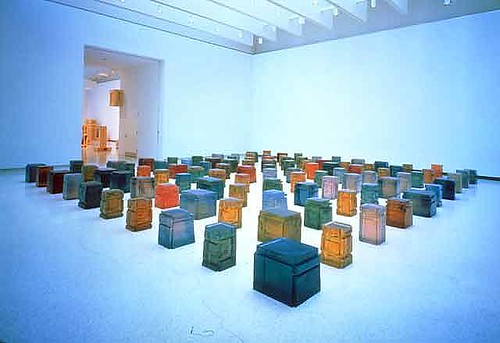
["One Hundred Spaces", Recin casts of spaces under chairs]

Wikipedia informs us:
For the Sensation exhibition in 1997, Whiteread exhibited Untitled (One Hundred Spaces), a series of resin casts of the space underneath chairs. This work can be seen as a descendant of Bruce Nauman's concrete cast of the area under his chair of 1965.
The critical response included:
"like a field of large glace sweets, it is her most spectacular, and benign installation to date [...] Monuments to domesticity, they are like solidified jellies, opalescent ice-cubes, or bars of soap — lavender, rose, spearmint, lilac. They look like a regulated graveyard or a series of futuristic standing stones with a passing resemblance to television sets."[7]
— Andrew Lambirth, The Spectator, October 12, 1996.


[Rachel Whiteread, Untitled (Air Bed II) 1992

Polyurethane rubber. Object: 1220 x 1970 x 230 mm,sculpture. Tate ]

The Tate site tells us more more:
"Whiteread's sculptures are casts of carefully chosen objects, most of which bear the traces of human use. She most often casts the 'negative' spaces around these objects, which then become the 'positive' form of the sculpture. Often the objects recall poignant events; her recent group of bed casts can be associated with sleep, illness and dying. This work adds another dimension to the group of bed casts, with its combination of solid sculptural form and associations of air-filled fragility. Here, the mould containing the air mattress during the casting process has become part of the work, enclosing the Lilo within its box-like shape.
 (From the display caption August 2004)"
It was this last piece that I was reminded of, when I came across concrete furniture cast in pvc inflatables, namely furniture by designers Tejo Remy & René Veenhuizen.
[Chair and bench cast in pvc]

A blog post on Dezeen informs us on the process of casting :"a series of furniture that appears to be made of inflated fabric, but actually is made from poured concrete. Remy & Veenhuizen cast each prototype as a single piece in individual molds created from waterproof PVC or plastic sheeting. Once assembled, the molds are placed upside down and concrete is poured into the feet. The legs are steel reinforced and the concrete itself contains small metal fibers that add stability. Within two days the works are solid enough for the mold to be cut off; and, within two weeks, the furniture is completely dry.

The pieces were exhibited in the designers' first solo exhibition in the spring of 2010 at Industry Gallery