Showing posts with label phd. Show all posts

Monday, August 19, 2013

Ole Egholm - Concrete making and formwork tectonics - doctoral defense

More flexible formed formwork tectonics
The Cast Thicket project I just wrote about here reminds me of work by the Danish architect and doctoral student Ole Egholm who also explores the formwork tectonics of folded plastic sheets. Egholm  is defending his doctoral thesis on Friday September 13th 2013 in Aarhus. His project is related to my own doctoral work in the sense that it is about concrete, formwork tectonics, about flexible formwork, uses Gottfried Semper and other similar theories and key texts about tectonics, and it is investigated through making with the assistance of lots of great students, yet Ole has a digital starting point where as my own investigations were analog. Also important is his focus on building systems based on concrete elements, for example the vault shown below. 
[Youtube video of the assembly of the ReVault]
The use of concrete elements in Denmark could definitely use a lift and Ole's approach is great. His project has the title The Tectonic Potentials of Concrete and you can read an English summary of it here. The experiment shown below is from the ReVault workshop made in Aarhus as a collaboration between researchers and architecture students from Aarhus and from University of Technology, (UTS) in Sydney, Australia.
[Images from Re-vault, via. Elements are connected with zip ties. See more images here]

Ole and I have found similar sources of inspiration and this becomes clear when Ole Egholm writes about his conceptual universe that it 
"is based on research into established writings concerning tectonic thinking. The ideas of German Theorist Gottfried Semper are presented as a strategy for describing form as a result of materials and technical matter. Furthermore the idea of poetic construction is presented. Set forth by the English / American theorist Kenneth Frampton, the idea is that poetic construction is achievable though attention the properties of materials, structural logics and the craft of making. The thoughts of Marco Frascari which suggest a reading of details as a creator of meaning are introduced to be able to help establishing a progression in the case studies. Due to the narrow research focus on the making of concrete, an additional conceptual framework which emphasizes tectonics as a physical phenomenon is presented: The relationship between material, technique and form. Finally, a distinction was made between relationships surrounding mould making and the actual creation of geometric forms in concrete. The former was referred to as mould tectonics, the latter concrete tectonics." From Egholm's summary
This relation between formwork principles and the cured physical manifestation (concrete) is what I relate to as Stereogeneity - I think that Ole, as I am, is drawing on the definition of tectonics presented by Eduard Sekler. - well, I did write an entire post about Sekler, the tectonic, and the relationship between the mold and the molded here

Revault credits, participants
Eleven students from Aarhus School of Architecture (AAA) and UTS
Dave Pigram -architect, Senior lecturer - UTS
Ole Egholm Pedersen - architect, ph.d. candidate - AAA
Niels Martin Larsen - architect, ph.d. candidate - AAA
Stefan Rask Nors - architect, assistant professor - AAA
Ronni Lundoff Madsen - M.Sc. Architectural Engineering - Alectia
Jacob Christensen - M.Sc. Architectural Engineering - Vision+


Tuesday, June 11, 2013

CAM Fingerprints as ornaments of construction

Robotic milling, EPS (expanded polystyrene foam) and concrete are the dancing partners in the newly defended PhD project by architect/industrial designer Johannes Rauff Greisen.
[Johannes Rauff Greisen in front of the industrial robot. Photo by Martin Kunzendorf, via]

As most academic titles, it's sexy: "Architectonic possibilities by robotic fabrication of formwork in concrete building". The project behind the title, however is great because it takes on an investigation of the architectural potentials of the technique by making lots of formwork and testing it and discussing this in terms of architectural applications as well as the challenges of actually using EPS as a mold for concret. The scope of the investigation includes scale issues as well as economic drivers for a new aesthetics.

Starting with the prototypes, Johannes was an Industrial Doctorate at the concrete centre at the Danish Technological Institute (TI). TI had purchased a robot which they had Johannes get well acquainted with - but furthermore the concrete centre has fully automatic but tiny version of an industrial mixing plant to make completely scaleable concrete mix designs. (Sensing my envy here?)
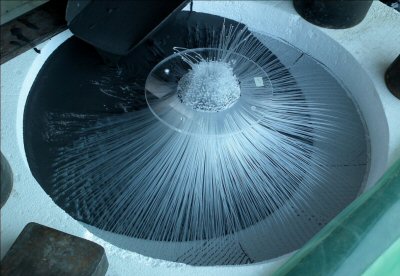
[Thousands of light transmitting fibers for the concrete formwork before the pour. Image from Johannes Rauff Greisen's research via]

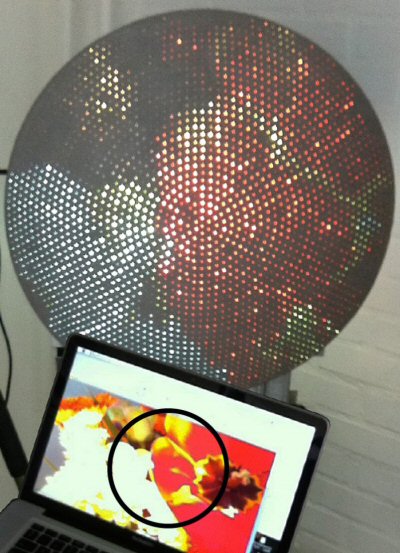
One of Johannes' experiments is one of those that 'can't be done', namely making translucent and image/pixel transferring concrete. - Well, on a curved surface that is. I am not good at explaining it and the available image online are less than great, so have a browse through Johannes' well-illustrated paper for the Prototyping Architecture conference, which we both attended earlier this year. - Download the proceedings here ((90+ Mb))and locate the paper and lots of images on page 131.
[The curved concrete screen with embedded optical fibers displaying/projecting the image shown on the computer screen. - Trust me, you'll get it as you browse through the paper! Image via]

Cheap becomes ornamental potential
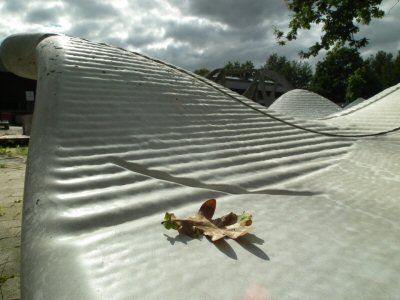
Another series of experiments deal with effectivity of the milling process. Often the aim with milled formwork - well the desire, anyway - is completely smooth and endless surfaces. One of the drawbacks here is price - the 'closer' the shave, the finer the tool, so to speak. In milling terms, this means that a finer milling tool would be needed for finer, more controlled surfaces. This is costly because of the time. - So, why not make a virtue out of the necessity and praise the crude patterns of the cheaper manufacturing to add an extra layer of interpretation on the concrete surface? What is at stake here, for Yours Concretely, is the robot version of stereogeneity which I wrote about here. 
[Fine patterns of milling or CAM fingerprints shown on the concrete surface (and my new nail polish). The image is by Rauff Greisen and reproduced from the anthology Material Evidence in Architectural Research, Eds Anne Beim & Mette Ramsgaard Thomsen]


[Coarser patterns of milling or CAM fingerprints shown on concrete surface. The image is by Rauff Greisen and reproduced from the anthology Material Evidence in Architectural Research, Eds Anne Beim & Mette Ramsgaard Thomsen]

Rather than fighting the inherent formal language of the milling tool, Johannes advocates the new aesthetic, almost ornamental language of a still new manufacturing process. He coins the term CAM Fingerprints in his dissertation as associated the expressed process of manufacture from coarser, cheaper milling.
Johannes sums this up:
At one end the scale is expanded by introducing fine detail and light emitting elements in the surface, elements which are so extremely small that they become a material component. At the other end of the scale, is introduced architectural use of a coarse milling, the so-called CAM fingerprint. Hitherto it has been the aim to obtain as smooth as possible milling. Targeted use of coarse milling is new and consists in consciously working with the robot's working pattern that forms a partially controlled technology fingerprint. This autonomous CAM fingerprint can be interpreted as neo-industrial digital ornament that share kinship with past ornaments - both the craft-based unintended ornaments and more random material contingent ornamentation. The Ph.D. thesis addresses these kinships openly, but concludes that the resource economy and practices around the coarse milling immediately lays considerably closer to the existing concrete building culture than the smooth milling. The Ph.D. project thus brings the robots opportunities closer to practical concrete buildings as architectural CAM fingerprints can reduce milling times and thus reduce the final manufacturing costs. Via
[CAM fingerprint consists of "milling tool's working patterns which are marketed in the mold surface and provides a technology footprint to the concrete surface. Here used CAM fingerprint as relief in an urban space concept (designed to SLA), consisting of a 'melting landscape' in concrete" cast with a membrane formliner via]

Johannes even suggests the term of a future concrete in a new-industrial context, robot concrete. This I am less convinced about but I really like the CAM fingerprints term and this eye for new aesthetics and ornamental potentials based on new techniques.

Despite the high-/low-tech discrepancy between fabric formwork and the 3d milled EPS this whole approach and love for expressing construction may tell you that we were in fact researching under the same roof, at the Royal DK Academy. Johannes was also my suuuper handy and cool cat co-teacher at several of the TEK1 workshops about fabric formwork.

Read an article (in Danish) about the perspectives of Johannes' research.

Wednesday, June 5, 2013

Concrete as stereogeneous construction or an academic material?

This post is an attempt to describe a concept that I have coined – stereogeneity – or concrete as a material and as process. If you wonder how that stereo word has any relation with concrete – it may be good to know that stereophonic or stereo sound means solid sound – because stereos is Greek for solid or hard and phone is voice in Greek (news to me).

While we may forget that sound is solid – there is rarely any forgetting that of concrete. So, often, concrete is explained in simple ways as the contrast between liquid and solid. Architects explain their fascination with the material because it, at least conceptually, is easily molded like a piece of clay in the hand. Yet the truth is, of course, more complex.

Multiple design tasks for concrete
For even minimal construction projects such as student workshops this means that they have to design structural formwork principles, the concrete object/structure, as well as the process of construction – and all simultaneously. I guess this focus on the relationship between architectural technology and the expression of construction and materials is somewhat old school tectonics. But I love it – call it tectonics or not, this approach to architecture is bound to a Scandinavian pragmatic and sober tradition in design and construction. – and then it is the foundation for constructing fabric formed concrete. Everything shows – the potential as well as the ‘danger’ when the slightest pinches, the shape and position of formtie impactos, - and when things go slightly wrong. – it all shows.
[Detail of the Walking Chromosome Column by yours Concretely, 2013. The formwork is closed using a seam technique and the fabric is sweating excess mix water under the hydrostatic pressure of the freshly poured concrete]

Take off the aesthetics hat and wear what?
In order to discuss as well as develop the architectural potentials for fabric formwork it has proved necessary to define a concept to embrace this relation rather than the concrete 'results'. With only a few built examples of fabric formed concrete and thus no context for a judgement, I am really reluctant to use aesthetics or beauty as factors for evalation here because it is not so relevant if you love or are repulsed by strange bulging concrete. If you do not like it, fine, but wearing the habitual hat of the aesthetic limits the scope of any investigation.

Concrete-ness?
The pioneer in fabric formwork, Mark West, once referenced an essay by American art critic and poet Peter Schjeldahl in which he describes concrete-ness and the presence and personality and intrinsic dichotomy of the liquid and solid characteristics of concrete.
 “Concrete is the most careless, promiscuous stuff until it is committed, when it becomes fa¬natically adamant. Liquid rock, concrete is born under a sign of paradox and does not care […] 
Concrete hardens in the shape of whatever container received its flow, its momentary sensual abandon in thoughtless submission to half-loved gravity. Once it has set, what a difference! Concrete becomes adamant, fanatical, a Puritan, a rock, Robespierre – the divinity! – of the shape it comprises, be the shape a glopped heap on the ground or a concert hall, ridiculous or sublime.”

Right, liquid concrete is promiscuous – it lets itself embrace in any shape and caress by any material formwork. Solid concrete on the other hand is not to be messed with. While describing each material extreme Scheldal’s approach to concrete-ness does not quite encompass the techniques, intentions, nor materials of getting from one condition to the other.

Concrete in Greek
I turned to my friend, the Greek author Iosif Alygizakis, to help me out. With his kind assistance I wanted to coin a term that would encompass how or that concrete when cured and solid appears with signs of its becoming. Why Greek you may wonder?? – well there are two direct reasons. – I have been studying the theories of Gottfried Semper and here concrete lies between a number of his schematic labels for materials and procedures – exactly due to the different materials, techniques and conditions of the material. The concept of stereotomi (cut stone or ‘mass’) is often associated with brickwork. Tectonic with timber, Ceramics with clay, and textile with weavings or the clad/draped façade.

Greek in many tongues
The other reason is very pragmatic – for the longest time I did not know which language I was writing my PhD dissertation… Danish or English. Greek is neutral in the sense that it is used in both languages and always means the same.
Iosif dissected words and meaning through almost mathematical methods and summa summarum he created a new word based on the words for solid stereos and for becoming  - i.e. to begin to be, genés

Stereo|genés
Στερεό|γενές written without the  |  in the middle

Genés – not genesis
Genés is an ending – which comes the verb: ginomai [ginomæ]
- it means: to become – it means – to be in the process of becoming something, to begin to be
- and – becoming what?? – well, StereoThe Gr. Ginomai refers to procedure of becoming. It describes the process of the becoming of – through a procedure.
What does it become – stereo – Gr. solid – by this formulation we don't need the word fluid, liquid.
It is absolute
If it becomes solid – stereo – so, of course, it was totally understandably liquid
Of factual ideas or constructural items in order for them to become something else, something – as an aftermath as a product. – important – it is through a series of manufacture.
Stereo-geneous – the English – an adjective
[above is basically notes taken from Iosif explaining the meaning of the words and their connection]

Petro or stereo
In the US there seem to be a use of the word cultured stone as a commercial word for concrete for design and architecture – and perhaps especially for home owners. – liquid stone and cultured stone – the words can be found in Iosif ‘s other suggestion petrogenés, petro is Greek for stone. I went for stereos because, well – concrete is more than stone to me and I liked how it sounded too.
[Detail of striking the formwork for the Walking Chromosome Column by yours Concretely, TEK1 2013. The seam as well as the fabric have left stereogeneous traces.

Sekler's tectonic
The discussion of concrete as material and process is not new - and also the relationship between structural principles, materials, techniques and construction is overly described, I know. Stereogeneity is to concrete, especially in situ concrete, what Eduards Sekler’s use of the term tectonic is to the overall relation is between structural principles, techniques and the expressed physical manifestation.

So, in English, stereogenés is stereogeneity. The value of concrete as a substance is stereogeneous – it is something that develops from a liquid to a solid state.

And how to use this?? Well, in my dissertation work I have developed the use the term by discussing qualities in built concrete works by architects such as Louis Kahn, Frank Lloyd Wright, Jean Nouvel and Peter Zumthor – to describe the relation between process and materiality. For the analytical cases of fabric formed concrete I have been even more specific and looked at the role of particular details in construction: The form-tie, the frame, and the textile. Furthermore, the aspect of conditions or states between liquid and solid has allowed to focus on a particular state in the 'becoming' of the analytical cases, say the intentions behind experiments, the particular technique behind a detail versus its stereogeneous consequence at the end.

– I  hope to return to this topic and the cases in a stereogeneous light in future posts.

References
Manelius, Anne-Mette (2012) Fabric Formwork - Investigations into Steregeneity and Formwork Tectonics in Architectural Constructions, PhD dissertation, Royal Danish Academy of Fine Arts, School of Architecture.
Schjeldahl, Peter (1994) Columns & Catalogues. Great Barrington MA: The Figures.
Sekler, Eduard. “Structure, Construction, Tectonics.” In Structure in Art and Science, edited by Gyorgy Kepes, 89- 95. New York: George Braziller, 1965.

As always, please accredit me if you use any of the original points or images from this post. I'd love to know how you used or applied it and what your think.

Wednesday, May 29, 2013

PhD in 3 minutes (in Danish)

[Ready to deliver a PhD in 3 minutes - Yours Concretely Anne-Mette Manelius, Photo by Martin Kunzendorf, DR]

Last year the excellent Danish newspaper Information (based on WWII illegal underground newspaper) and DR (the public Danish Broadcasting Corporation) launched a competition for newly finished PhD candidates to communicate their projects in terms of the relevance to society. It is easily criticized to be superficial but communication to others than your peers is a way to democratize knowledge and furthermore the PhD Cup is a great opportunity to practice communicating substantial work in a second... the elevator speech more or less.

This year I was lucky to be selected to be among 32 participants nation wide. I did not make it to the final but part of the PhDCup 2013 included a 3-minute talk which I give to you with no further ado.

Here is the link to PhD in 3 minutes about fabric formwork and my project. This may mostly for Danish/Scandinavian readers since the linked speak is in Danish.

Tuesday, January 8, 2013

A doctoral dissertation

Better late than never, below is a link to my PhD thesis about the architectural potentials of fabric formwork. As always, feel free to contact me with feedback, much appreciated!!
[Cover of the dissertation about fabric formwork, by yours concretely]
[Cover of the appendix named Experimental with literally tons of fabric formed concrete constructed by hundreds of students, image of student project "Clamp Wall"]

The long title of the thesis is (take a deep breath) "Fabric Formwork for Concrete – Investigations Into formwork Tectonics and Stereogeneity in Architectural Constructions" and you can download it right here. Here is a link to some of the terminology used/coined.


Here is a much shorter version - an interview about the work.

[Yours concretely in the Ambiguous Chair, photo by Rikke Grendal]

Thursday, September 13, 2012

Concrete futures in the news

[Photo: Colourbox via]
Beautifying concrete
With the smashing headline New techniques can beautify concrete buildings, here's a link to an interview with yours concretely written in the news portal Science Nordic written after defense of my doctoral dissertation. My point in the interview was that new methods of construction demands a new way of discussing the use and the aesthetics of concrete in architecture, well actually, that we have to think of the material's potentials anew.

Here is a link to the Danish version of the article.
For both articles, please disregard the 'fact boxes'...

This next post reflects a little upon evaluating the material 'results' of fundamental architectural research

Friday, March 5, 2010

Ambiguous chairs - a surprice encounter with concrete

In order to generate discussion of the architectural perspectives of a new building method it seems crucial, constantly to expound on aesthetical as well as technological and structural aspects which are balanced in an integrated architectural practice.

Facing concrete's image -  If nobody likes the idea, never mind how clever the technology.
Besides these issues, the social notion of concrete can be seen as a barrier for initiating a discussion of the implementation of a new concrete technology: Concrete is the most used building material in the world - yet still the cultural image of concrete is really challenged in this part of the world and concrete surfaces are thus seldomly left exposed.
[Anne-Mette in the fabric formed concrete chair /photo by Johannes Rauff Greisen]

The following is a summary of my paper I presented at the Structural Membranes conference in Stuttgart last October – the session on flexible moulds was small but fun amongst a lot of more heavy engineering papers. My part presented a sort of a social experiment done as part of my thesis work on fabric formwork for concrete.

[Detail of fabric with large washers and bolts]
Below is a detail of the concrete surface cast in the fabric above.
 [Detail of concrete surface cast in fabric]

A surprise encounter with concrete
So – since fabric formwork already has ambiguity within the term I decided to create a piece of furniture with the same ambiguity. The specific experiment is the design and production of two fabric formed chairs. The exploration includes presenting to the observer physical objects of a familiar function and scale, but containing ambiguities of the materiality, construction and affordance.

Optical appearance vs haptic perception
The mentioned ambiguities concern optical appearance vs. the haptic perception and information which comes when touching the object and from the act of sitting down. Using fabrics for furniture and thus getting some associations right that come with the function of a chair: Fabric, patterned surface structure and a bulging surface are all associated with the notion of an upholstered chair such as the Chesterfield.

Upholstery fabrics for casting furniture
It seemed a natural choice to use upholstery fabrics for casting a chair in fabric formed concrete. Architecture students at University of Edinburgh have studied the aesthetic surfaces of concrete cast in a number of conventional fabrics bought at the local fabrics store, including both very thin and cheap materials and more sturdy fabrics for upholstery. It was the intention of using upholstery fabric that the pattern from the fabric would transfer to the concrete surface making the appearance of the chair even more ambiguous to the observer.
[Detail of concrete surface cast in fabric]

An observer remarked: “I looked at the chair and in my head I knew it was concrete and couldn’t understand that it wasn’t fabric. Then when I sat on it, in my head I knew it would be hard but I was still surprised to find that the chair wasn’t as soft as it looked.”

Since this conference I attended another one, in Aachen, entitled Constucting Knowledge. I presented a poster in which I further elaborated on the work with this chair and propose it as a physical summary of my literature studies.

Wednesday, October 14, 2009

Hello concrete world

[Image: detail of the concrete surface of a concrete chair cast in fabric formwork]
So - here it is - my first blog post - basically stating that it and I exists in this concrete world.
Posts and links will be about concrete and architecture - due to a PhD project that I'm doing right now on the architectural perspectives in the use of fabrics as formwork for casting concrete. A recent post on the blog of the research center where I do my research is here. It's a post on what I call ambiguous chairs -