Showing posts with label conference. Show all posts

Wednesday, March 27, 2013

Lecture: Prototyping concrete as material, process, and context

The fine people at the Building Centre in London who hosted the conference about Prototyping Architecture, have posted videos of the presentations at their Vimeo Channel.

Below is a link to my own lecture, which is titled "Fabric Formwork - Prototyping concrete as material, process, and context."

The presentation was recorded at the Prototyping Architecture Conference, The Building Centre, 21 February 2013

Here is a link to the proceedings from the conference Prototyping Architecture. Be careful - the 'e-book' is in fact a 465 page pdf. The paper on fabric formwork is the very first and should be easy to locate. Look into the many interesting papers!


Thursday, February 7, 2013

Prototyping Architecture - exhibition and conference

[Image of the fabric-formed concrete column by yours concretely in the exhibition space for Prototyping Architecture. Photo by Agnese Sanvito]

I am looking forward to presenting a paper at the Prototyping Architecture conference in London.  The conference is organized in connection with an exhibition of the same name, which is a collection of a broad variety of architectural 'prototypes' ranging from a 3d printed violin that I am not so certain of how to categorize architecturally, to a 1:1 mock-up of the Loblolly House by Kieran Timberlake, to a number of research objects testing new manufacturing techniques and materials. The field of fabric forming is based on prototyping in the sense that every new experiment is the prototype of material and process.

The first exhibition venue was at the University of Nottingham. I contributed to the exhibition there with the design and production of a prefabricated fabric mold, which I then brought to the site (the prototyping hall at the school of architecture) in a bag , unfolded it there and arranged a concrete pour. In lack of a better name, I refer to the column as the PA Column (PA as in Prototyping Architecture)
[the formwork hanging over the fabric-formed column at the exhibition venue at the University of Nottingham. Photo by Victoria Gaskell]

Here follows the text that accompanies the exhibited object: Fabric formwork is a new construction method for concrete structures that utilizes sheets of fabric as flexible, lightweight moulds. Based on a recently completed PhD project about the architectural potentials of fabric formwork for concrete, the fabric-formed column designed and constructed especially for the Prototyping Architecture exhibitions is the investigation and material prototyping of a lightweight, prefabricated fabric mould, which unfolds to be cast on site. The three-legged concrete column is form-optimized for stability and constructed with minimal means.

The principles of tensioning the fabric, of restraining it, and placing concrete have a direct formal consequence as a material dialogue between relaxation and control; thus the technique encourages an architectural understanding of concrete as material and as process. Essentially the exhibited prototype must then be understood as the formwork, the process, and the concrete object, and the contribution discusses the future of industrialized concrete architecture by emphasizing the prefabrication of intelligent, and lightweight moulds as an alternative to ‘dumb’ and heavy concrete elements.

With the high ceiling of the exhibition venue at the Prototyping Hall of University of Nottingham the mould was exhibited, hung next to the concrete object and details of the sculptural concrete object could be compared with its two-dimensional textile origin. In London, the ceiling is much lower and there was no room for the formwork, which is really a shame for the understanding of the piece as a prototype.
[The homemade flight bag containing the entire formwork structure: wooden braces/form ties, metal clamps, tools, everything besides the concrete mix]


[yours concretely hand-filling the formwork aided by the great student workers in Nottingham]
[Detail of the PA Column after it was moved to the Building Centre in London]

The title of my presentation is Fabric Formwork - Prototyping concrete as material and process - and I better get back to finishing it.
Here's the link to the program of the conference - I'm very excited to go.

Friday, March 5, 2010

Ambiguous chairs - a surprice encounter with concrete

In order to generate discussion of the architectural perspectives of a new building method it seems crucial, constantly to expound on aesthetical as well as technological and structural aspects which are balanced in an integrated architectural practice.

Facing concrete's image -  If nobody likes the idea, never mind how clever the technology.
Besides these issues, the social notion of concrete can be seen as a barrier for initiating a discussion of the implementation of a new concrete technology: Concrete is the most used building material in the world - yet still the cultural image of concrete is really challenged in this part of the world and concrete surfaces are thus seldomly left exposed.
[Anne-Mette in the fabric formed concrete chair /photo by Johannes Rauff Greisen]

The following is a summary of my paper I presented at the Structural Membranes conference in Stuttgart last October – the session on flexible moulds was small but fun amongst a lot of more heavy engineering papers. My part presented a sort of a social experiment done as part of my thesis work on fabric formwork for concrete.

[Detail of fabric with large washers and bolts]
Below is a detail of the concrete surface cast in the fabric above.
 [Detail of concrete surface cast in fabric]

A surprise encounter with concrete
So – since fabric formwork already has ambiguity within the term I decided to create a piece of furniture with the same ambiguity. The specific experiment is the design and production of two fabric formed chairs. The exploration includes presenting to the observer physical objects of a familiar function and scale, but containing ambiguities of the materiality, construction and affordance.

Optical appearance vs haptic perception
The mentioned ambiguities concern optical appearance vs. the haptic perception and information which comes when touching the object and from the act of sitting down. Using fabrics for furniture and thus getting some associations right that come with the function of a chair: Fabric, patterned surface structure and a bulging surface are all associated with the notion of an upholstered chair such as the Chesterfield.

Upholstery fabrics for casting furniture
It seemed a natural choice to use upholstery fabrics for casting a chair in fabric formed concrete. Architecture students at University of Edinburgh have studied the aesthetic surfaces of concrete cast in a number of conventional fabrics bought at the local fabrics store, including both very thin and cheap materials and more sturdy fabrics for upholstery. It was the intention of using upholstery fabric that the pattern from the fabric would transfer to the concrete surface making the appearance of the chair even more ambiguous to the observer.
[Detail of concrete surface cast in fabric]

An observer remarked: “I looked at the chair and in my head I knew it was concrete and couldn’t understand that it wasn’t fabric. Then when I sat on it, in my head I knew it would be hard but I was still surprised to find that the chair wasn’t as soft as it looked.”

Since this conference I attended another one, in Aachen, entitled Constucting Knowledge. I presented a poster in which I further elaborated on the work with this chair and propose it as a physical summary of my literature studies.

Monday, November 16, 2009

Jimenez Lai - cartoon as a weapon of choice

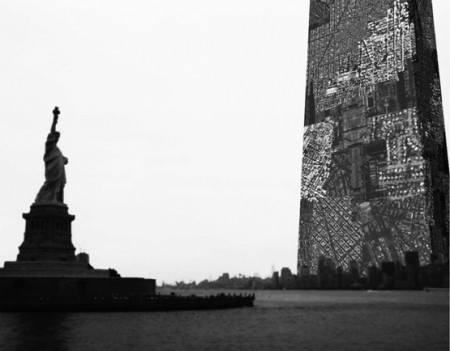
[IMAGE: TOWER OF BABEL - CENTRAL PARK EXTRUDED, 12 KM]

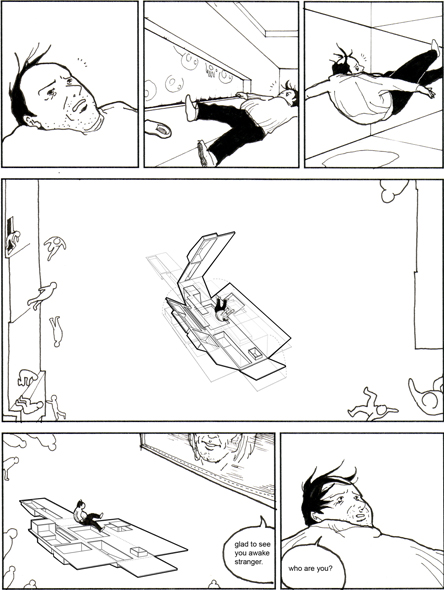
Jimenez Lai’s presentation at the Constructing Knowledge conference was the very last one but entertaining and thought provoking. Jimenez borrows his title (this and that) from Victor Hugo who claims that Architecture is dead and was killed by the printing press. Jimenez Lai is fighting the aparent uncoolness of architecture outside the academies and claims the cool. Using the power of ideology and narrative methodology, Jimenez draws architectural narratives in graphic novels with sceneries of direct references to architecture theory of fx Rem Koolhaas in this story – the tower of Babel (Delirious New York) in which Central Park is extruded to the limits of the stratosphere.


[Image above: Cartoon by Jimenez Lai]

 
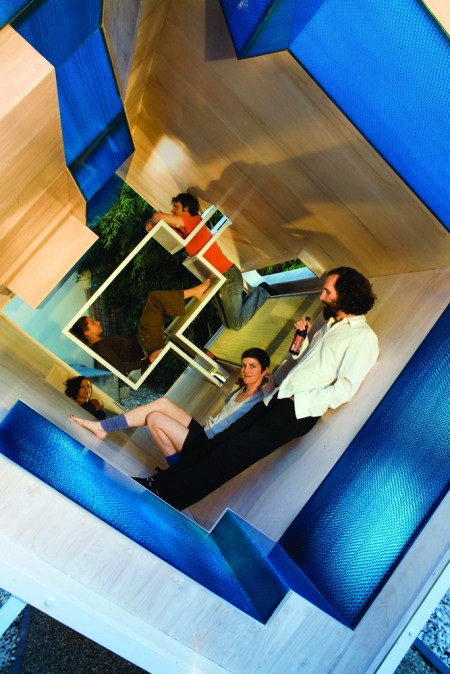
[Image: Phalanstery Module (2008) designed by Jimenez Lai, Photo by Scott Mayoral ]

Another project is derived from travelling in space for generations in order to get to distant planets where the human race can live...When weightless in space Jimenez considers how plan and sections must constantly change. Jimenez has built a physical model for a capsule for weightlessness during which the object and/or user will rotate and all elevations of an object become plans. As such, all surfaces can be inhabited. The pavillon turns 360 degrees in one hour. Here's Jimenez web site Bureau Spectacular.

Tuesday, November 3, 2009

Constructing Knowledge, part II

The hard part in participating at a conference on Knowledge is of course that the question of Knowledge gets addressed to myself – how do I generate knowledge, what is it, at which part of my work does it ‘arrive’. Yikes – not that easy – but the question of knowledge is a framework to look and reflect on my production during the thesis work until now.

3 knowledge generators
Hmm – I have three references to look at from the past six months: a workshop with 60 first year students at the Royal Danish Academy of Fine Arts, School of Architecture; the chairs experiment described here; and the full scale cast in Vermont introduced here and here. This post will get into the 'chairs' because, in a way the chairs experiment is a sort of physical summary of previous literature studies. Literature, objects, images and lectures on the topic of fabric forming all remain theoretical. Only by testing techniques and adding some personal thoughts on details or function do I or anyone generate knowledge – I know  
you can describe the techniques and the feeling and even show it – not until you actually try it do you get an idea of what this could lead to - sort of like kissing.

Except, and thank you Rikke-Julie for that note - when it comes to the knowledge of kissing, that’s a pretty straight forward goal to pursue, you pretty much know what you’re searching for. When it comes to the architectural exploration of a completely new technology it really doesn’t seem all that simple. What is simple is that the continuous exploration of form and matter – more than just access to sources of descriptive knowledge and reflection and more than experience alone, creates something – let’s call it knowledge – great, so this is what all designers and artists do and have done forever.

Reactions
An extra point of entry comes when the physical object exists with all the layers of reflection and acquired knowledge hidden behind the actual presence of something… it calls for a reaction from others than the maker – reactions, associations, references, discussion, more knowledge – and only because it exists. This shared knowledge is created by an actor network I guess – this is a theoretical approach to the world that I’m still not sure of how to use or if I really want to use but in these lines it does make sense.

[IMAGE: DISCUSSION ON CONCRETE AND SUCH
ON THE BASIS OF A PHYSICAL OBJECT] 

Experimental tectonic practice
A sort of finish in this weaving post is that this might just be the beginning – experimental tectonic practice which is the method of my thesis work - is all about generating knowledge. And like getting the knowledge of kissing, practice is fun!

Constructing Knowledge, part I

I’m on my way to a conference in Aachen, Germany with the broad title Constructing Knowledge. The conference is a celebration of the inaugural (first) issue of a new peer reviewed architectural journal – CANDIDE. Journal for Architectural Knowledge. The name is taken from a fictional character of Voltaire, Candide who travelled on an eager but often disappointed search for knowledge. For now, I'm yet eager and really quite excited about the journal – and the fact that the theme is knowledge and not research; this has the potential of really opening up for a wide range of interesting entries, methods and media which again could generate a wide audience amongst architects and others interested in the field.

What is knowledge in architecture?
So – the opening conference has the title Constructing Knowledge and some open question regarding what is knowledge in architecture and architectural production – what is research by design (or should I say knowledge?); “Do we search for or generate architectural knowledge?”; and not least: “Why should architects write when what they do best is design?” with subtitles: “Architecture, fiction and other stories” and “The digital turn after the ‘end of history’” the black box is open.

Knowledge and fabric forming
The next post will be on knowledge and fabric forming. I'm presenting a poster at the conference and out of four main topics my contribution has been labeled under three of them already - by the organizers that is - I'm not sure myself either to which part of the Knowledge Construction the practice of experimental tectonics belongs.