Showing posts with label Chairs. Show all posts

Sunday, August 11, 2013

Cool fabric-formed contrast - Christian Flindt and Contec

[You need to know in order to notice - I love the contrasting combination of classic furniture materials like wood and upholstered seats with concrete sprayed in flexible molds. Design by Christian Flindt. Photo via]
[Fabric former and he is handsome too - the Danish designer Christian Flindt. Photo via]

It is about time I introduce you to some fabric formed concrete designs by Danish designer Christian Flindt. He may be one of the first designers to combine flexible formwork and sprayed high-performance concrete for design products. That is designs intended to actually be reproduced in greater numbers. I first came across his use of sprayed concrete on fabric molds when my mother (sweetheart, yes) sent me a cutout from her newspaper interview from when Flindt was invited to participate in the competition to make new designs to refurbish Iconic UN assembly Finn Juhl. Since the interview was from during the competition I have not seen any images – and they are not se clearly seen on Flindt’s web site – you really need to know it when you see these images of the entry prototypes that combines soft upholstered seats for the long meetings, with an alternative to backs made from bent wooden veneer ply.
[Look again - the dark finish and the back of the classic chair design is not leather nor is it wood but the smoothest concrete. Design by Christian Flindt. Photo via]

I, finally, found the images of the fabric-formed chair in a lovely hiding place of a company web site today – Contec-prefab - another treat for you, is the high-performance concrete division within the Danish company Contec. While I tend to feel stupid when a company this relevant for my concrete endeavors slips under my concrete radar – I really wish that companies would invest in being searchable online. Oh well. It turns out that Contec and Flindt have teamed up and I really love their work.


[GFRC and wood. Images from the design prototypes for the Finn Juhl Hall. Design by Christian Flindt. Photo via]

I have always had a soft spot for the contrast between the materialities of concrete next to other materials like wood or steel. – Italian architect icon Carlo Scarpa was my first encounter, the amazing Castel Vecchio. I really, really want one of Flindt’s tables where he combines wood and smooth high strength concrete. The accuracy and finishes are great!!

Oh – I nearly forgot – look at the façade prototypes in colored concrete. 

[Facade panels. Design by Christian Flindt. Photo via]

I look forward to more fruitful collaborations by Flindt and Contec. – and I hope that manufacturing technologies soon will make it economically feasible to produce sprayed concrete panels and furniture in flexible formwork in the limited numbers...

The Arizona based design-builder-educator Gore Design is another goodfella using GFRC and flexible formwork. - They do design and manufacture/contracting themselves – but you already knew about that, right?

Wednesday, September 12, 2012

The French Sister of the Ambiguous Chair

This summer I received a letter from a group of French students. Using the step-by-step descriptions in the book DIY Furniture Design the students of a technical school in Le Havre had managed to produce a sibling to the Ambigous Chair, we could call it la Chaise Ambiguë.
[Bérénice Martin, Lucie Tramoy, and Édouard Vermès in front of their Chaise Ambiguë]

It was so pleasing to see these guys taking on the task of constructing the chair - it was definitely the more complex of the do-it-yourself examples in the book, and I must admit that I didn't really expect anyone to have a go at it. Now I am pretty sure that these guys may have been smitten by the concrete fever - the active knowledge of constructing with fabric formwork has now reached France and the narrow community of fabric formers has increased with its youngest members yet :)

The point goes beyond my own personal pride but states an example of how to share knowledge of something bound so heavily to the experience of the hand through making. The step-by-step approach is one way and using the scale of furniture to explore principles of construction allows much freedom.

See images of the work process below that follow the instructions in the book perfectly - all pictures by Édouard Vermès, Lucie Tramoy, Bérénice Martin, and Hilly Saint-martin Vincent of Lycée Auguste Perret. Le Havre, France.


[yes, despite its soft looks the chair is heavy]

[La la Chaise Ambiguë]


Wednesday, August 10, 2011

Stitching concrete

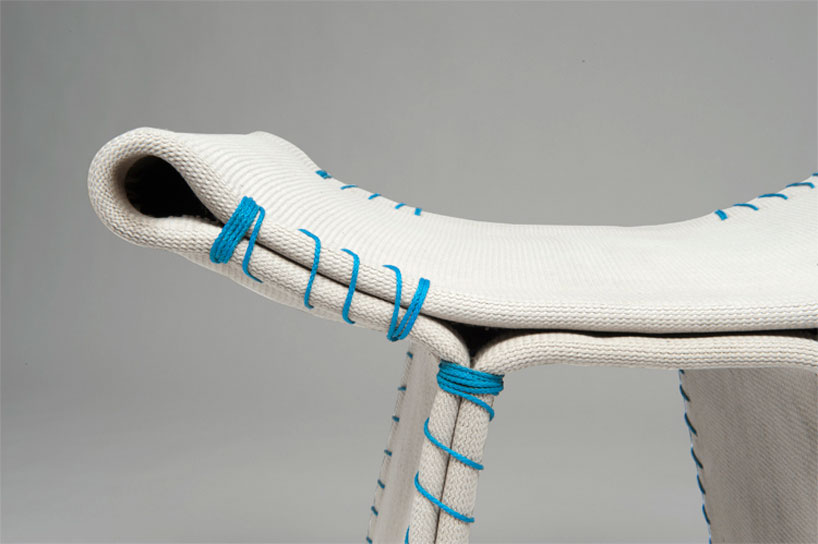
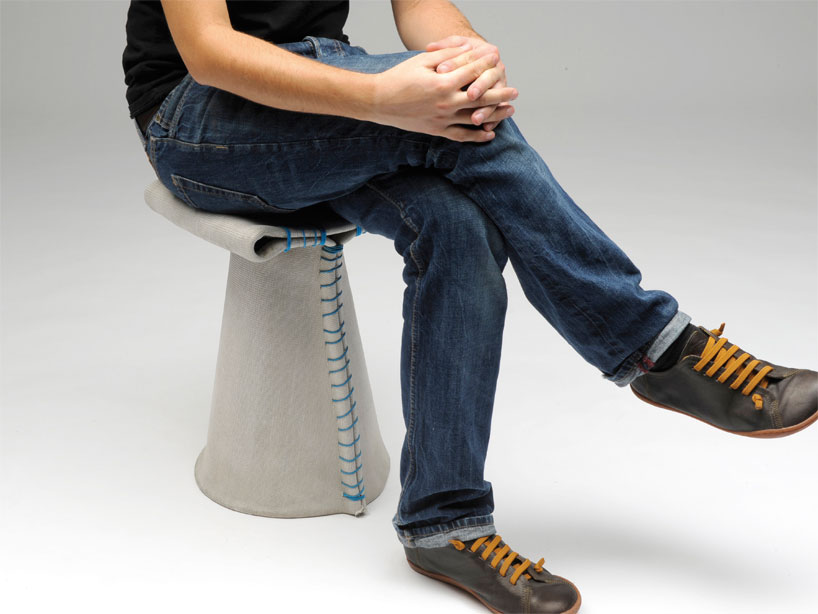
[Concrete Canvas is formed, stitched and watered - and you get a concrete stool. Via]
Furniture and especially chairs have a great scale to test new (or old) material principles at a manageable size and weight and stripped down to essential production details that mean much if not everything to the concept and tectonics of the piece. I enjoy as well how the stool has a recognizable function, the socalled affordance, that make you immediately judge even images based on your own bodily experience.


By now several concrete design pieces have made it to your Concretely blog - [just search 'chair' on this blog to check out a few]. German designer Florian Schmid's stool seem particularly tactile and the production principle is wonderfully easy to grasp.
Below project is via this post on Designboom.
"German designer Florian Schmid has developed 'stitching concrete', a project which has been influenced by the contrasts of the material Concrete Canvas
Concrete cloth is a flexible cement impregnated fabric that hardens on hydration to form a thin, durable water proof and fire proof concrete layer. it combines the softness and warmth of fabric with the stability of cold, hard concrete.
[It looks like felt but it's concrete. Via]
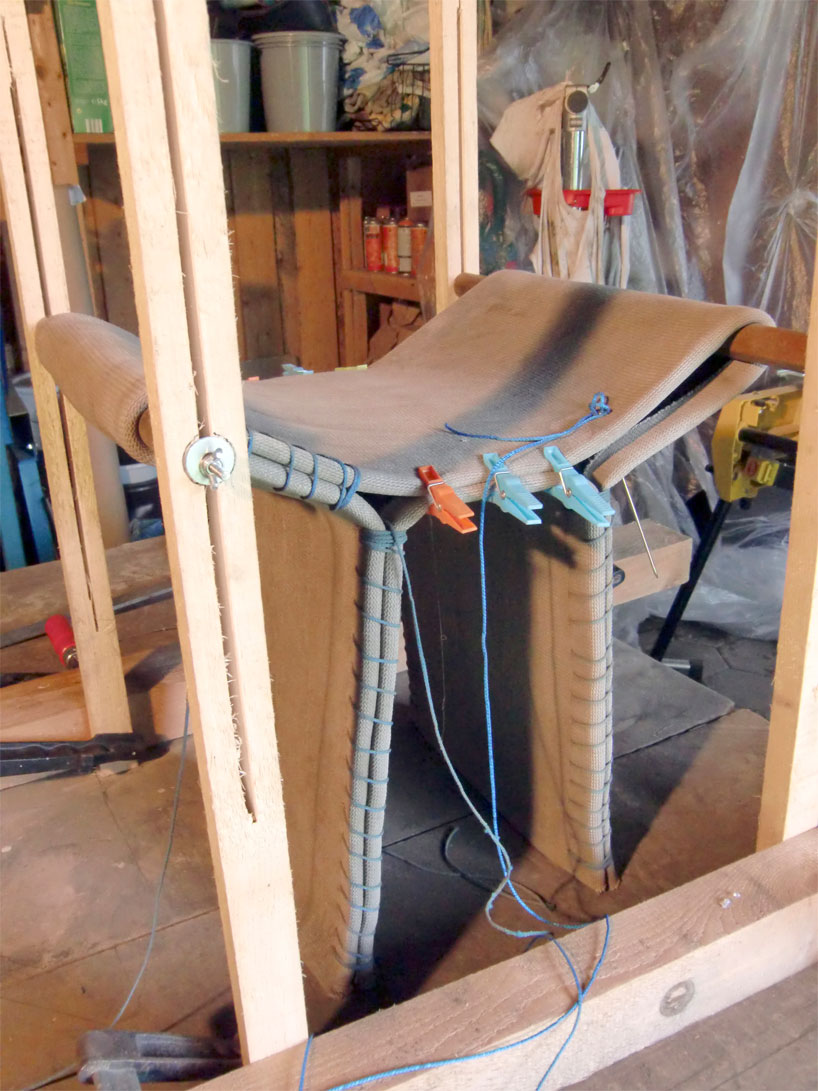
[A rig supports the textile structure as it is formed, sewn, watered and finally cured to be a concrete textile stool. Image via]
To create each stool, Schmid has built a special wooden rack that is used as a mould in which he forms the concrete canvas around it.
The device gives hold to the material during the watering and drying process in which the exposed seams are sewn together with either blue, red or yellow string providing extra stability and reinforcements. Once the stool is hardened, it can be removed from the mould, which always remains the same, but can be adjusted according to the different heights, lengths and widths of the objects."


I think I'll drape and sew myself a concrete summer cabin one of these days ;)
Concrete Canvas is introduced in my blog post 'Shake, drape and bake' here


Thanks, Diederik for sending the link

Tuesday, July 19, 2011

Fabric formed concrete chair in print

It's summer and I'm trying to finish writing my thesis on fabric formwork - it's hard work - but something look forward to while working is the launch of a design book that features my Ambiguous concrete chair.
The cover of DIY Furniture, image from the publisher

"DIY Furniture: A Step-by-Step Guide" is edited by Christopher Stuart. Chris has worked hard in getting all the designs together and to finish the book - I'm proud to be included and i can't wait to see the result.


The publisher Laurence King Publishing writes about the book:
"Featuring 30 designs by leading designer-makers from around the world DIY Furniture shows you how to use simple techniques to make stunning designer furniture from scratch. 
Along with designs for seating and storage, the book also features projects for making your own bed, wardrobe, lighting and garden furniture. Each project features hand-drawn diagrams with short, easy-to-follow instructions on how to build the piece. 


All the projects can be easily assembled using common materials to be found at the local hardware store, allowing the reader to create unique designer pieces at a fraction of the normal cost. Brief biographies of all the featured designers are included at the end of the book"

The chair will be among 30 designs that you can make yourself - I bet the concrete chair will be the heaviest of them all.
The Ambiguous Chair - se more images here
Detail of Ambiguous Chair cast in fabric formwork.
Please, do share with me if you get inspired to make your own fabric formed concrete furniture.
Info about the publication:
Paperback
270 illustrations
144 pages
245 x 210 mm
ISBN 978 1 85669 742 2
£17.95
Published by Laurence King Publishing, October 2011

Wednesday, November 17, 2010

Eternit chairs explores production

I enjoy the curious look by Rainer Mutsch into the production facilities at Viennese composite concrete company Eternit. Eternit is the commercial name for fibre reinforced concrete normally used as flat facade panels.

Rainer Mutsch (1977) is the recent designer who've added to the range of design products produced along with the weather boards.
[Image of the three modular types in the Dune series, from Mutsch's website]

Mutsch informs on the background:
When I saw the very first Eternit – machine, I was amazed: 20 metres long, more than 100 years old and by now of course upgraded with high-tech computers, the very heart of the machine is still the cast-metal construction built back in 1905. This impressive device survived 2 world wars and is until today producing a material which is sold worldwide.

[Image from the production, photo  from Dezeen]
[Image of Dune chair during production, Photo from Dezeen]

[The shell and the mold, photo from Dezeen]

[Video of the production process]

Loop Chair - the forefather
If you think the design looks familiar you probably recall the forefather of Eternit Chairs - Mutsch's design is indeed inspired by Swiss Willy Guhl who designed the iconic 1954 Loop Chair - still in production by Eternit.

[Image of Loop Chair, by Willy Guhl, 1954]

Mutsch quotes Guhl (1915-2004) who said:
“there is no ‚good’ or ‚bad’ material, what makes the difference is its right and adequate use.”

Friday, July 2, 2010

Forms and surfaces cast in fabric formwork

I used the nice sunny weather to take some concrete samples - and one of the Ambiguous Chairs, which I have written about here - outside for a bit of documentation.

I never actually managed to take any photos of the chair before so this was about time.

[Image of fabric formed concrete chair by yours truly Anne-Mette Manelius. Photo by Rikke Grendal]

[Surface detail of fabric formed chair]]

Below are a few surface samples I cast a while ago during a workshop I taught but never got around to document. The samples are cast in rigid formwork with fabric treatments - my favorite is the flowery one first one below because subtle changes in the light - or the position of the viewer - makes a huge difference in the experience of the concrete surface.

[Image of concrete surface with embedded silver fibres]

[Image of the same flowery concrete surface - in a different light the surface appears more neutral]

[Image of concrete surface with embedded fibres from fabrics]

[Image of concrete surface with embedded sequins...]

[Another image of concrete surface with embedded sequins...]

Fun as it would be to have a drag queen concrete surface (I mean - a concrete surface with thousands of colorful sequins) - one might as well paint the surface after the pour...

Friday, March 5, 2010

Ambiguous chairs - a surprice encounter with concrete

In order to generate discussion of the architectural perspectives of a new building method it seems crucial, constantly to expound on aesthetical as well as technological and structural aspects which are balanced in an integrated architectural practice.

Facing concrete's image -  If nobody likes the idea, never mind how clever the technology.
Besides these issues, the social notion of concrete can be seen as a barrier for initiating a discussion of the implementation of a new concrete technology: Concrete is the most used building material in the world - yet still the cultural image of concrete is really challenged in this part of the world and concrete surfaces are thus seldomly left exposed.
[Anne-Mette in the fabric formed concrete chair /photo by Johannes Rauff Greisen]

The following is a summary of my paper I presented at the Structural Membranes conference in Stuttgart last October – the session on flexible moulds was small but fun amongst a lot of more heavy engineering papers. My part presented a sort of a social experiment done as part of my thesis work on fabric formwork for concrete.

[Detail of fabric with large washers and bolts]
Below is a detail of the concrete surface cast in the fabric above.
 [Detail of concrete surface cast in fabric]

A surprise encounter with concrete
So – since fabric formwork already has ambiguity within the term I decided to create a piece of furniture with the same ambiguity. The specific experiment is the design and production of two fabric formed chairs. The exploration includes presenting to the observer physical objects of a familiar function and scale, but containing ambiguities of the materiality, construction and affordance.

Optical appearance vs haptic perception
The mentioned ambiguities concern optical appearance vs. the haptic perception and information which comes when touching the object and from the act of sitting down. Using fabrics for furniture and thus getting some associations right that come with the function of a chair: Fabric, patterned surface structure and a bulging surface are all associated with the notion of an upholstered chair such as the Chesterfield.

Upholstery fabrics for casting furniture
It seemed a natural choice to use upholstery fabrics for casting a chair in fabric formed concrete. Architecture students at University of Edinburgh have studied the aesthetic surfaces of concrete cast in a number of conventional fabrics bought at the local fabrics store, including both very thin and cheap materials and more sturdy fabrics for upholstery. It was the intention of using upholstery fabric that the pattern from the fabric would transfer to the concrete surface making the appearance of the chair even more ambiguous to the observer.
[Detail of concrete surface cast in fabric]

An observer remarked: “I looked at the chair and in my head I knew it was concrete and couldn’t understand that it wasn’t fabric. Then when I sat on it, in my head I knew it would be hard but I was still surprised to find that the chair wasn’t as soft as it looked.”

Since this conference I attended another one, in Aachen, entitled Constucting Knowledge. I presented a poster in which I further elaborated on the work with this chair and propose it as a physical summary of my literature studies.

Tuesday, November 3, 2009

Constructing Knowledge, part II

The hard part in participating at a conference on Knowledge is of course that the question of Knowledge gets addressed to myself – how do I generate knowledge, what is it, at which part of my work does it ‘arrive’. Yikes – not that easy – but the question of knowledge is a framework to look and reflect on my production during the thesis work until now.

3 knowledge generators
Hmm – I have three references to look at from the past six months: a workshop with 60 first year students at the Royal Danish Academy of Fine Arts, School of Architecture; the chairs experiment described here; and the full scale cast in Vermont introduced here and here. This post will get into the 'chairs' because, in a way the chairs experiment is a sort of physical summary of previous literature studies. Literature, objects, images and lectures on the topic of fabric forming all remain theoretical. Only by testing techniques and adding some personal thoughts on details or function do I or anyone generate knowledge – I know  
you can describe the techniques and the feeling and even show it – not until you actually try it do you get an idea of what this could lead to - sort of like kissing.

Except, and thank you Rikke-Julie for that note - when it comes to the knowledge of kissing, that’s a pretty straight forward goal to pursue, you pretty much know what you’re searching for. When it comes to the architectural exploration of a completely new technology it really doesn’t seem all that simple. What is simple is that the continuous exploration of form and matter – more than just access to sources of descriptive knowledge and reflection and more than experience alone, creates something – let’s call it knowledge – great, so this is what all designers and artists do and have done forever.

Reactions
An extra point of entry comes when the physical object exists with all the layers of reflection and acquired knowledge hidden behind the actual presence of something… it calls for a reaction from others than the maker – reactions, associations, references, discussion, more knowledge – and only because it exists. This shared knowledge is created by an actor network I guess – this is a theoretical approach to the world that I’m still not sure of how to use or if I really want to use but in these lines it does make sense.

[IMAGE: DISCUSSION ON CONCRETE AND SUCH
ON THE BASIS OF A PHYSICAL OBJECT] 

Experimental tectonic practice
A sort of finish in this weaving post is that this might just be the beginning – experimental tectonic practice which is the method of my thesis work - is all about generating knowledge. And like getting the knowledge of kissing, practice is fun!