Showing posts with label Adrian Forty. Show all posts

Wednesday, August 28, 2013

Is concrete sustainable?

In the book Concrete and Culture by British architectural historian Adrian Forty that I wrote more about here, his interest in labor as a material is used to frame the subject of culture around the use of concrete. With themes spanning from sustainability and nature to art, politics and economy, and time/weathering, Forty discusses concrete as a symbol of all, or the opposite. Despite its historical nature, I really appreciate the pages that Forty invests in the crucial discussion about sustainability – is concrete a sustainable material or is it not! Cons point at the high use of energy to produce cement. Cement is made from baking its raw materials, limestone and clay, at 1450 degrees Celsius – conservatively stated, 5 % of the world’s CO2 emissions come from the production of cement. – it is hard to be precise because it is uncertain how much cement is actually produced, between 1.5 and 2.5 billion tons. A rule of thumb from traditional production is that the production of one ton of cement emits one ton of Carbon. Around 50 per cent of the carbon emissions are the result of the chemical reaction; around 40 per cent by the burning of fuel in the kilns, and about 10 per cent come from fuel to extract and transport the raw materials.

Forty discusses ways to reduce either the use of fuels and the amount of cement used - the most effective way to decrease the carbon emissions is obviously to limit the use – while maintaining the properties and quality of the end product – most extremely is to leave the hydraulic Portland cement out and use pre-modern building technology in an industrialized way. An example is hemp-concrete – in which lime and vegetable aggregate mixed with organic hemp fibers as reinforcement for a lightweight non-structural product, with sound-absorbing properties.
[While hemp is naturally growing, one could then discuss whether crops should be grown to supply the World population before building blocks?]

Forty describes aspects of an important and more complex issue of energy use in building which means that one cannot rule out concrete as the biggest energy sinner. While concrete is heavy on carbon emissions during construction, figures from the British Concrete Centre estimate the ‘typical’ 60-year life of a building that about 10 per cent of its CO2 emissions are attributable to construction, and about 90 per cent to heating, cooling and lighting. 90 per cent. This indicates clearly the importance of focusing on the energy use and culture over buildings’ lifetime. Furthermore, heavy buildings (brick and concrete) heat and cool slowly due to the thermal mass. This means that these building types tend to overheat less than more lightweight structures – and will do so in the estimated steep rises of summertime temperatures.

I hate it when I feel like a used car sales person by pointing out benefits – my aim is to add some nuances to the good concrete vs bad concrete (non-)discussion. Judging by the quotes and the references Forty's section may have been written in 2009. This book will be read in ten and twenty years from now so accurate numbers is less important than and the multifaceted approach to the topic. The ten pages about the issue are obviously very general but highlight aspects of the topic of sustainability, of development and the politics and the blame pushed around in the world between the developed and developing countries.
The Concrete Centre uses a ‘typical’ age of 60 years for a building… what does that mean? – for sustainability’s (and everyone’s sake) build beautiful buildings. I heard partner Stephen Kieran of the architectural office Kieran Timberlake say something like this at a debate once: If architecture is ugly it will have a very short lifetime and will never be sustainable. Could this then, please, become a more prominent parameter in the various (expensive and thus complicated) certifications of buildings that pop up everywhere?

For more on the discussion about certifications and sustainability, do keep an eye and ear out for the talented architect and researcher Jan Schipull in his research and architectural work - as soon as he breaks the surface for fresh air after his PhD-dissertation-writing race. (The only decent link that includes some of his work is this presentation about Sustainable integrated product deliveries in renovation and new building construction)

The numbers in this post are all based on Adrian Forty's Concrete and Culture, a Material History, 2012

Concrete wilderness - Adrian Forty's Concrete and Culture - review

If not at the Concretely Blog then where? - I actually wanted to write a review on British architectural historian Adrian Forty's "Concrete and Culture, a Material History", published in 2012. But I haven't really finished,- so here is my recommendations to get the book as well as a few examples from the ten chapters framing dualities of concrete in regards to culture and architecture, the never changing paradox of concrete.
[Cover of Adrian Forty's Concrete and Culture. Via. Despite the beautiful picture on the cover, Forty has made a virtue of leaving out the money shots and this book is not a coffee table book - Forty has instead taken most of the photos himself and planned the research for the book to involve immense traveling to Japan, Brazil, Italy etc- oh the joy of being an architectural historian]

Anyone with an interest in concrete or in the discussion of how we understand and use concrete in architectural constructions should check out the book by British architectural historian and Professor at the Bartlett, Adrian Forty. I have been anticipating the publication of Adrian Forty’s book on concrete since I read his 2006 article ‘A Material Without a History’[1]. The article is much quoted for stating the somewhat obviously, that “concrete, let’s face it, is a process not a material.” Following this claim, Forty adds human labor as an ingredient in concrete – as well as cement, aggregate, reinforcement and water. Human labor is obviously an ingredient in other ‘natural’ materials too in order to make stones a cladding, or a tree trunk become a beam etc. For concrete, the work and process about concrete is just crucial and also links to the cultural side of the use of concrete, which is Forty's main objective.
"The book has turned out to be more about architects and architecture than I would have liked. Yet there is a good reason for this, in that architects have paid more attention to the interpretation of concrete as a medium." p11
The research on concrete as a medium (more than a material - which makes sense, I guess, because concrete is the lazy way of describing a group material technologies and practices with cement in common) started around the year 2000. Not an architect, Forty is attracted to the material “because of the inconsistency and contradictoriness of much that was said and written about it, and because of the absence of any coherent account of it as a major component of the modern world.” Forty says, “My work is not so much to increase detailed knowledge of the history of concrete, but rather to develop a general argument about concrete's role in the modern world, as well as within architecture.” [From the Bartlett profile on Forty accessed 26 oct, 2011]


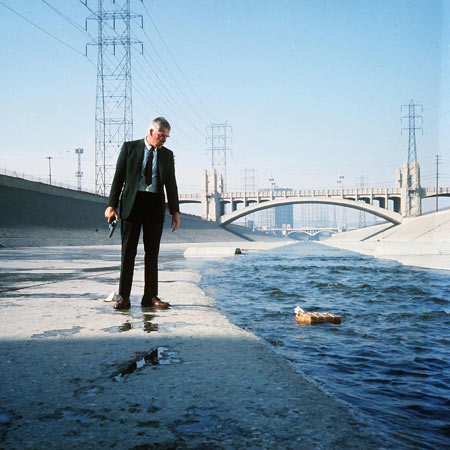
[Lee Marvin as Walker in Point Blank. Via]
In the chapter on Concrete as Natural or Unnatural Forty discusses the changing views on concrete as a natural 'cultured stone' or a more unnatural, artificial building material. The continuous issue of weathering is discussed but also how concrete landscapes are used by film-makers. Though I have not seen John Boorman's 1967 Point Blank starring Lee Marvin, I especially enjoyed Forty's analysis of the use of empty concrete landscapes of Los Angeles taking the place of the classic and symbolic dessert as location. In scenes set against concrete, "men are tested, and sometimes destroyed." (p61)
[Image from the book of the reinforcement placed prior to the floor being poured in a villa by architect Rovelli. From the Hennebique archive. Image link via]

Concrete and photography is the topic of one of the interesting chapters of the book. The architect and scholar Guan Lee of the amazing Grymsdyke Farm was the first I have come across who used this comparison between the process as well as history of photography and concrete. His doctoral dissertation from the Bartlett has not yet been examined. Until then, the chapter written by Forty (also from the Bartlett, remember) offers one aspect of photography and concrete. The early pioneers such as Hennebique and Frank Gilbreth used the photographic medium commercially. Hennebique used photographs in advertisements to sell the systematic and well-proven methods using licensing. The photos had great compositions and were conveying the qualities of the product: its monolithic nature; the precision of the placement of reinforcement (which was invisible but essential features that the client could not see in the end product) – Frank Gilbreth used photography for management - quality control in order to document the construction process on remote construction sites.

Falling apart
One big shame and great nuisance is the fact that most pages have fallen out of the copy of the book I got out of the library. It is ironic that a book about a sturdy building material is not able to stay together. I hope the copy I have ordered for myself may be from another batch, that reprints will solve this major embarrassment of the printer’s. For now, I will have to tie a pretty bow around the library book for other poor readers to deal with as well as trying to make a virtue out of it when I get my own copy.


[1] in [Forty,A. (2006), 'A Material Without a History' in Cohen,J-L., Moeller,G.M. (ed.) Liquid Stone: New Architecture in Concrete, New York: Princeton Architectural Press, (ISBN: 1-56898-570-3), 34-45.] 2006