Showing posts with label Bench. Show all posts

Friday, April 12, 2013

898 - Fabric-formed concrete couch

Inspired by the previous post about Nacho Carbonell's soft concrete, here's a few images from my own backyard.


898 (kg)
Carbonell's 'soft sofa' reminded me of something that I haven't shared with you - so here's another one - a couch cast by my students during a TEK1 workshop in 2011. The focus in the workshop was on exploiting sharp edges and curved surfaces. The theme was benches but this piece is more of a couch-thing than a bench.
The 898 is cast in fabric-formed concrete. The edges of the furniture is controlled and cut out of rigid plywood. Its surface, on the other hand, is made to appear soft and cast in fabric restrained with a garden fence netting.
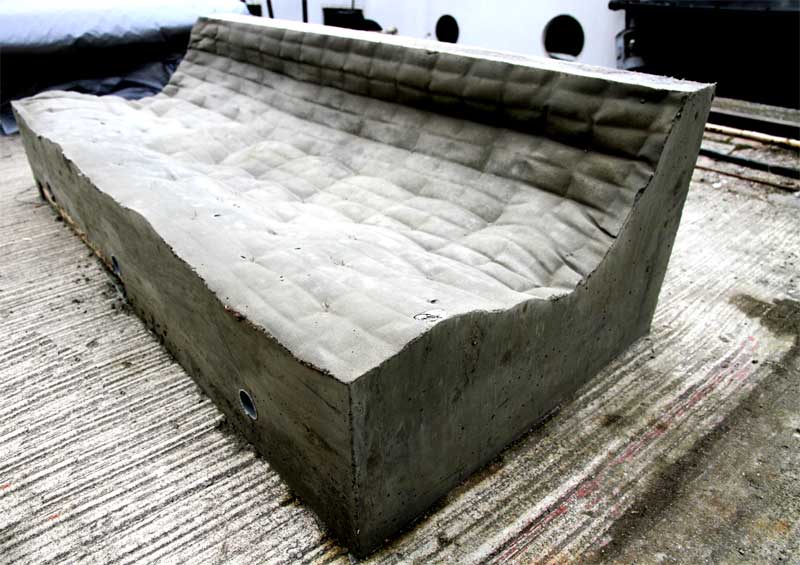
[898, couch. From TEK1 concrete workshop at the Royal DK Academy, School of Architecture]

The title of the piece, 898, refers to its calculated weight... The really attentive Concretely reade, may recognize the surface. The students who made the 898 were inspired by the expression of an earlier fabric-formed piece for which the forming method was also its expression.
[Fabric formed concrete surface from 'Wall de Mort'. I discuss the project in my PhD dissertation - and regret to admit that I changed its funky title to the Net Wall... ]

898 couch by:  Cisse Bomholt, Philip Messmann, Michael Sivertsen, Maja Kozak Dehlin, Amanda Lilholt, Mathias Rasmussen, Søren Rosendahl Svare and Kenni Bruun Rasmussen.
Wall de Mort by: Siri Reisæter Rasmussen, Astrid Asmussen, Rasmus Gosvig, Christian Bencke Nielsen
TEK1 teachers, 2011: Anne-Mette Manelius, Finn Bach, and Johannes Rauff Greisen

Dutch concrete sofa

Continuing to share old news, this piece of old news (to me) is still much more recent than Mr Englund's 60's work. The Dutch designer Nacho Carbonell designed the prototype for a concrete couch cast on site in flexible formwork. - back in 2007. - it is in fact more a designed process than an object.

[Soft Concrete by Nacho Carbonell, 2007, image via MatandMe]
See more images of the piece at the designer's website

Carbonell writes about the prototype: "The idea of the process defining the final shape of the object, is something that has always interested me. You cannot have total control, the materials are alive and do what they want. I just give them boundaries, against which they can react with freedom, always surprising me. They are my best partners and my source of inspiration. Experimentation is my way of translating a concept into an object. Here I created bags of different shapes. Once the bags are filled up with concrete they reveal their final shape and function, in this case a proposal for a bench for outdoor purposes. The concrete is first colored, then poured into the bags. Once these are ripped off, the furniture  achieves a friendly, funny and soft look as well as a beautiful texture imprinted on it by the material of the bags. Another aspect that is very interesting about the project is the possibility of creating it on the spot, allowing it to be integrated better into the surroundings." via

While discovering Carbonell through the fabric-formed lens, I admit to enjoy the development of his work away from the solid to the more spatial, it is so much tighter. He has made some collections of spatial and communicative structures that are light and textured and architectural sculptures that I would love to experience live. Check them out here.
[Communication Line by Nacho Carbonell, via]

898 in Copenhagen
Pardon the jump but Carbonell's sofa reminded me of something in my own backyard that I haven't shared with you - so see the next post here.

Sunday, September 25, 2011

The textile block - Lloyd Wright vs 3d printing

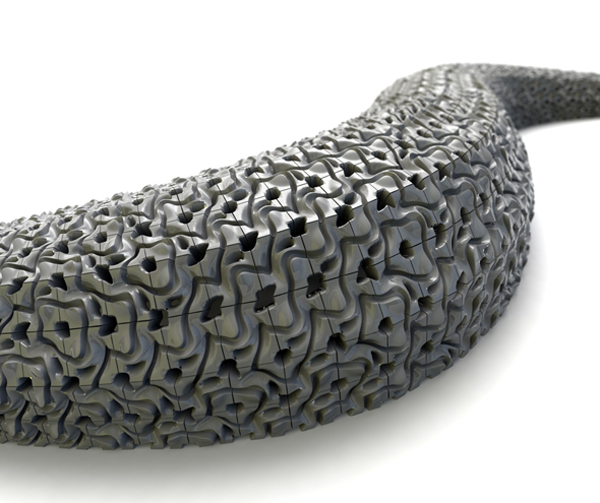
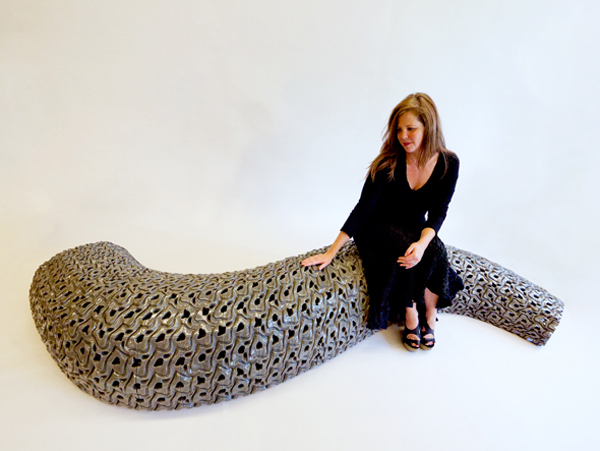
Here is what concrete could be - or is - if you include the ever expanding group cement based composites to your conception of 'concrete'. And better get used the look because 3d printing has never been cheaper and more available with this new fusible mix. SeatSlug is the first 3d Printed Bench at a Low Cost / Rael San Fratello Architects.

[Image of the G.M Millard House aka La Miniatura, the first of a series of houses where Wright explores the textile block. Via Coletta Design Blog.]

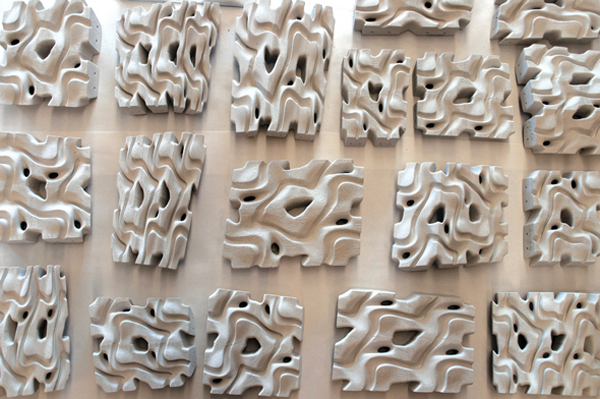
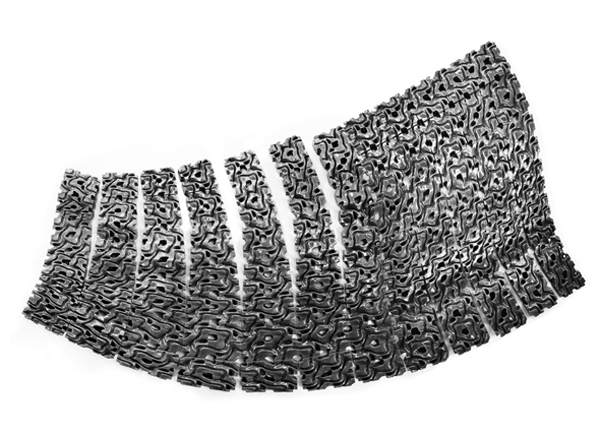
It is also quite the take on the 'textile block', the concrete unit developed by Frank Lloyd Wright for La Miniatura and a series of houses where he explored this notion of a 'machine produced concrete block', perfect like an industrially produced fabric. This particular notion of 'textile concrete' also has quite new perspectives for architecture in the light of the 3d printed project. The 'textile surface' of the SeatSlug is comprised of 230 individual pieces. The textile elements printed for the bench makes me wonder into which form Lloyd Wright's La Miniatura would have been 'printed' today?

Below is via stumpleupon
The cement based polymer has a compression strength of 4700 pounds but cost up to 90% less than conventional fusible powders. Rapid 3d printing technologies have been traditionally used to create relatively expensive prototypes for industrial design or more recently small scale objects with low cost devices.


The promise of 3d printing for usable mass consumed objects seem to have been just around the corner for nearly a decade now. A new formulation cement-based polymer developed by Rael San Fratello Architects in partnership with the University of Washington and University of California Berkeley replaces more expensive powder mediums for large scale objects. The prototype SeatSlug bench is a demonstration project of the potential of the material and 3d printing process to make sophisticated large pieces using low cost, non repetitive objects. The bench is comprised of 230 individual pieces, each developed as a unique shape.


The SeatSlug is based on the shape of the recently discovered flabellina goddardi sea slug and surface inspired by karakusamon patterns, traditional Japanese designs. The unique shape is both functional and collectable with its provocative massing and highly polished finish, possibly with an eye to be built individually for higher end furniture stores or galleries. The manufacture of large scale merchandise as low cost printed objects with hand assembly near the end user addresses the issues of scale and cost of high quality products, which are often not available to market due to restraints in supply and demand.


Via stumpleupon

Thursday, March 24, 2011

Concrete Benches cast in fabric

Wow, what a while it's been since my last post - well, as for now I've just finished a great workshop with 80 (yes, 80) first year students of architecture and architectural engineering. In a week's time the students had to design and produce a concrete bench: This included designing the formwork principles and building the formwork. Finally the students had to pour the pieces of around 300 liters each (750 kgs of concrete), and finally - strip the formwork and reveal the concrete evidence of the experiments...
[Students pouring the fabric formed concrete bench - and getting advice from the concrete sponsor, Unicon]
Here's an older post with some images of references to benches.

No blow outs
The pieces of this year's workshop weren't super tall - the tallest formwork was 140 cm high. Out of 12 pieces and 4 cubic meters of concrete, we had no blow outs - yipee - this wasn't really the case last year. Formwork pieces were all 2 meters high - and only one student piece survived in its initial state... read more about last years workshop here.

The Clover
Below are some images of the Clover Bench. More info to follow. Enjoy!
['Trekløver', the Clover. Fabric formed concrete bench. Student work at TEK1]
Do I need to say that the focus was on fabric formwork?
Besides being the subject of my research, fabric formwork has great potentials for introducing concrete to students of mostly no previous experience to either pouring or building formwork - in fact building anything yet :)

Formwork tectonics
First of all, building with light weight fabric lets you produce quite large structures just because the weight of the formwork structure is kept down.
More importantly (says the teacher) there's a structural hierarchy in building fabric formwork - an apparent material dialogue to be considered. The material dialogue is between the concrete and the three elements that the formwork is made out of: the frame holding the fabric, the fabric itself, and a restraining method to keep the fabric in tension and control bulges during the pour. 

Formal consequence
When the concrete is poured as an almost ruthless matter the formwork is really put to the test. All choices made during the construction of the formwork results in a direct formal consequence on the form and surface of the concrete.
[Fabric form for the 'Clover' - without the inner form, Student work]

Formwork statics is quite an interesting subject - designing formwork structures the students get a grasp of pure tectonics. Quite simple structural principles may result in striking concrete forms :)

[The funky inner form for the Clover. Students used scrap vinyl flooring to create a smooth surface inside the bench. Student work]

Credits to the members of the Clover team who built the formwork shown above: Alva Altgård, Symra Joner Andbo, Helga Hallgrimsdottir, Rasmus von Wurstemberger Nielsen, Marie Rugholm Nielsen, Andreas Klestrup Hansen. Students study at RDAFA or DTU

The workshop was part of a course held by the Institute of Technology and co-teachers were Johannes Rauff Greisen and Finn Bach