Showing posts with label CAST. Show all posts

Wednesday, December 21, 2011

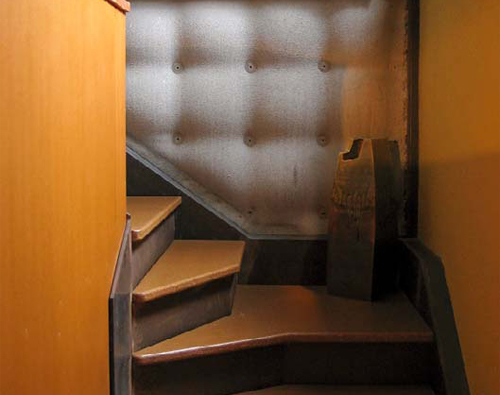
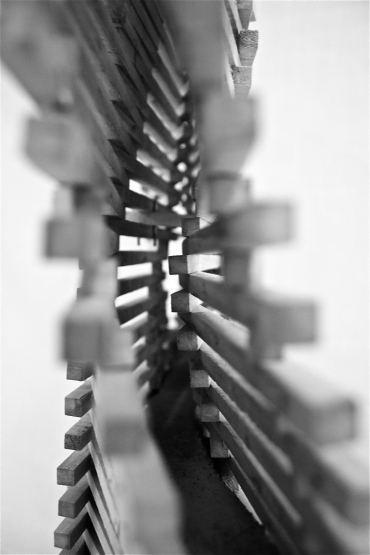
Flex Form by Allison Adderley

Building Matters is a blog compiled around the wonderful experimental thesis work of permanent, flexible formwork of Allison Adderley, architecture student at the University of Buffalo in the state of New York.
[Flex Form via]

"Typically, formwork is understood as a temporary building element, often being discarded and seen only as a construction tool, rarely a component of the final design.  This proposal explores the opportunity of employing formwork as a permanent building element, thus incorporating the formal elements inherent in building within the final form itself," Adderley states
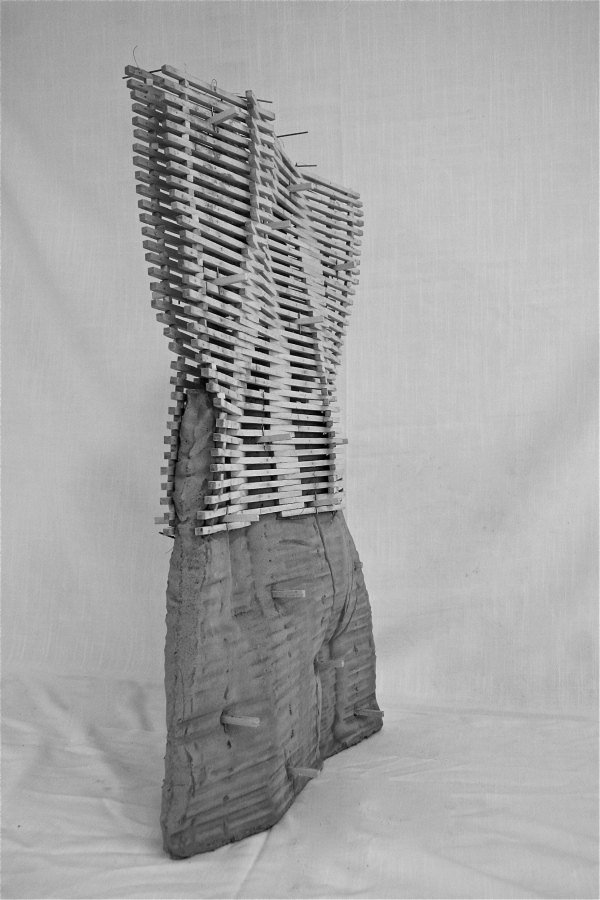
[A very 'textile' formwork principle for a permanent formwork principle, "Flex Form" via]

Some of Adderley's formwork principles are permanent, and some 'just' leaves a permanent, formal consequence of the construction principles behind the formwork structure. I share this interest with Adderley in practices of molding and the relation between the mold and that which is molded. Basically, what I like to call 'formwork tectonics.'

Adderley introduces her abstract and theoretical references, Gottfried Semper, Kenneth Frampton, and Gework Hartoonian, and how she uses these theories. In this sense, find inspiration in the blog as a nice way to present rigorous, experimental and poetic work.

Semper's theories of the transformation of textile principles to methods of 'weaving' and 'dressing' facades are evident in the above experiment.

There is also a nice gallery of photos from a visit to the laboratory of CAST at the University of Manitoba. Adderley is obviously inspired by the work at CAST but has found her own way of investigating the roles of the fabric in formwork for concrete.
[Formwork detail, Series3 - Permanent Fabric (Suspension) via]
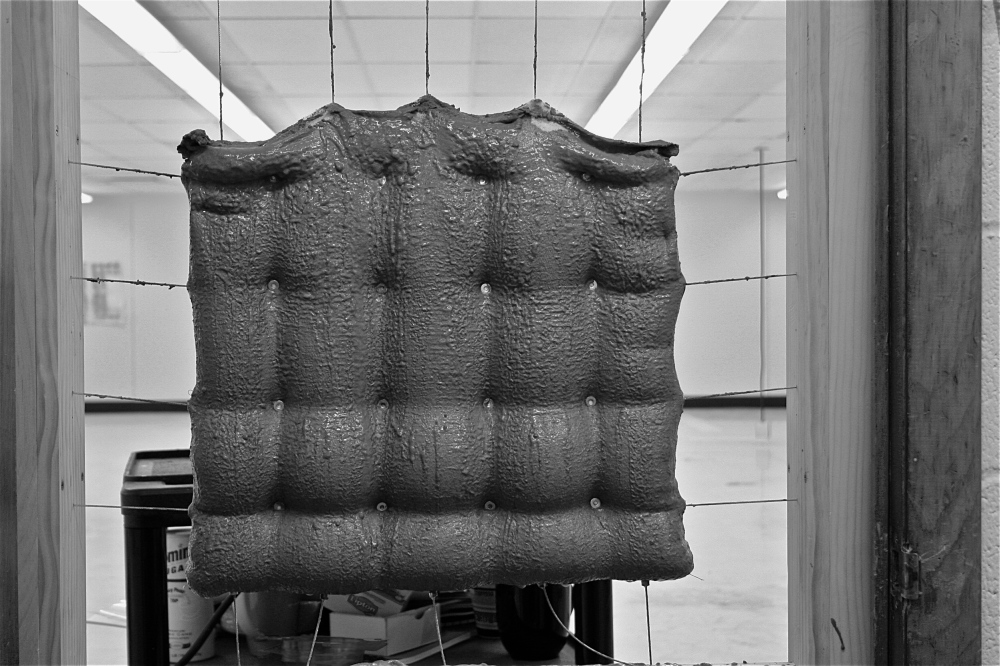
[Casting Series3 - Permanent Fabric (Suspension) via]

A goal in the abstract is to end the thesis work with a full scale cast, so more appears to come on the blog.
 Allison, I hope to see you at the ICFF2012 (World's Second International Conference of Fabric Formwork) in Bath, (UK) June 2012 :)

Tuesday, July 12, 2011

Lecture by Mark West

Mark West is the founder of the Center for Architectural Structures and Technology (CAST) at the University of Manitoba, Canada.
West is a pioneer of contemporary research into fabric formed concrete; recently he gave a lecture at ETH, Zürich hosted by the Block reseach group. Thanks to PhD-scholar and engineer Diederik Veenendaal who has sent me the link to the lecture on You Tube.
Above is the link to Mark West's lecture at ETH

Thursday, January 6, 2011

Thesis work on fabric formed concrete columns

Here's the abstract for a recently finished Master of science thesis by Farhood Delijani, University of Manitoba. Farhood posted a link to share on the Fabric Formwork Facebook group that you are so welcome to join.

The title of the thesis is: The Evaluation of Changes in Concrete Properties Due to Fabric Formwork

The work confirmed that fabric formwork is structurally safe alternative for forming reinforced concrete columns. The abstract found here goes like this:

"Fabric as a flexible formwork for concrete is an alternative giving builders, engineers, and architects the ability to form virtually any shape. This technique produces a superb concrete surface quality which requires no further touch up or finishing. Woven polyole-fin fabrics are recommended for this application.

A permeable woven fabric allows excess water from the concrete mix to bleed through the mold wall, and therefore reduce the water-cement ratio of the concrete mix. Due to the reduction in water-cement ratio, higher compressive strength in fabric formed concrete may be achieved, as also suggested by earlier research.

The current research study was conducted to investigate and document the changes in concrete strength and overall quality due to use of commercially available woven polyolefin fabrics. Use of fabric formwork will contribute to decreased construction cost, construction waste, and greenhouse gas emissions.

Two sets of tests were conducted as a part of this research study including comparison of compressive strength of fabric formed versus PVC formed concrete cylinders and comparison of be-haviour of the fabric formed reinforced columns versus cardboard formed reinforced concrete columns. Variables in this research were limited to two types of fabric with dif-ferent permeability (Geotex 104F and Geotex 315ST) and two types of concrete; concrete made with conventional Portland cement and no flyash herein called normal concrete (NC) and concrete with 30 percent flyash in its mix design (FAC).

The laboratory results revealed that fabric Geotex 315ST is an ideal geotextile for forming concrete. It was also found that the effects of fabric formwork on concrete quality in a large member are limited mostly to the surface zone and the core of the concrete remains the same as a conventionally formed concrete.

Even though fabric formed cylinder tests showed an average of 15% increase in compressive strength of the concrete samples, compressive strength of the reinforced columns did not dramatically change when com-pared to the companion cardboard formed control columns.

This research confirmed that fabric formwork is structurally safe alternative for forming reinforced concrete columns."


Congratulations to Farhood on his degree! It will be interesting to see if the fabric forming community will see more interesting work from him in the future.

Monday, March 29, 2010

Sensual and bizarre - cast in flexible formwork

I just came across the website of architect Ryan B. Coover. He has some beautiful pictures of his experiments with fabric formwork which reminds me of work I wish to share.

 [Image: Constraining system with strings and tubes (top); membrane and holes for columns (middle); Cast surface and columns seen from below (bottom), Photos by Ryan B. Coover]

Coover's images show a system to cast a voluptuous ceiling and fabric formed columns in the same pour.
It looks like images of plaster models made at CAST  maybe from Coover's time doing research or studies there.

Hands on at CAST
The approach to research at CAST is 100 % hands on in producing plaster models at a scale 1:4 and then do full scale in concrete.
 [The workshop at CAST with hundreds of plaster models everywhere. Photo by CAST]

If it works in plaster
Where others would say: don't try it in concrete if it doesn't work in a scale model in plaster - West has the approach which states: if it works in plaster it will not fail when cast at full scale.
So with this preaching in mind the principles shown in Coover's images should easily transfer to concrete. In fact the images above resembles facades by spanish architect Miguel Fisac.
The work of Miguel Fisac is well-known at CAST

The principle shown in the first image is a horizontal panel cast into a frame with a suspended membrane.
The flexible membrane will 'accept' imprints by objects placed below such as tubes, strings or dowels

[Image:concrete facade cast in flexible formwork of Centro social de las Hermanas Hospitalarias, Architect Miguel Fisac, Photo by Javier Azurmendi]

P-Wall and self-organization
Another architect who's been inspired by Fisac is San Fransisco based Andrew Kudless.
Kudless has explored the inter related consequences of two flexible materials: a plaster composite and a flexible membrane. He calls it self-organization of material under force

Self-organization is a theme in Kudless' work in general at his studio Material Systems or Matsys: "Matsys is a design studio that explores the emergent relationships between architecture, engineering, biology, and computation" from Matsys.

Wall at MoMA in San Fransisco
His latest piece shown below (2009) is part of a series of socalled P-walls (P for plaster?) starting in 2006 I believe. P-wall was commisioned by the Museum of Modern Art, SF and is exhibited permanently at MoMA in San Fransisco

[Image: P-Wall at SFMoMA by Andrew Kudless(2009), Photo from Kudless website]
[Image: P-Wall by Andrew Kudless consists of 150 plaster panels cast in nylon fabric over wooden dowls, Photo from www.matsysdesign.com]

Wednesday, March 10, 2010

Article about Fabric formwork in Concrete Decor

I haven't really written much about fabric formwork in general... fortunately the North American forum Concrete Decor has decided to publish an article introducing the technology to its readers. I've supplied info and an image to the piece but I'm actually still not really sure who or what is behind Concrete Decor - but once on the site you can search for suppliers and techniques - so I guess it's like the Yellow Pages for business within decorative concrete. Read the article here.

The article features most of the researchers and builders I know of who have done research and built using fabric forming tecniques - it even introduces my 'ambiguous chairs'. Among the featured researchers is CAST, my first and largest source of inspiration in this field. Center of Architectural Structures and Technology which the abbreviation stands for has an extensively informed website here. 
[Image: Concrete columns cast in fabric formwork, Photo by CAST]

 [Image: Detail of a fabric formed wall designed by Japanese architect Kenzo Unno who has deviced building methods called "Unno Reinforced Concrete." Photo by Mark West]
Fabric formed concrete sinks
I am not very familiar with fabric formwork used for design objects. The application of flexible moulds for slender but small scale structures seems to hold many perspectives. An interesting example is Gore Design Co based in Arizona, USA, which has developed techniques for forming GFRC sinks that seem really cool.
[Image: sink cast in fabric formed moulds, photo from GoreDesign Co]

Sunday, October 25, 2009

One Gaudí beam and fabric formed shells

At the recent Structural Membranes conference in Stuttgart, Ronnie Araya presented a paper on the current research at CAST. This summer Ronnie and his crew have produced a number of shell structures in a sort of composite formwork created by tensioned sheets of fabrics and padded frc. The methods are low tech and fairly simple; the structures are effective in using only a minimum of materials to obtain structural properties; and the images of the structures are just beautiful.
 
[image: formwork and cast shell structure in fibre reinforced conrete (frc) done at CAST, Winnipeg, Manitoba, photo by CAST]

I spent this past weekend in Barcelona and got the chance to visit Casa Batlló by Antoni Gaudí. A lot can be said about the structures produced from the mind set of the brilliant Catalan architect, however, I want to point out the immediate ressemblance with the work done at CAST. I know Gaudí is a huge source of inspiration af knowledge to CAST; references I've come across have been concentrating on the design work using hanging chain models and catenary curves.

The image below shows a beam or possibly just a shell covering the details of the top of the skylight - more on that later - When I saw this part of the structure I was stunned at the close ressemblance to the works Ronnie had presented only weeks before.  The actual construction methods are pretty different as far as I'm informed. Gaudí used brick and plaster to a great extend in this house - I'm pretty sure that the simplicity of the CAST methods (using technical textiles and frc) deviced a century after Batlló would inspire the old master - both certainly inspire me.


[image: Beam across the atrium in Casa Batlló, Barcelona, photo: Anne-Mette Manelius]

Wednesday, October 14, 2009

Fabric formwork in the NYTimes Magazine


[Image: The concrete wall reveiled.
The white building in the back is the Yestermorrow Design/Build School]
Yestermorrow is a socalled Design/Build school in rural Vermont, USA. I was there recently attending a workshop casting full scale fabric formed concrete walls - while working a photographer from the TMagazine was there to shoot for an article on the place - and so I and the piece that we were working on ended up among the illustrations. The article is an overall picture of the school which they name 'the Bauhaus of Birkenstock nation' - and nothing on fabric forming - sigh - the magazine will just have to make an exclusive piece on FF another time - I'm sure another great pun will come from that ...