Tuesday, August 24, 2010

Material Culture - fabric formwork workshop


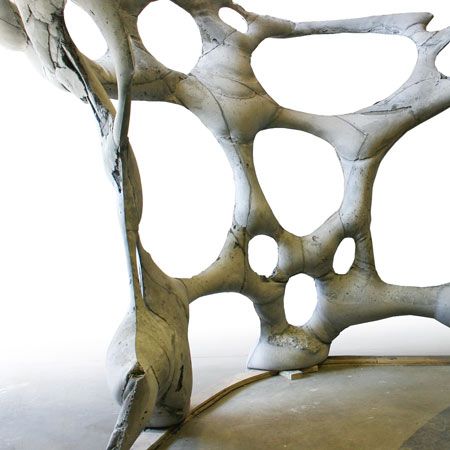
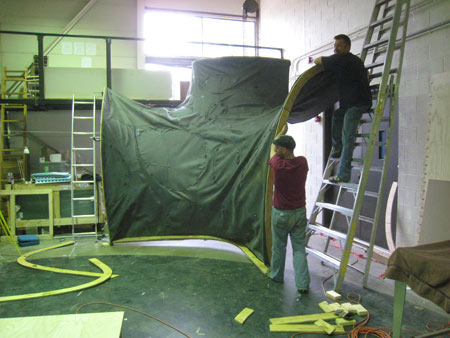
I've been busy the past week with an Erasmus summer school in the 'Material Culture' series, which has included workshops dealing with catalan vaults (Barcelona); bricks (Netherlands); wood (Norway) and stone masonry (Ireland). In Denmark the choice of a 'cultural' material was concrete - and I have been fortunate to be part of the planning of a workshop dealing with fabric formed concrete structures.

Tomorrow is the big pour day - and everything is wonderfully hectic and many things still to be resolved in the making - quite in the nature of the workshops. That you learn a lot of the material nature as you go along and do things.

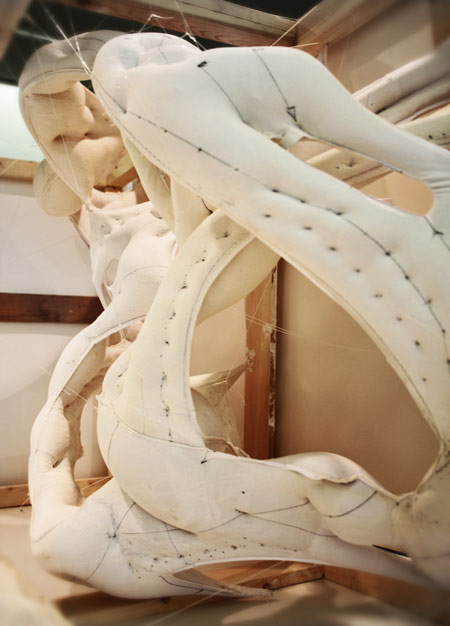
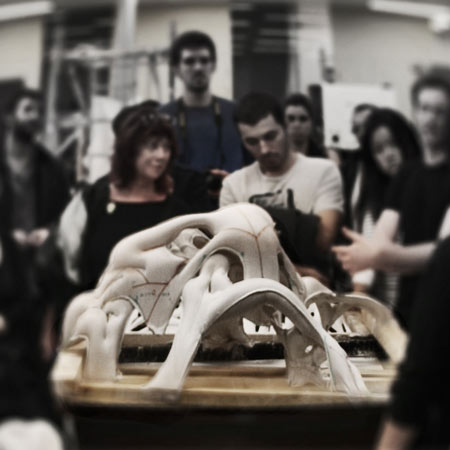
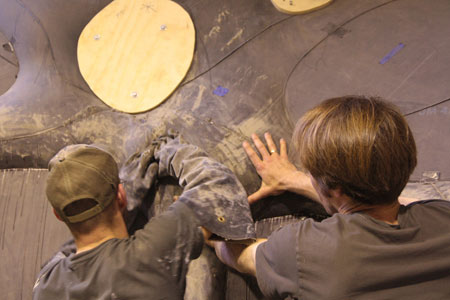
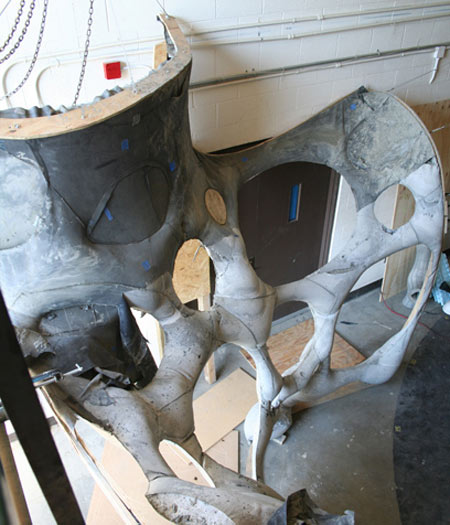
The image above is from a crit. One team has the site of a ditch and is assigned to make a crossing. The installation is wonderful, discussing the spatial qualities to be obtained by placing objects that affords crossing and invites for actually inhabiting a space.

Of course we've done a lot of pouring as well - more pictures to come.

Best regards from Bornholm

Friday, August 6, 2010

Concrete mattresses and curtains

Here's a few pictures and a link to remind myself to look further into the product of Pro-Dive Marine Services. The company has some really specialized flexible concrete products for the off-shore use and underwater pours. They work in conjunction with FoundOcean ("FoundOcean is the leading subsea and offshore grouting specialist for the global energy construction industries" - now you know).

[Massiv Mesh by Pro-Dive Marine Services]

Massiv Mesh
We learn from the web site about the company's Massiv Mesh that it is a flexible, concrete mattress consisting of hexagonal concrete elements linked together with high strength non-degradable polypropylene rope.

[Flexiweight by Pro-Dive Marine Services]


And about Flexiweight: 
"Flexiweight is a concrete mattress consisting of hexagonal section bars, reinforced with steel and linked by polypropylene rope. Flexiweight is flexible, robust, designed for ease of installation and available in a range of sizes and concrete densities.

Flexiweight has an established track record for such applications as Stabilization, Crossovers, Trawlboard, Cable protection and Scour prevention."

[Fabric formwork - underwater mattresses]

About their version of fabric formwork we learn:
"Engineering fabric formwork offers a considerable range of possibilities to the offshore industry. In addition to the standard pipeline supports, specially designed fabric formwork is supplied for specific requirements, including:
  • Mattresses for load distribution
  • Pipeline crossings
  • Riser supports
  • Anti-scour systems
  • Fabric seals for structural work in platforms
These varied systems have been used in water depths of 340 meters; deeper waters are within the scope of the plant."

Concrete curtain
I really like the huge concrete meshes, which greatly outsizes this little but intriguing concrete curtain by the Viennese Architectural Design office Mumex, as seen on Materia:


Monday, July 26, 2010

Sergio Musmeci's funky concrete bridge


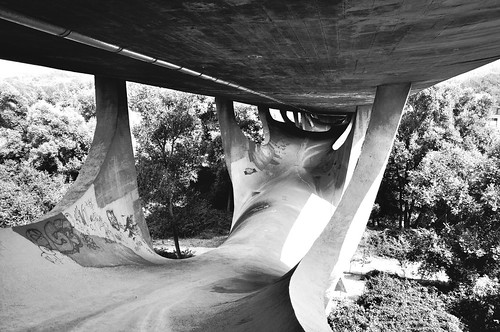
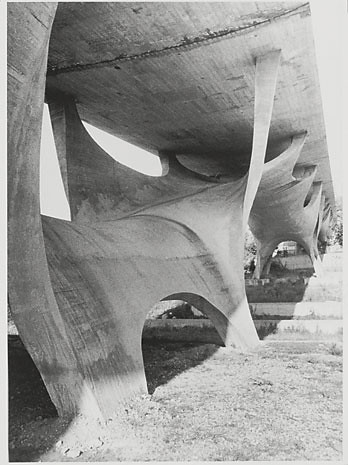
While at the library at the RDAFA and browsing Paolo Portoghesi's book Nature and Architecture, I bumbed into a picture of the Basento viaduct in Potenza, Italy, by Italian structural engineer Sergio Musmeci (1926-81) whom I had never heard of - shame on me

Portoghesi's book is full of references and comparisons between natural and built structures - the image of the bridge (1967-69) really caught my attention because of its striking sculptural and modern appearance and obvious organic, efficient-looking design. 

"Graduated in Rome with a degree in Civil Engineering (1948) and Aeronautical Engineering (1953), Sergio Musmeci (Rome, 1926-1981) is considered one of the most daring structural engineers of the 20th century. The years of his training in the offices of Riccardo Morandi and Pier Luigi Nervi had a significant influence on his work and personal interests; in 1953 he began working with Zenaide Zanini, a collaboration that would last the rest of his life. Professor at the Faculty of Architecture in Rome, he is the author of scientific publications on structures with minimum absolute weight and other topics related to the investigation of forms derived from incomplete structural solutions."
From the biography on the The Sergio Musmeci and Zenaide Zanini Archive at MAXXI_National museum of 21st century arts, Rome web page


[Image of a neoprene model of the Basento bridge by Sergio Musmeci]
[Image of the structural principles for the bridge]

Bloggers at core.form-ula write: "Sergio Musmeci’s very cultured and refined activity is the answer to those who believe that the studies concerning the relationship between architecture and mathematics are much too theoretical. Musmeci is one of the most daring and transgress engineers born in the twentieth century; he was master equally of music, astronomy, aeronautics, mathematics, and philosophy, all of which informed his structures, whose shape was determined by the spatial distribution of static actions. Musmeci thought that he could reach the expression of “modernity” through science. He is the designer of a project for the bridge on the Strait of Messina that has been only recently understood and appreciated, more than twenty years after its conception."
[I think this must be a sketch of the bridge over the Strait of Messina: a single-span bridge with an unsupported length of 3 km]

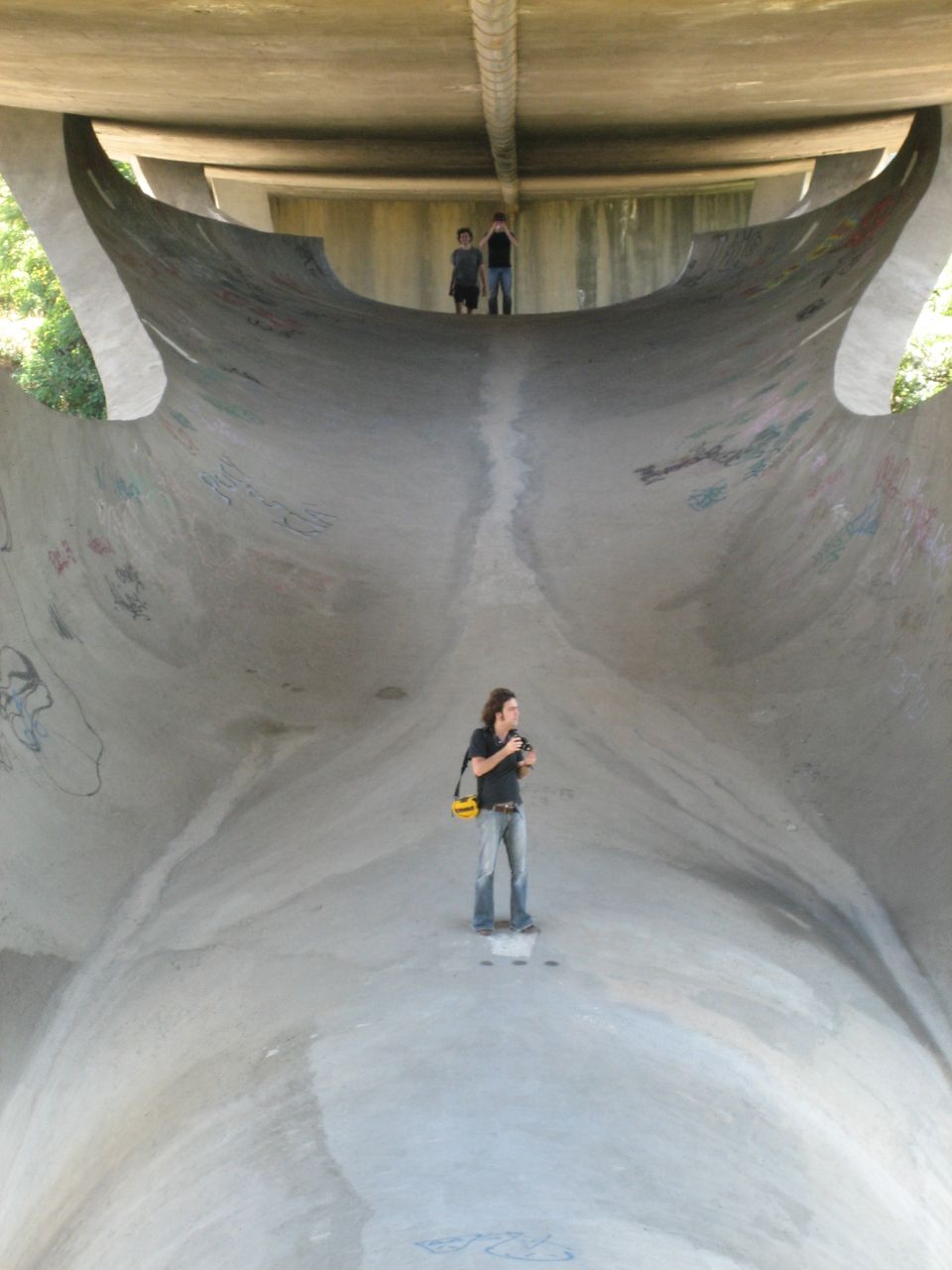
Below are a number of images of the bridge in Potenza and it's design. I'll have to dig a bit into the work of this fellow - hopefully more to come!


[Image of railroad tracks under the bridge - I wouldn't mind experiencing the bridge sitting in a train going through in the Italian countryside... ]
[Image of random guy with camera on - or in the bridge structure - just for scale]

Friday, July 2, 2010

Forms and surfaces cast in fabric formwork

I used the nice sunny weather to take some concrete samples - and one of the Ambiguous Chairs, which I have written about here - outside for a bit of documentation.

I never actually managed to take any photos of the chair before so this was about time.

[Image of fabric formed concrete chair by yours truly Anne-Mette Manelius. Photo by Rikke Grendal]

[Surface detail of fabric formed chair]]

Below are a few surface samples I cast a while ago during a workshop I taught but never got around to document. The samples are cast in rigid formwork with fabric treatments - my favorite is the flowery one first one below because subtle changes in the light - or the position of the viewer - makes a huge difference in the experience of the concrete surface.

[Image of concrete surface with embedded silver fibres]

[Image of the same flowery concrete surface - in a different light the surface appears more neutral]

[Image of concrete surface with embedded fibres from fabrics]

[Image of concrete surface with embedded sequins...]

[Another image of concrete surface with embedded sequins...]

Fun as it would be to have a drag queen concrete surface (I mean - a concrete surface with thousands of colorful sequins) - one might as well paint the surface after the pour...

Monday, June 14, 2010

Grompies - lycra and plaster

Here's another student project in which flexible membranes are used as formwork for a pour. I picked it up while browsing the Dezeen Blog.

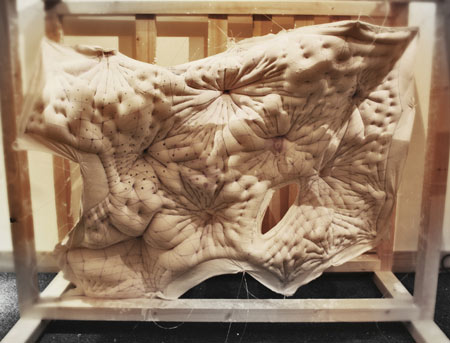
The project is called Grompies and is done by Brendon Carlin and fellow students at the Architectural Association Design Research Laboratory. The structure is stitched and suspended lycra filled with plaster.

[Image of Grompies by students at AA, image from www.dezeen.com]

Materia.nl writes: "With due recognition to the work of Antonio Gaudi, Frei Otto and Felix Candela, among others. A virtual pattern is generated on the computer through behavioral rule sets which play out with no finite time limits. A moment is observed in the looping of those behaviors in virtual space, and captured. The resulting pattern is translated by hand and sewing machine into a stitched pattern on lycra by printing and tracing its form. The stitched sheets of lycra are fixed to wooden frames constructed of scrap material. A plaster, water mix is poured into the tightly stitched lycra pattern and left to set."


[Image of Grompies by students at AA, image from www.dezeen.com]


[Image of Grompies by students at AA, image from www.dezeen.com]


As the image above shows the Grompies aren't large. The intricacy of the stitched and suspended plaster structures do make them an interesting addition to the concrete discourse of fabric forming and structural and formal investigations using catenary curves in general.

- The whole digital aspect is another most relevant matter in which the computer generated and simulated designs meet physical realities during the pour and relationships between material properties are explored as well. Read more about explorations of material relations in a post here.

FattyShell - concrete coral in flexible formwork

Before I forget - here's a link to a post on Dezeen Blog about  a concrete structure cast in flexible formwork that resembles the porous, organic structure of a coral reef.

[Image of FattyShell (v.01) by Kyle Sturgeon, Chris Holzwart and Kelly Raczkowski, image from www.Dezeen.com]

The project is by Masters of Architecture students at the University of Michigan.

The work is great - so little formwork material for such a complex and light weight structure. The students cast in a rubber membrane cnc cut and stitched together. I'm pretty sure that they could have cast in several fabrics had they chosen to. the elasticity of rubber might have intreagued the team or maybe the choice of material was caused by limits of the cnc cutter?

[Image of FattyShell (v.01) under construction, image from www.Dezeen.com]

[Image of FattyShell (v.01) under construction, image from www.Dezeen.com.]

The blog post informs us: "Fiber reinforced high cement based concrete is prepared in 12 batches at 265 lbs (3,200 lbs at completion). lifts occur at 3 hour intervals. At each lift, concrete is sculpted, transferred, or blocked from its gravitational destination in order to reinforce weaker moments in the shell’s composition.


[Image of FattyShell (v.01) with the formwork partly off, image from www.Dezeen.com]


Wednesday, May 19, 2010

Concrete and laces

Here's a link to a very fine project by Japanese Kochi Architects.
Below images are from the renovation of an existing industrial space into an office space for Hu-La Creative (2005).
I really love how the delicacy of the lace meets the rough, worn concrete - the two senses of materiality contrast and enhance each other. Precision, precision, precision - fx in the fitted electrical fittings  (or what that's called) really add to the degree of exclusivity of this conceptually flippant yet poetic project.


[Images: lace fixed to the existing concrete wall. Images from www.kkas.net]

The company who moved into the space is Hula Creative - who might be this company. Wedding photographers... so - laces are a part of a continuous theme here...