Thursday, October 14, 2010

Cracked Concrete Garden

It's a really gray Thursday morning and I just came to think of this fine garden design project done by San Francisco landscape architects Conger Moss Guillard.
[Images of little tough plants growing in the concrete cracks. Photos from CMG website]
The company writes about the project:
"The Crack Garden is a hostile takeover of a concrete urban backyard by imposing a series of jackhammer “cracks.” Inspired by the tenacious plants that pioneer the tiny cracks of the urban landscape, the formal rows of this garden create order amongst the random and mixed planting of herbs, vegetables, strange flowers and rogue weeds"


[More images of the cracked concrete garden. Photos from CMG website]
There's a beautiful oxymoron within the entire idea of a Concrete Garden. The project, direct in its approach, appeals to me in the stated inspiration by the appearance of a strong sprout managing to root itself in a little crack of concrete.

I couldn't help thinking of the drug when I came across Crack Garden. I guess, that garden might be more disturbing.

Harsh beauty of worn concrete
The strong contrast of the worn concrete and the fresh plants enhance the beauty in each other. Lovely! - Because, yes, I do find that worn concrete contain a great beauty!

[Image from the harbor of Trondheim - part of the Atlantic Wall, photo by yours truly]

Remind myself to post more images of the Atlantic Wall, the coastal fortification cast by the Nazis in a whole lotta concrete that remain very present all along the western European coast. 

Here's a link to a guide to (concrete) war tourism of the west coasts of Denmark and Norway 

Monday, October 11, 2010

Dutch Prefab Case Studies

While I'm at it here's another link from my Summer School Concretum Compendium introduced here.
It's still an anonymous author from the Academy of Architecture, Amsterdam
[Image of concrete surface from Case study presented on BureauBakker's web site]
Prefab Case Studies was or is an initiative into exploring prefab concrete which received the Dutch Building awards 2009 in the category Services & Communication.

Here's the link to a slide show of works described further below.
And here's a little movie


'jury commentary Dutch Building Awards 2009:


Creative with concrete! That's how the jury describes this entry. As they should. The Prefab Concrete Casestudies unveil the building material's potential. Exchange of knowledge among designers and manufacturers proofs that concrete is much more than tough, gray and simply straightforward. The casestudies offer room for imagination and lead to a formal language that this industry normally is not able to, or does not want to speak. This opportunity for creativity is beneficial for the industry as a whole. According to the jury the integral manner in which the initiators handle the open dialogue and knowledge exchange is unique.'


Bureau Bakker describes the initiative here:
'The initiative for the Prefab Concrete Casestudies originates from striving towards a more intense, exploring and fruitful communication between manufacturers of prefab concrete and designers. The Casestudies are organized in such a way as to focus this communication on the development of the product – prefab concrete. As such an innovative approach of design, application and manufacturing becomes the main issue.'


Fascinations and ambitions
and continues:
'The Casestudies are seemingly focused on research and development of concrete. The invitation to the designers seems to be very clear about that. Even more than pure product development the Casestudies are foremost an introduction into different cultures. Those of designers and manufacturers. De proposals are often so extreme that within the very short time span of a Casestudy there can only be a first and extremely important step towards a serious product innovation. Nevertheless promising prototypes are being further researched and developed.


The core of the Prefab Concrete Casestudies as presented by the initiators is to discover each others fascinations, ambitions and potential. The potential of concrete. The fascinations for the material by designers as well as the industry. And the ambitions for aesthetics, manufacturing and innovation.'
[Image from the website - featuring Concrete Design Competition, photo: Maarten Veerman]
What is Bureau Bakker?
Siebe Bakker is the architect by training who's behind Bureau Bakker - I've come across the office before because he is involved in the Concrete Design Competition - another site worth exploring for inspiration into concrete futures!!.

Baukje Trenning's art in concrete

As a preparation to the Erasmus Summer School 'Concretum', students of eight European Architecture Schools made a marvelous compendium of concrete innovations from their respective countries. 

I just browsed through it again and pursued some web links in the printed booklet (of 200 pages).

Without further ado, I'm passing on the link to you - aging as it is - the portfolio collected in 2007 of Amsterdam based artist Baukje Trenning (B. 1969) is still a great source of alternative concrete surfaces used in the urban landscape.

[Image collection from Baukje Tenning's web site]

The author who provided the link doesn't appear in my compendium, but it's from the section produced by the students of the Academy of Architecture, Amsterdam

Friday, September 17, 2010

Particule stool

[Adrien Rovero: Particule Stool]

Just something I should get back to - the stool is not even concrete - but it's just the way the parts are produced in parts that you can transport flat and stack - and then assemble, could be transferred to fabric formwork - possibly to uses of Concrete Canvas, which I wrote about here.

The stool by Swiss designer Adrien Rovero, is made of compressed and moulded wood chips, the technology borrowed from the wood pallet industry. Light-weight, sigh :)

[Stool parts]

Master of plaster - Rachel Whiteread

For some reason I just recently looked further into the amazing, solid world of Rachel Whiteread.
In the beginning of the 1990s she basically cast all the voids she could find - empty houses, inflated mattresses, the space under furnitures, behind book shelves, you name it.

Of course what she did, tells stories of what those spaces are about and adds narrative aspects to casting into molds. It's about time that I add a few images and some words someone else has written:
[Rachel Whiteread: Untitled (Nine Tables) 1998]

Untitled (Stairs)2001 - from Tate Advent Calendar [the image above is of tables and not of chairs, sorry]

"Chosen by Jo Fells - "I first saw this in a show in Edinburgh, it reminded me of how I love to sit on the stairs and used to play under the stairs in the broom cupboard - Whiteread's work gets me thinking about spaces we don't often consider, under the chair, the bed, the texture of the walls, the space under the stairs. For me that's what art is about - a trigger to make you see the world through new eyes."
Jo Fells, Museum of London


object: 3750 x 220 x 5800 mm

sculpture
T07939"

[Rachel Whiteread: House, 1993]

About House, Whiteread's most famous piece - For Damon Hyldreth, he sees,

“…a reversal of an enclosing, comforting, dwelling, a place of repose and comfort, a symbol of domestic hopes and dreams. What was left was a monument to one’s most private moments but with the privacy stripped bare and petrified. “House” monumentalized the past in a subversive manner, instead of allowing for a connection to and retrieval of the past, “House” subverted the warm cozy memories of home.”
I found the quote in a longer post about the cast house spaces on the Imoralist blog here.

[Spaces between book shelves, Plaster - the dye on the back of cheap paperbacks has transferred into the plaster, it seems]

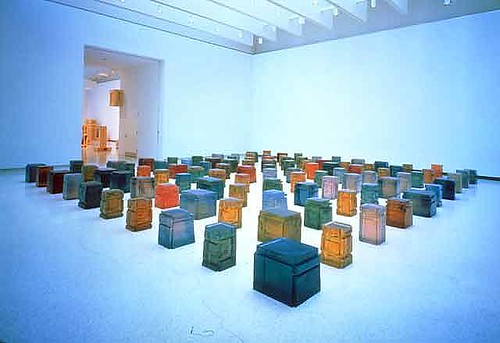
["One Hundred Spaces", Recin casts of spaces under chairs]

Wikipedia informs us:
For the Sensation exhibition in 1997, Whiteread exhibited Untitled (One Hundred Spaces), a series of resin casts of the space underneath chairs. This work can be seen as a descendant of Bruce Nauman's concrete cast of the area under his chair of 1965.
The critical response included:
"like a field of large glace sweets, it is her most spectacular, and benign installation to date [...] Monuments to domesticity, they are like solidified jellies, opalescent ice-cubes, or bars of soap — lavender, rose, spearmint, lilac. They look like a regulated graveyard or a series of futuristic standing stones with a passing resemblance to television sets."[7]
— Andrew Lambirth, The Spectator, October 12, 1996.


[Rachel Whiteread, Untitled (Air Bed II) 1992

Polyurethane rubber. Object: 1220 x 1970 x 230 mm,sculpture. Tate ]

The Tate site tells us more more:
"Whiteread's sculptures are casts of carefully chosen objects, most of which bear the traces of human use. She most often casts the 'negative' spaces around these objects, which then become the 'positive' form of the sculpture. Often the objects recall poignant events; her recent group of bed casts can be associated with sleep, illness and dying. This work adds another dimension to the group of bed casts, with its combination of solid sculptural form and associations of air-filled fragility. Here, the mould containing the air mattress during the casting process has become part of the work, enclosing the Lilo within its box-like shape.
 (From the display caption August 2004)"
It was this last piece that I was reminded of, when I came across concrete furniture cast in pvc inflatables, namely furniture by designers Tejo Remy & René Veenhuizen.
[Chair and bench cast in pvc]

A blog post on Dezeen informs us on the process of casting :"a series of furniture that appears to be made of inflated fabric, but actually is made from poured concrete. Remy & Veenhuizen cast each prototype as a single piece in individual molds created from waterproof PVC or plastic sheeting. Once assembled, the molds are placed upside down and concrete is poured into the feet. The legs are steel reinforced and the concrete itself contains small metal fibers that add stability. Within two days the works are solid enough for the mold to be cut off; and, within two weeks, the furniture is completely dry.

The pieces were exhibited in the designers' first solo exhibition in the spring of 2010 at Industry Gallery

Shake, drape and bake - Concrete Canvas

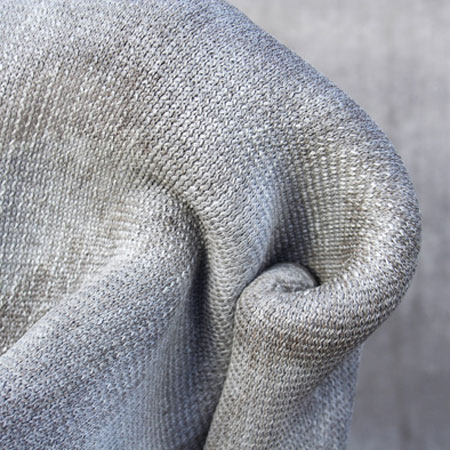
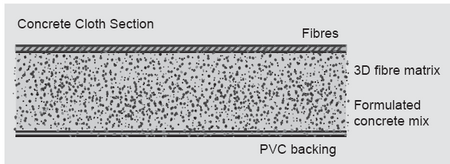
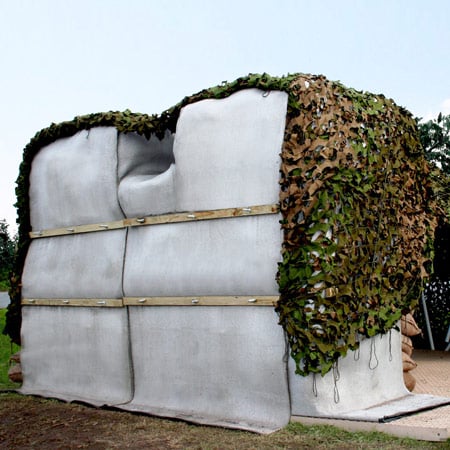
[Concrete cloth is a concrete impregnated canvas, which you drape in shape you want - and then add water]

Following the post on a fabric formed side-table, I was reminded of Concrete Canvas - A textile impregnated with dry concrete mix - you shape the heavy canvas - and add water to activate the chemical binding process of the cement.
Like the Shake and Bake cake mix, you just add water

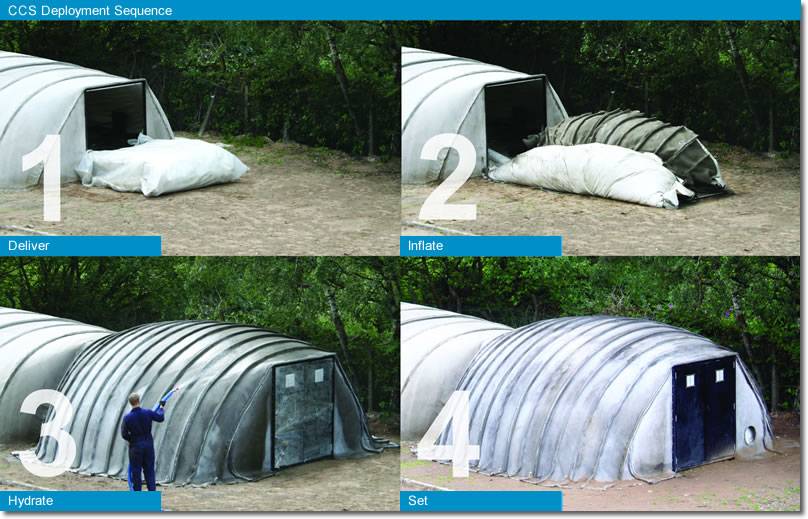
The clever idea was started for an idea of creating emergency shelters that would work as seen below.
Today the company have created a civil line of use and a military one. 
To erect the shelters, the inner liner is inflated via an electric fan. As the liner expands it lifts the concrete cloth into the Nissen hut shape, which is pegged out and the canvas is then hydrated with water or seawater. In 1 hour the structure is self-supporting and in 24 hours it’s ready to use
[Concrete Canvas is used by the British Army - concrete draped sandbags work well as protection against bullets]
I guess the fact that the military has started using Concrete Canvas is the proof of the great idea - I'm looking forward to seeing some more architectural and poetic uses of this 'shake, drape and bake' concept.

Concrete Canvas has been awarded several prizes - I think the company have received the Red Dot Award Last year the company received the Medium Material Award from Material Connexion.

Here's some text from the inauguration in November 2009:

"The award recognizes materials juried into the company’s Materials Library within the past year that demonstrate outstanding technological innovation and the potential to make a significant contribution to the advancement of design, industry, society and economy. 
“The MEDIUM Award for Material of the Year is an opportunity to celebrate the extraordinary breadth and scope of materials innovation today,” says George M. Beylerian, Founder & CEO of Material ConneXion. “The winner is distinguished not only for its technical ability, but for its capacity to make a lasting impact on our lives.”

"With the simple addition of water, Concrete Cloth makes it possible to create safe, durable, non-combustible structures for a wide range of commercial, military and humanitarian uses," 
said Dr. Andrew H. Dent, Vice President, Library & Materials Research at Material ConneXion.

"This innovation is especially remarkable for enabling the construction of rapidly deployable shelter and food storage structures in disaster relief situations," Dent added.

Fabric formed concrete side-table

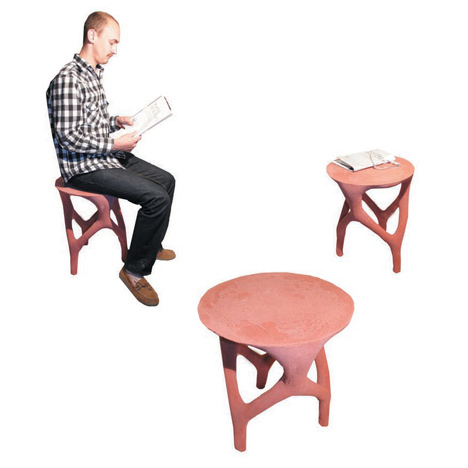
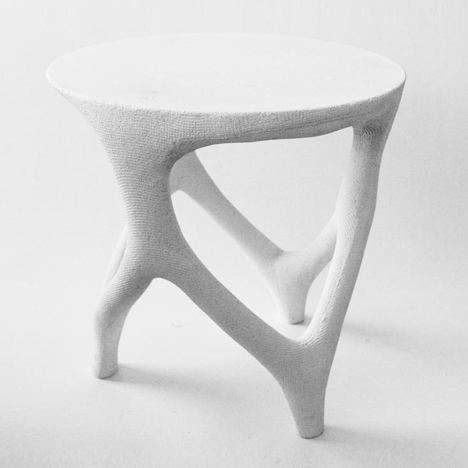
[MASS |||| by Janwillem van Maele]

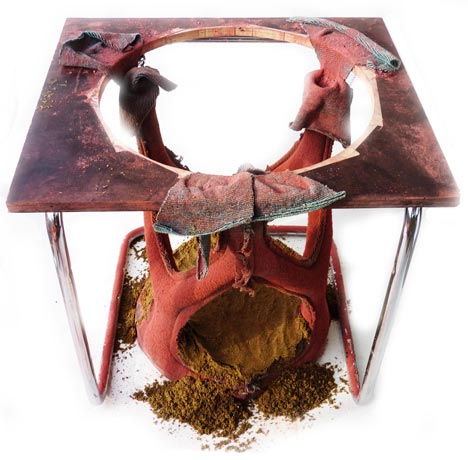
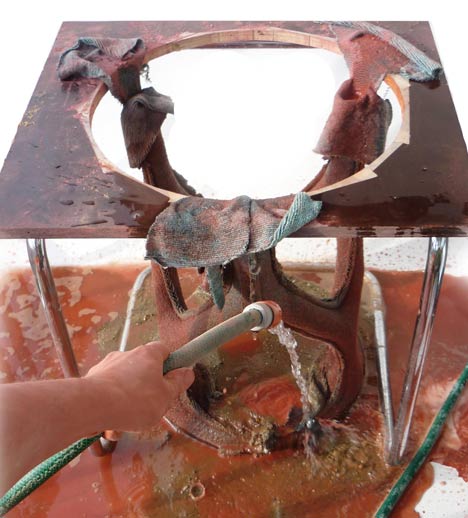
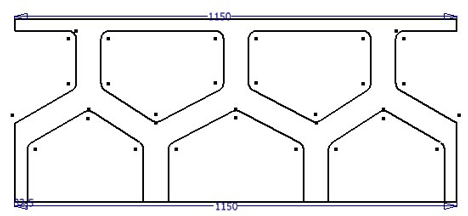
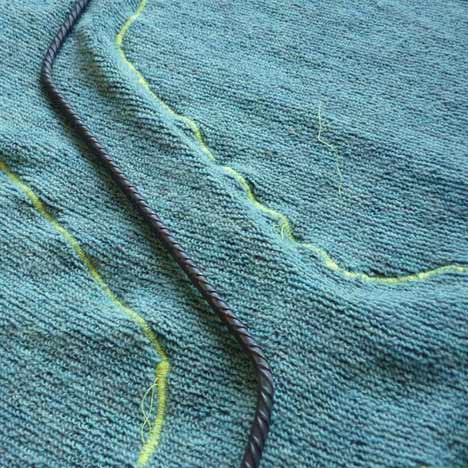
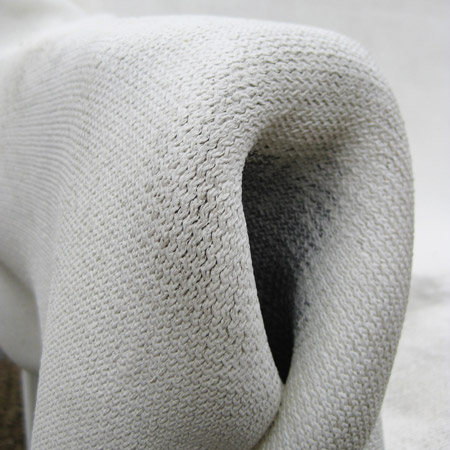
Here's an introduction to the production of a fabric formed concrete design piece, the thesis work of Janwillem van Maele aDe Hogeschool West-Vaanderen. The feeding of the DWG file to an automatic stitching of the fabric mold is the part to have in mind here - the pour is done by filling the form with dry concrete mix and then watering the form afterwards (see below images that tell the story well). 


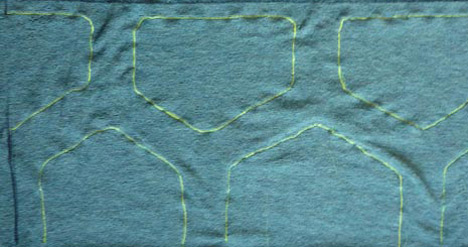
Van Maele writes this (as communicated on the Dezeen Blog) The MASS |||| is a concrete sidetable with the following production process: "I started with a DWG file for the right shape of the legs. That file can be entered in an industrial embroidery machine. This is automatically sewn."


The pictures below go mostly without saying - in the bottom of the post is a reference to a product that uses a similar technique at a larger scale.
[Sand- I think it must be to tension the fabric and maintain the shape in place, that extra load is added]

[Water added to the filled fabric form. The water drenches the form and activates the cement inside]

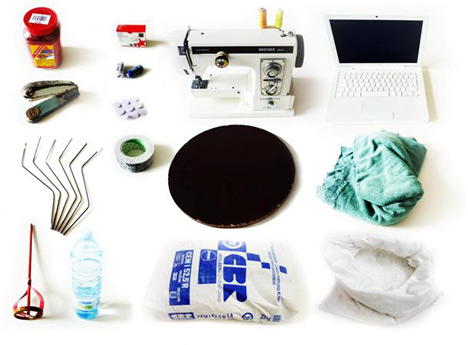
[Kit of parts to create the fabric formed concrete side-table]
[The DWG drawing of the unfolded fabric formwork]
[Tailored fabric formwork]
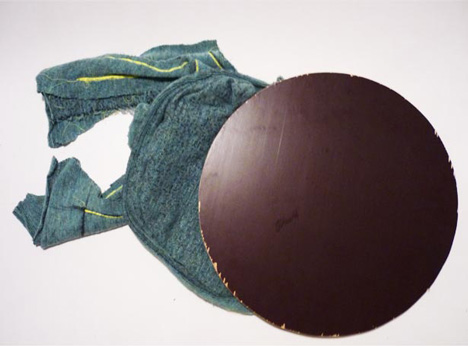
[Formwork before it's hung and filled]
[Reinforcement bars were pushed into the form when filled. I'm surprised if the concrete mix doesn't have fibres as well]

At a larger scale
The 'watering technique' resembles, in a smaller scale the ingenious product Concrete Canvas, which I just did a post on here:
[Concrete cloth is a concrete impregnated canvas, which you drape in shape you want - and then add water]
Materials used for the side-table:


Color Pigment, Staple, Iron Reinforcement, Mixer, Staples, Yarn, Tape, Water,Industrial embroidery machine, 15-layer crosswise glued birch veneer, shuttering plate, Portland cement, Computer, Textile, White sand, Cork