Sunday, May 8, 2011

Weaving galore

As a remark to the post about the machine park at Swedish School of Textiles, a friend forwarded a link of cutting edge use of weaving, namely the automated weaving of auto parts made from carbon-fibre and plastic.
 As technology blogger, Sandrine Ceurstemont explains in this NewScientist post: 

"It's a sports car few people will be able to get their hands on. In production since last December, only 500 Lexus LFAs will be produced and they were already sold out in early June 2010. But it's not just its top speed of 325 kilometres per hour that's attracting buyers. The car is being used as a test bed for newly-designed parts made from carbon fibre and plastic."

Of interest here, of course – is the key technology used, namely the high-tech circular loom, guided by lasers, that can weave 3D objects – (see the video link above).

Compared to steel or aluminium, carbon fibres make the car stronger and lighter but producing these components is much more time-consuming: only one car is currently being assembled per day.

3D-Woven sails
At a larger scale robotic weaving - or laminating is more the technique, I guess - is used for custom made three dimensional sails for racing boats. (See video link below by North Sails)
[Video of the weaving process of 3dl technology]

Woven architecture?]
When will this technology be used in architectural applications as woven load-bearing structures?? So spectacular - and seemingly achievable (at a 'certain cost'). In the concrete optics of this blog perspectives of producing high strength, low weight structures out of carbon would affect the way concrete structures are reinforced.

Textile concrete at Aachen
A cross disciplinary research project called Textil Beton (textile concrete) at the University of Aachen combines research in textile production technologies with reinforcement technologies of carbon fibres. The project was initiated in 1999 and running until 2012.

The abstract for the part-project Textile production, process and machine development is: For a sufficient and cost-effective reinforcement, a defined positioning of the fibers is necessary. Thus, a geometrically defined design of the textiles, both 2D and 3D, is required.   Aim of this project is the development and investigation of processes, which allow a textile production of non-corrosive reinforcements. Fibers used are alkali resistant glass, carbon and aramide.   Finally the investigation of integrated 3D textiles are focused in this project.

[Diamond lattice, prototype of textile reinforced concrete structure, from 'Insu-Shell']

For now, it seems as if the technology has mostly been developed for matting reinforcement that is flexible in two directions. The thin, non-corrisive reinforcement has been tested in repairing thin concrete shell structures. The technology seem ideal for this purpose because of the minimal required thickness of a protective layer of concrete.

I'm looking forward to more spatially woven reinforcement structures that combine the precision weaving of the Lexus robot with the knowledge of reinforcing concrete. They might be out there already.

Thank you, Jacob for forwarding the video link in the first place.

Monday, April 18, 2011

Computational Composites

To continue from my previous post from the happy day in Borås, I must introduce to you, Anna Valgårda.
I was invited to the Swedish School of Textiles by Anna Valgårda who has her background in computer science and did her  PhD project about the computer as a material. - as a post-doc at Borås she's also the head of the research school in practice based textile research.

Anna introduces her interest at her web site
I study the computer as a material for design. Computers, however, have no expression in and by themselves so in order to study and work with them I develop various "computational composites." The vision is that we through understanding the materiality of computers at some point will be able to work with computers in the same way we work with other more traditional materials like textile, glass, or wood. Current experiments evolve around textiles exploring the possibilities in the various structures of textiles.
 [Recurring Patterns piece, from Anna Valgårda's web site]

Anna writes about the ongoing project that were just exhibited at Salon de Mobile:
These prototypes are part of a larger project in the Smart Textile Design Lab at the Swedish School of Textile where we explore how to use programmable textile expressions in furniture design. What does it entail to design with expressions that change in context over time? What can these recurring patterns do to the use of furniture? What new kinds of furniture can we imagine?

Textile Tectonics

I great while ago I was fortunately invited to lecture at the Borås University, Swedish School of Textiles. The focus of my talk was obviously to be upon the textile aspects of research into fabric formwork for concrete structures.

It's no secret that most ongoing research into fabric forming deal with the forming principles and not so much developing textiles. - but, wow, was a visit to the 'machine park' at the university was overwhelming. It brings layers and layers upon the potentials of Textile Performance into fabric formwork. I'm sorry not to dwell into those aspects and share with you - for now, I'll share some images of machines.

Scroll through the images to get to a little treat of machine poetics:
[Weave]
[3d Knitting machine]
[A computer is aligned with each thread to go into the knit]
[Metal knits at Borås School of Textiles]
[Tube of metal knit at Borås School of Textiles]
[Knit at Borås School of Textiles]

['Section' of knit at Borås School of Textiles]

[Spatial knitting at Borås School of Textiles]

Since you made it here, it's time for a little treat - a movie the depicts the machine poetics of weaving. Thanks to the blogger at textilesmithing who did a post about fabric formwork - and for posting the link to the video...

  
I was invited to Borås by Anna Valgårda who has her background in computer science and did her  PhD project about the computer as a material. - as a post-doc at Borås she's also the head of the research school in practice based textile research. I've dedicated a post to introduce Anna here.

Thursday, March 24, 2011

Concrete Benches cast in fabric

Wow, what a while it's been since my last post - well, as for now I've just finished a great workshop with 80 (yes, 80) first year students of architecture and architectural engineering. In a week's time the students had to design and produce a concrete bench: This included designing the formwork principles and building the formwork. Finally the students had to pour the pieces of around 300 liters each (750 kgs of concrete), and finally - strip the formwork and reveal the concrete evidence of the experiments...
[Students pouring the fabric formed concrete bench - and getting advice from the concrete sponsor, Unicon]
Here's an older post with some images of references to benches.

No blow outs
The pieces of this year's workshop weren't super tall - the tallest formwork was 140 cm high. Out of 12 pieces and 4 cubic meters of concrete, we had no blow outs - yipee - this wasn't really the case last year. Formwork pieces were all 2 meters high - and only one student piece survived in its initial state... read more about last years workshop here.

The Clover
Below are some images of the Clover Bench. More info to follow. Enjoy!
['Trekløver', the Clover. Fabric formed concrete bench. Student work at TEK1]
Do I need to say that the focus was on fabric formwork?
Besides being the subject of my research, fabric formwork has great potentials for introducing concrete to students of mostly no previous experience to either pouring or building formwork - in fact building anything yet :)

Formwork tectonics
First of all, building with light weight fabric lets you produce quite large structures just because the weight of the formwork structure is kept down.
More importantly (says the teacher) there's a structural hierarchy in building fabric formwork - an apparent material dialogue to be considered. The material dialogue is between the concrete and the three elements that the formwork is made out of: the frame holding the fabric, the fabric itself, and a restraining method to keep the fabric in tension and control bulges during the pour. 

Formal consequence
When the concrete is poured as an almost ruthless matter the formwork is really put to the test. All choices made during the construction of the formwork results in a direct formal consequence on the form and surface of the concrete.
[Fabric form for the 'Clover' - without the inner form, Student work]

Formwork statics is quite an interesting subject - designing formwork structures the students get a grasp of pure tectonics. Quite simple structural principles may result in striking concrete forms :)

[The funky inner form for the Clover. Students used scrap vinyl flooring to create a smooth surface inside the bench. Student work]

Credits to the members of the Clover team who built the formwork shown above: Alva Altgård, Symra Joner Andbo, Helga Hallgrimsdottir, Rasmus von Wurstemberger Nielsen, Marie Rugholm Nielsen, Andreas Klestrup Hansen. Students study at RDAFA or DTU

The workshop was part of a course held by the Institute of Technology and co-teachers were Johannes Rauff Greisen and Finn Bach

Thursday, January 6, 2011

Thesis work on fabric formed concrete columns

Here's the abstract for a recently finished Master of science thesis by Farhood Delijani, University of Manitoba. Farhood posted a link to share on the Fabric Formwork Facebook group that you are so welcome to join.

The title of the thesis is: The Evaluation of Changes in Concrete Properties Due to Fabric Formwork

The work confirmed that fabric formwork is structurally safe alternative for forming reinforced concrete columns. The abstract found here goes like this:

"Fabric as a flexible formwork for concrete is an alternative giving builders, engineers, and architects the ability to form virtually any shape. This technique produces a superb concrete surface quality which requires no further touch up or finishing. Woven polyole-fin fabrics are recommended for this application.

A permeable woven fabric allows excess water from the concrete mix to bleed through the mold wall, and therefore reduce the water-cement ratio of the concrete mix. Due to the reduction in water-cement ratio, higher compressive strength in fabric formed concrete may be achieved, as also suggested by earlier research.

The current research study was conducted to investigate and document the changes in concrete strength and overall quality due to use of commercially available woven polyolefin fabrics. Use of fabric formwork will contribute to decreased construction cost, construction waste, and greenhouse gas emissions.

Two sets of tests were conducted as a part of this research study including comparison of compressive strength of fabric formed versus PVC formed concrete cylinders and comparison of be-haviour of the fabric formed reinforced columns versus cardboard formed reinforced concrete columns. Variables in this research were limited to two types of fabric with dif-ferent permeability (Geotex 104F and Geotex 315ST) and two types of concrete; concrete made with conventional Portland cement and no flyash herein called normal concrete (NC) and concrete with 30 percent flyash in its mix design (FAC).

The laboratory results revealed that fabric Geotex 315ST is an ideal geotextile for forming concrete. It was also found that the effects of fabric formwork on concrete quality in a large member are limited mostly to the surface zone and the core of the concrete remains the same as a conventionally formed concrete.

Even though fabric formed cylinder tests showed an average of 15% increase in compressive strength of the concrete samples, compressive strength of the reinforced columns did not dramatically change when com-pared to the companion cardboard formed control columns.

This research confirmed that fabric formwork is structurally safe alternative for forming reinforced concrete columns."


Congratulations to Farhood on his degree! It will be interesting to see if the fabric forming community will see more interesting work from him in the future.

Fabric formed concrete benches

As a direct continuation of the previous post on an upcoming concrete workshop in which students will design and produce benches, here's another couple of examples. Bench could be read as just another word for span - it's just a matter of scale, whether the span holds a person or a floor, right?
[Image of fabric formed beam - could be used as bench, by CAST at University of Manitoba, Canada]

Fabric formed beam - or bench
Above image is cast as a beam of 22 metres. - I've sat on it, so you could use it as a bench, I guess - What's interesting about this piece when it comes to producing a long span is the fact that it was cast in just two flat sheets of fabric!
The beam is actually quite old and the good people at CAST (very firgurative abreviation for Centre for Architectural Structures and Technology at the University of Manitoba).
Do read more about the pioneering work at CAST and professor Mark West here.
[Image of Buenos Aires concrete bench by Grupo Bondi, 2010]
[Detail of concrete bench with aluminium clamp tube, photo from Grupo Bondi]

Fabric formed furniture
The pieces of furniture by the Argentinian Grupo Bondi definitely look familiar. (see the post on the Ambiguous Chair here). The guys have been working with flexible molds for some years and, opposed to the research pieces done elsewhere, there's actually price tags on most items.

The bench weighs 145 kgs. The concrete mattress sits on iron legs and will fool you with the apparent upholstered bulges. Previous work could be shells? The cushion below is only 39 kgs according to the designers.
[Concrete furniture by Grupo Bondi]
I bet that those pieces must have been cast in fabrics or similar flexible formwork. Do check out the web site for more design ideas cast in flexible formwork and products to order.

The stunning shell solution
I need to show you a more recent project from CAST. Ronnie Araya works there as an assistant Professor and did these beautiful thin shells that also have some spin off work for furniture. - the overall interest is architectural structures - but, as mentioned befor - working with technologies at a furniture scale is an interesting starting point - and something that is more likely to sooner have a life outside the studio than large load bearing structures.
I wrote more about this piece in this previous post
[Image of rigid fabric formwork and the cast shell - I think this is a scale model in plaster. Image courtesy of CAST]
[Image of full scale PVC-coated mold ready to be cast with GFRC, Glass Fibre Reinforced Concrete, Photo from CAST].

Read more about the stunning shell work at CAST here. The words is that the studio is doing a project with shells like these - so I guess work does get out of the lab! Can't wait to see it!

Concrete benches

These days I'm preparring a workshop for a large group of architecture and architectural engineering students. The materials given are concrete (but of course), fabric, plywood and laths. The assignment will be to designg and construct a bench. Several issues goes into this assignment - there's the functional and aesthetic part of designing a bench in concrete - and then there's a focus on the choice and use of materials if the aim is light weight, or spectacularly sculpted, there'll be some advanced geometries to figure out.

Well - much fun is awaiting for an intense workshop!! I found some images of concrete benches - and some made without concrete that might work as inspiration.

There's a point to make with regards to the choice of materials: namely, where and how is precision desired and obtained via clamps or the design of restraining devises - and where is the fabric allowed to work its ways and deflect under the load of concrete. - Another question is how to deal with the transition of the formwork to the uncovered surface.

Light weight structures
[Image of pleat table from Arktura ]
[Coral bench by Arkitura]
Above images are all but heavy - and they are not cast in concrete but by laser cut metal. A concrete mind would imagine these these algorithmically generated patterns cast in high strength fibre reinforced concrete - and soon after scale the fellow to something a lot larger - Otherwise you might use a big cookie cutter and stamp your flat sheet of Eternit (fibre reinforced concrete mostly used for cladding) and make a perforated version of the award winning 'Dune' concrete chair below by Rainer Mutsch.
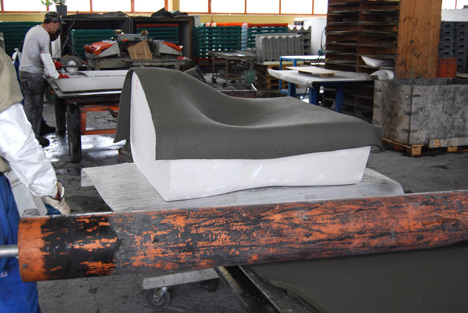
[The production of the Dune lounge chair at Eternit. Read more about it at this older post. 

Post to be continued - now
This post was actually much more elaborated but my computer is having an off day and deleted most of it (sigh) - so - this post continues right away for some examples cast in fabrics - click here when ready.