Wednesday, September 1, 2010

Butong - flexible, perforated concrete

[When crayfish aren't happy at the habitat you've got - remake the 'city plan' - hence the name: Cancer City]

Swedish architects VisionDivision have collaborated with Butong on their recent project Cancer City, an underwater habitat for cray fish - with the luxurious feature of embedded LED lighting to ease catching the crayfish by night.

Butong seems to be a brand new company and patent for a 'concrete based material' as the company write on their website. Another term to use might be the also very broad ECC (Engineered Cementious Composite) which just implies that the material contains cement. 
It seems like both the concrete properties and the formwork technology are very flexible in deed. The surfaces look draped.

Read more about Cancer City here.
Scroll down to view other applications of Butong's own products.
[Embedded functions in the Cancer City]

[Section of the habitat]

[Cancer city before put in the river]

[Crayfish hunting in the LED illuminated underwater concrete landscape]

The architects write about the special concrete they used:
"The choice of material was crucial for the success of the project.
The construction obviously should be water resistance, the city should be strong enough to carry some full grown persons or animals walking on it, the city should also provide shelter to the crayfishes and the construction should not be too heavy since it should be moved to a remote place where no machines can go. The choice of material became "Butong"; a lightweight slightly transparent concrete invented by the firm with the same name.
Butong is only two centimeters in depth without any metal reinforcement that can rust and the mould could be bendable after casting,
which enabled us to make an undulated landscape of concrete without having to build time consuming casting forms. Another attribute with Butong is that it includes calcite; a substance that attracts crayfishes."

[Lamp design by Butong: Bright Night will hit Swedish stores soon (and hard ;)]

[Panel design: Buttong-Pattern]

[Panel design using Butong]

Thin, perforated concrete
I especially enjoy the combination of the concrete and formwork technologies to perforated panel designs. They remind me of beautiful traditional islamic shutters. Besides the effects of transparency and the surface design, using this kind of filigree concrete for solar filtering, you obtain a thermal effect from the concrete mass. 

The mass cools down at night and helps keeping the interior cool during the day of blazing sun. 
[Fragment of a lattice window shutter, Lahore, Pakistan, 15th century. From www.lindenmuseum.de ]

I just looked these shutters up - they're called moucharabiehs - how could I forget ;)

"Summers can be exceedingly hot in Islamic lands; consequently, from an early date 
openings in buildings were partially closed by means of open-work coverings made from stone, stucco, ceramic, or wood
These coverings were commonly known as claustra after the Romans, and subsequently came to be called moucharabiehs in the Arab world and jali in India."

[Window screen (jali), floral and lattice design India, c. 1630-1650 or first half of the 17th century Red sandstone, openwork and engraved decoration, Louvre]

Friday, August 27, 2010

Material Culture - World press

[Bornholms Tidende: "Hard concrete in new soft frames"]

Yesterday the workshop made it to an entire page in the regional newspaper Bornholm Tidende (Bornholm Journal). A wonderful piece of reporting that really makes the reader feel on site with the concrete pour the day before. I'm quoted about the wonders of fabric forming, and the local concrete truck driver, Flemming, is featured big time as well. It's just big, local news - and my mother will be very proud of the exposure.

I'm sure the article has been read by a lot of people - the next page was the football section with big news on the local teams.

A few days ago, another article featured the workshop as well - yay.

[Bornholms Tidende: "Kan beton være blødt"]


Wednesday, August 25, 2010

Material Culture - Pour day

[Image of a team after successful pour of one of their fabric formed concrete shell elements]

Just finished an exciting pour day in the Erasmus workshop I also wrote about here. The four formwork pieces constructed by students were filled with concrete from our sponsor, the local concrete factory.

Below are a few images from the stormy, yet sunny day.
[Team working on a 5 meter long fabric formed concrete wall. Only 5 cm at the most narrow point made pouring directly out of the truck impossible - in stead the wall was poured by hand]

[Image of fabric formed concrete wall after the pour. The turf pieces on top are from the lawn. Their function is to weigh down folded down fabric flaps on the top from flying away...]

[Team working down reinforcement into their concrete bridge, poured on site - the fabric formwork was constructed in sections off site and moved to the site]

[This an image of the last group's concept model - a 'wood shelter' in which the wood forms the interior space cast directly into the fabric form. Wedges placed between the logs makes it easier to remove the wood after the pour - or when it is to be used]

Tuesday, August 24, 2010

Material Culture - fabric formwork workshop


I've been busy the past week with an Erasmus summer school in the 'Material Culture' series, which has included workshops dealing with catalan vaults (Barcelona); bricks (Netherlands); wood (Norway) and stone masonry (Ireland). In Denmark the choice of a 'cultural' material was concrete - and I have been fortunate to be part of the planning of a workshop dealing with fabric formed concrete structures.

Tomorrow is the big pour day - and everything is wonderfully hectic and many things still to be resolved in the making - quite in the nature of the workshops. That you learn a lot of the material nature as you go along and do things.

The image above is from a crit. One team has the site of a ditch and is assigned to make a crossing. The installation is wonderful, discussing the spatial qualities to be obtained by placing objects that affords crossing and invites for actually inhabiting a space.

Of course we've done a lot of pouring as well - more pictures to come.

Best regards from Bornholm

Friday, August 6, 2010

Concrete mattresses and curtains

Here's a few pictures and a link to remind myself to look further into the product of Pro-Dive Marine Services. The company has some really specialized flexible concrete products for the off-shore use and underwater pours. They work in conjunction with FoundOcean ("FoundOcean is the leading subsea and offshore grouting specialist for the global energy construction industries" - now you know).

[Massiv Mesh by Pro-Dive Marine Services]

Massiv Mesh
We learn from the web site about the company's Massiv Mesh that it is a flexible, concrete mattress consisting of hexagonal concrete elements linked together with high strength non-degradable polypropylene rope.

[Flexiweight by Pro-Dive Marine Services]


And about Flexiweight: 
"Flexiweight is a concrete mattress consisting of hexagonal section bars, reinforced with steel and linked by polypropylene rope. Flexiweight is flexible, robust, designed for ease of installation and available in a range of sizes and concrete densities.

Flexiweight has an established track record for such applications as Stabilization, Crossovers, Trawlboard, Cable protection and Scour prevention."

[Fabric formwork - underwater mattresses]

About their version of fabric formwork we learn:
"Engineering fabric formwork offers a considerable range of possibilities to the offshore industry. In addition to the standard pipeline supports, specially designed fabric formwork is supplied for specific requirements, including:
  • Mattresses for load distribution
  • Pipeline crossings
  • Riser supports
  • Anti-scour systems
  • Fabric seals for structural work in platforms
These varied systems have been used in water depths of 340 meters; deeper waters are within the scope of the plant."

Concrete curtain
I really like the huge concrete meshes, which greatly outsizes this little but intriguing concrete curtain by the Viennese Architectural Design office Mumex, as seen on Materia:


Monday, July 26, 2010

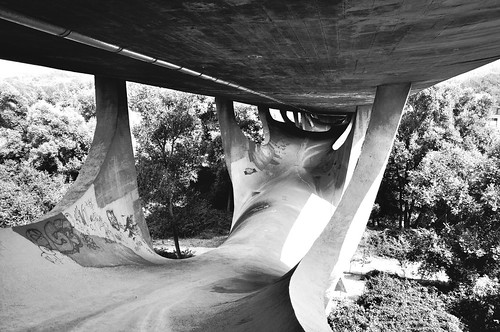
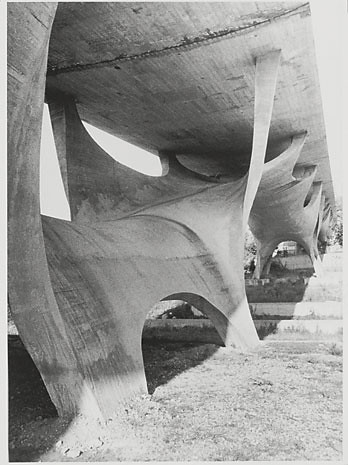
Sergio Musmeci's funky concrete bridge


While at the library at the RDAFA and browsing Paolo Portoghesi's book Nature and Architecture, I bumbed into a picture of the Basento viaduct in Potenza, Italy, by Italian structural engineer Sergio Musmeci (1926-81) whom I had never heard of - shame on me

Portoghesi's book is full of references and comparisons between natural and built structures - the image of the bridge (1967-69) really caught my attention because of its striking sculptural and modern appearance and obvious organic, efficient-looking design. 

"Graduated in Rome with a degree in Civil Engineering (1948) and Aeronautical Engineering (1953), Sergio Musmeci (Rome, 1926-1981) is considered one of the most daring structural engineers of the 20th century. The years of his training in the offices of Riccardo Morandi and Pier Luigi Nervi had a significant influence on his work and personal interests; in 1953 he began working with Zenaide Zanini, a collaboration that would last the rest of his life. Professor at the Faculty of Architecture in Rome, he is the author of scientific publications on structures with minimum absolute weight and other topics related to the investigation of forms derived from incomplete structural solutions."
From the biography on the The Sergio Musmeci and Zenaide Zanini Archive at MAXXI_National museum of 21st century arts, Rome web page


[Image of a neoprene model of the Basento bridge by Sergio Musmeci]
[Image of the structural principles for the bridge]

Bloggers at core.form-ula write: "Sergio Musmeci’s very cultured and refined activity is the answer to those who believe that the studies concerning the relationship between architecture and mathematics are much too theoretical. Musmeci is one of the most daring and transgress engineers born in the twentieth century; he was master equally of music, astronomy, aeronautics, mathematics, and philosophy, all of which informed his structures, whose shape was determined by the spatial distribution of static actions. Musmeci thought that he could reach the expression of “modernity” through science. He is the designer of a project for the bridge on the Strait of Messina that has been only recently understood and appreciated, more than twenty years after its conception."
[I think this must be a sketch of the bridge over the Strait of Messina: a single-span bridge with an unsupported length of 3 km]

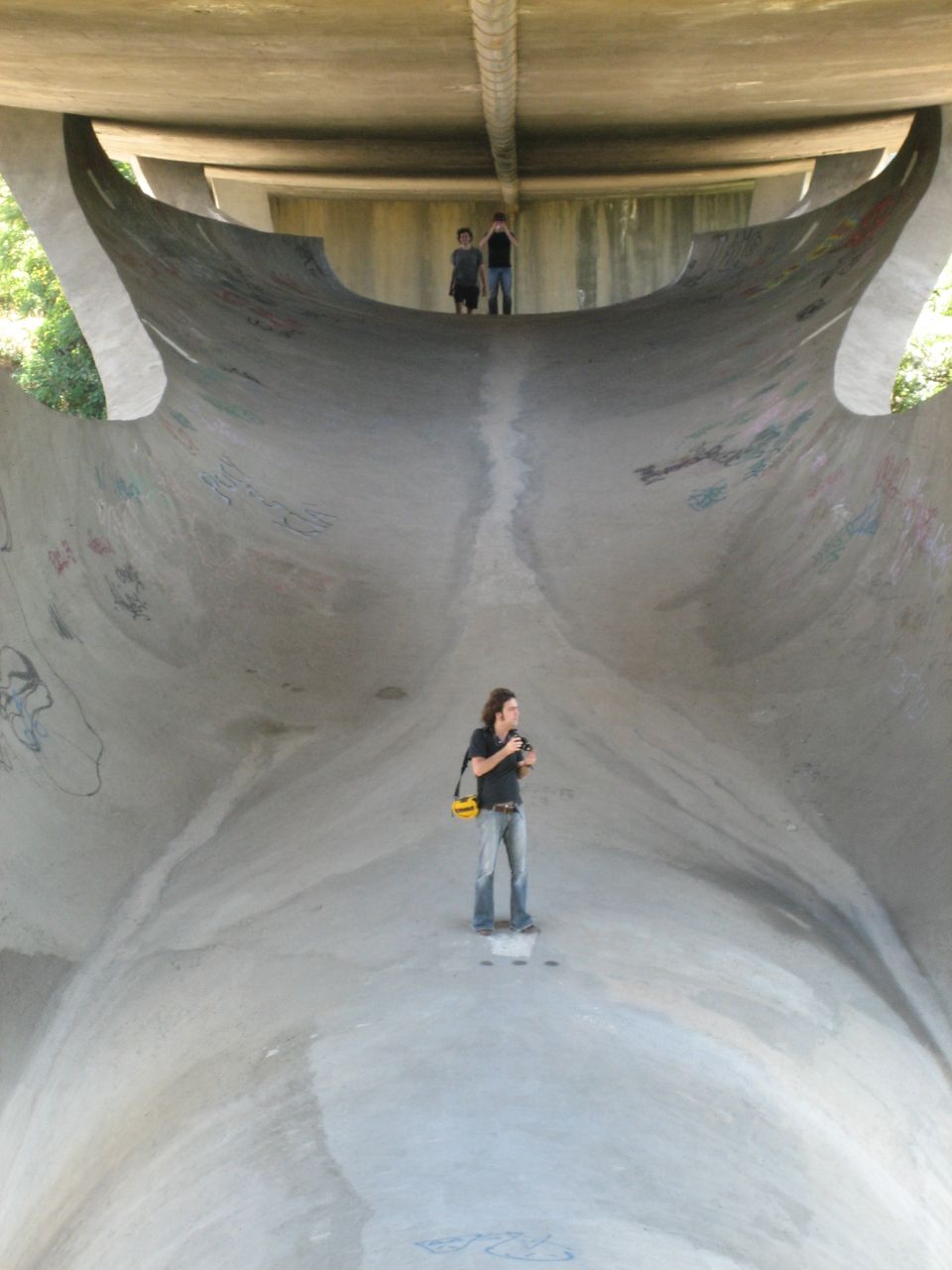
Below are a number of images of the bridge in Potenza and it's design. I'll have to dig a bit into the work of this fellow - hopefully more to come!


[Image of railroad tracks under the bridge - I wouldn't mind experiencing the bridge sitting in a train going through in the Italian countryside... ]
[Image of random guy with camera on - or in the bridge structure - just for scale]

Friday, July 2, 2010

Forms and surfaces cast in fabric formwork

I used the nice sunny weather to take some concrete samples - and one of the Ambiguous Chairs, which I have written about here - outside for a bit of documentation.

I never actually managed to take any photos of the chair before so this was about time.

[Image of fabric formed concrete chair by yours truly Anne-Mette Manelius. Photo by Rikke Grendal]

[Surface detail of fabric formed chair]]

Below are a few surface samples I cast a while ago during a workshop I taught but never got around to document. The samples are cast in rigid formwork with fabric treatments - my favorite is the flowery one first one below because subtle changes in the light - or the position of the viewer - makes a huge difference in the experience of the concrete surface.

[Image of concrete surface with embedded silver fibres]

[Image of the same flowery concrete surface - in a different light the surface appears more neutral]

[Image of concrete surface with embedded fibres from fabrics]

[Image of concrete surface with embedded sequins...]

[Another image of concrete surface with embedded sequins...]

Fun as it would be to have a drag queen concrete surface (I mean - a concrete surface with thousands of colorful sequins) - one might as well paint the surface after the pour...